Skywalker X8 — Small Fixed-Wing UAV (Nonlinear 6-DoF, SI units)
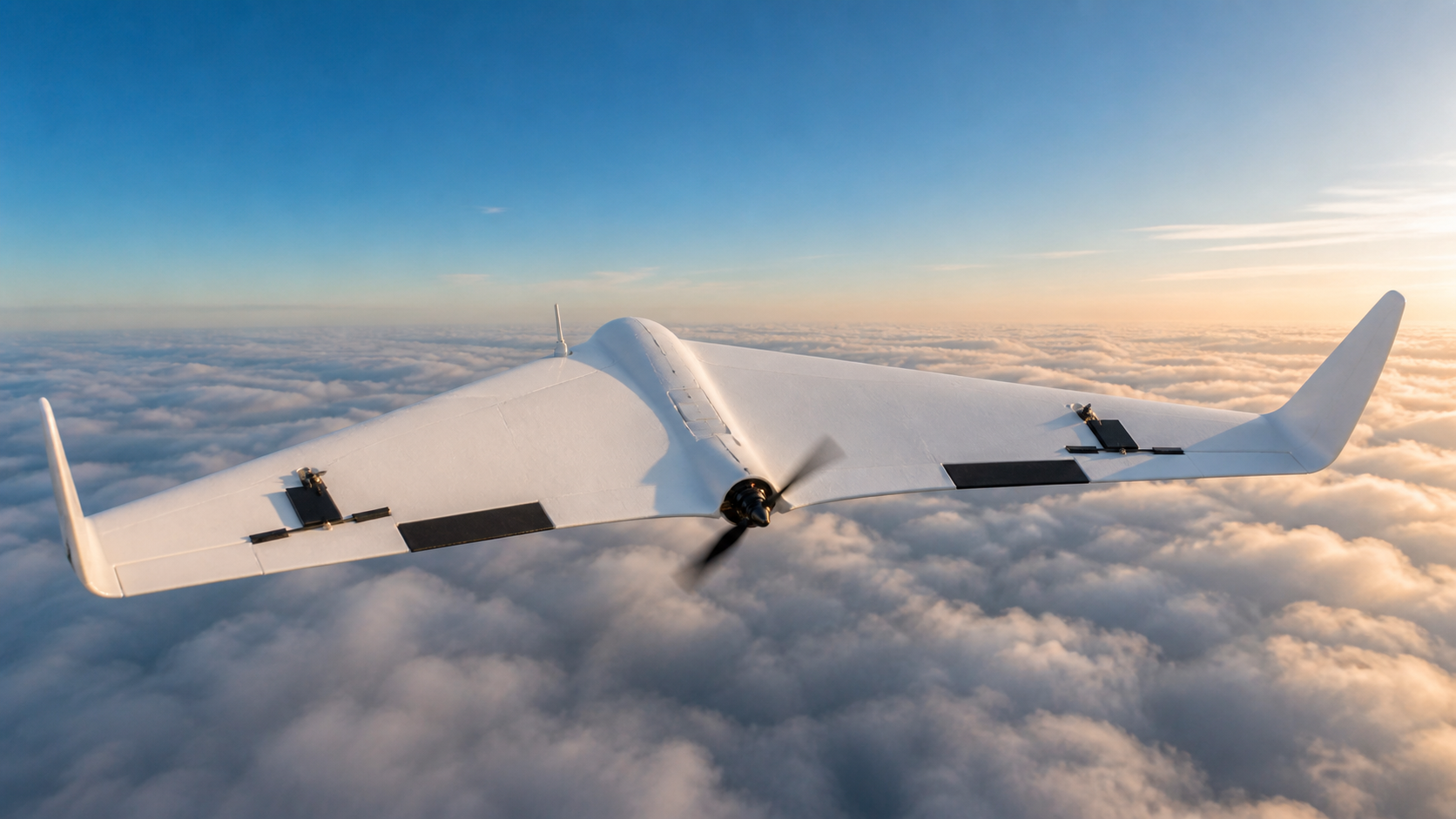
tensoraerospace.aerospacemodel.skywalker_x8.nonlinear — full nonlinear
6-DoF model of the Skywalker X8 flying-wing UAV (~3.4 kg, 2.10 m
span). Aerodynamic data is peer-reviewed flight-test
identification from a 2025 CEAS Aeronautical Journal paper.
The Skywalker X8 is the canonical "small fixed-wing UAV" representative in the tensoraerospace roster — it covers the niche of ~ 2 m-span, ~ 3 kg, electric-propeller hobby-grade airframes used widely in academic flight-research. Compared to other entries in the same class (the Sentera Vireo, KHawk Zephyr, HobbyKing Bix3, Telemaster, PA-18 Super Cub, Ultra Stick 25e, etc. — see references), the X8 is the most carefully and recently identified, with all its derivatives published in a single open-access paper.
| Parameter | Value |
|---|---|
| Aerodynamic source | CEAS Aeronautical Journal (2025) — Løw-Hansen et al. |
| Identification method | Hybrid Output Error Method (OEM), Fitlab tool |
| Mass / span / area | 3.364 kg / 2.10 m / 0.75 m² |
| Engine | Hacker A40-12 KV610 + 14×8 Aeronaut prop, 4S 16 V |
| Coordinates | NED, body axis, ZYX 321 Euler |
| State | 12-D (no propellant channel — electric) |
| Controls | 3 channels: collective elevon (δ_e), differential elevon (δ_a), throttle (δ_T) |
| Units | SI (kg, m, N, rad, s) — all other tensoraerospace nonlinear models are FPS |
Geometry & mass (paper Table 1)
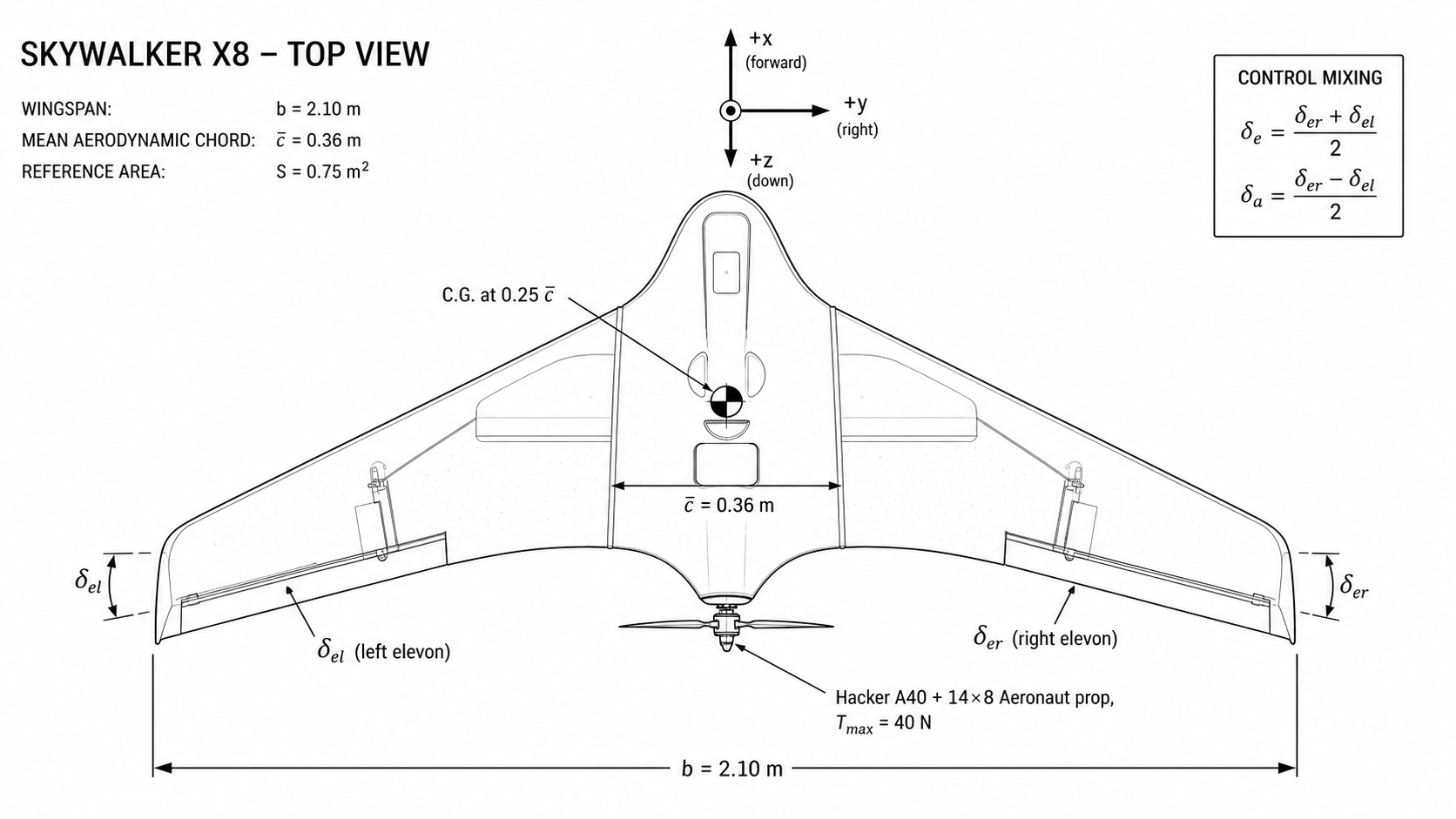
m   = 3.364 kg
Ix  = 0.325 kg·m²
Iy  = 0.140 kg·m²
Iz  = 0.400 kg·m²
Ixz = 0.029 kg·m²
c̄  = 0.36 m       (mean aerodynamic chord)
b   = 2.10 m       (wingspan)
S   = 0.75 m²      (planform area)
The flying-wing layout, two-elevon control surface arrangement, central LiPo bay, c.g. at 0.25 c̄, and rear-mounted pusher propeller are visible in the top-view diagram above. The control mixing inset shows how the two physical elevon deflections (δ_el, δ_er) map to the collective elevator (δ_e) and differential aileron (δ_a) inputs the agent uses.
State and control
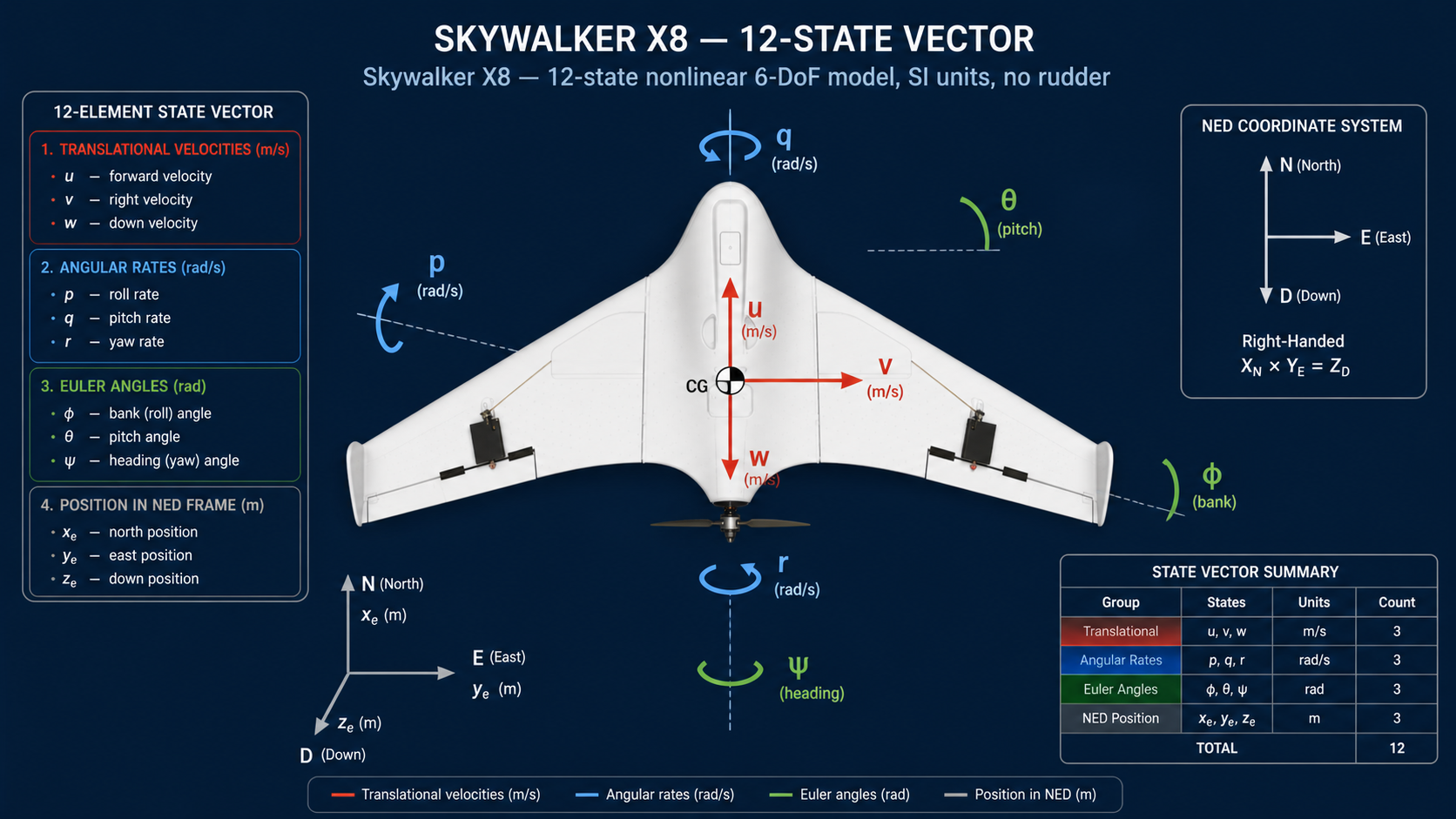
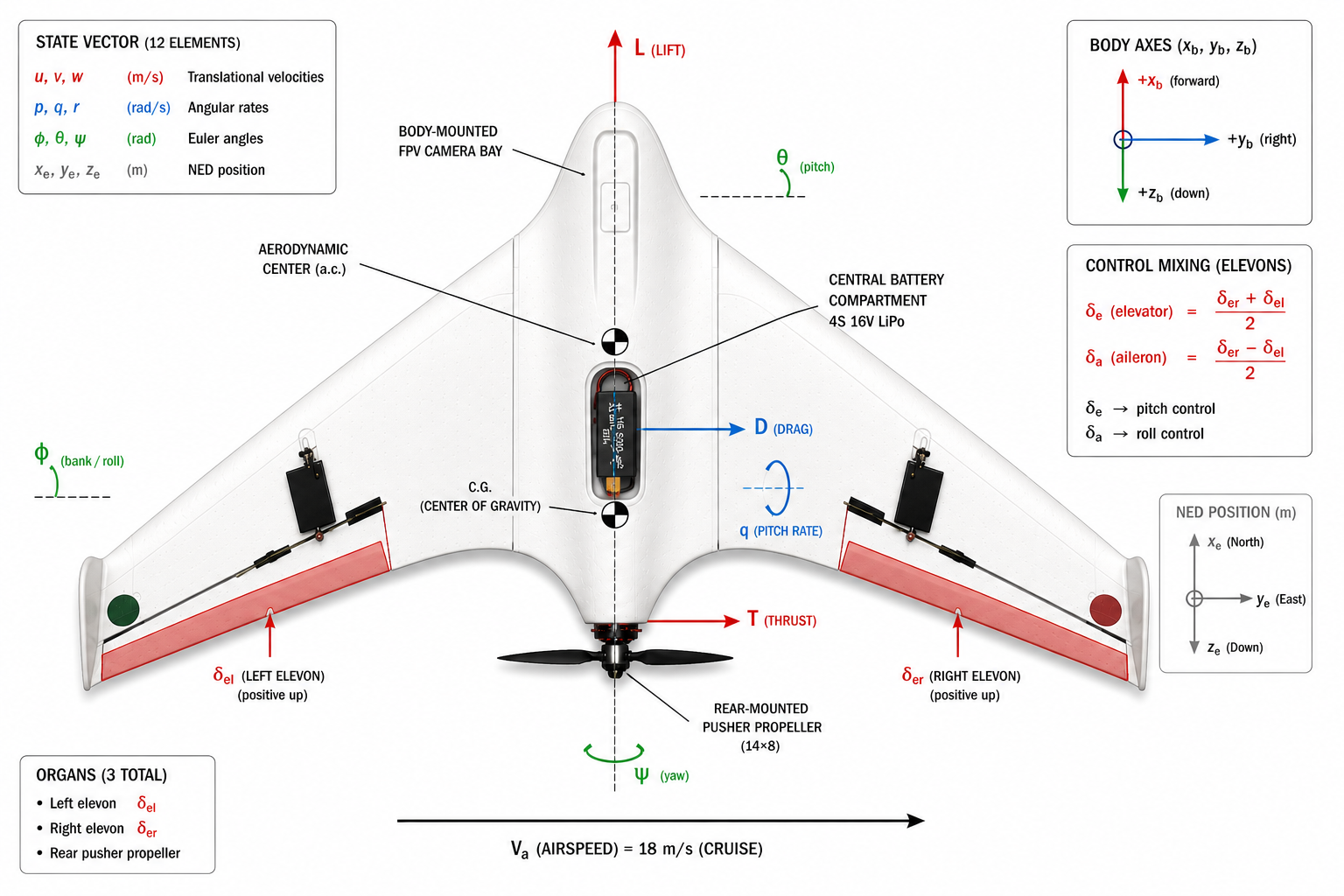
The diagram above unpacks the full 12-element state vector and the body-axis frame on the X8: three translational velocities (u, v, w), three angular rates (p, q, r), three Euler angles (φ, θ, ψ) and three NED position components (x_e, y_e, z_e). The accompanying perspective overview ties the state vector together with the physical control organs and propulsion group:
State (12-D, body axis, NED, ZYX 321 Euler — SI units):
[u, v, w,           # body velocity, m/s
 p, q, r,           # body angular rates, rad/s
 φ, θ, ψ,           # Euler angles, rad
 x_e, y_e, z_e]     # NED position, m
Control (3-D — no rudder):
The X8 is a flying wing with two elevons (left and right). The standard control mixing maps these to a collective input (elevator, δ_e = (δ_er + δ_el)/2) and a differential input (aileron, δ_a = (δ_er - δ_el)/2). Lateral-directional yaw control is via differential aileron only (no rudder surface).
Aerodynamic build (paper Table 8)
All coefficients are identified from flight test data at V = 18 m/s in October 2024 with a hybrid Output Error Method. Functional forms (paper Eqs. 17, 18):
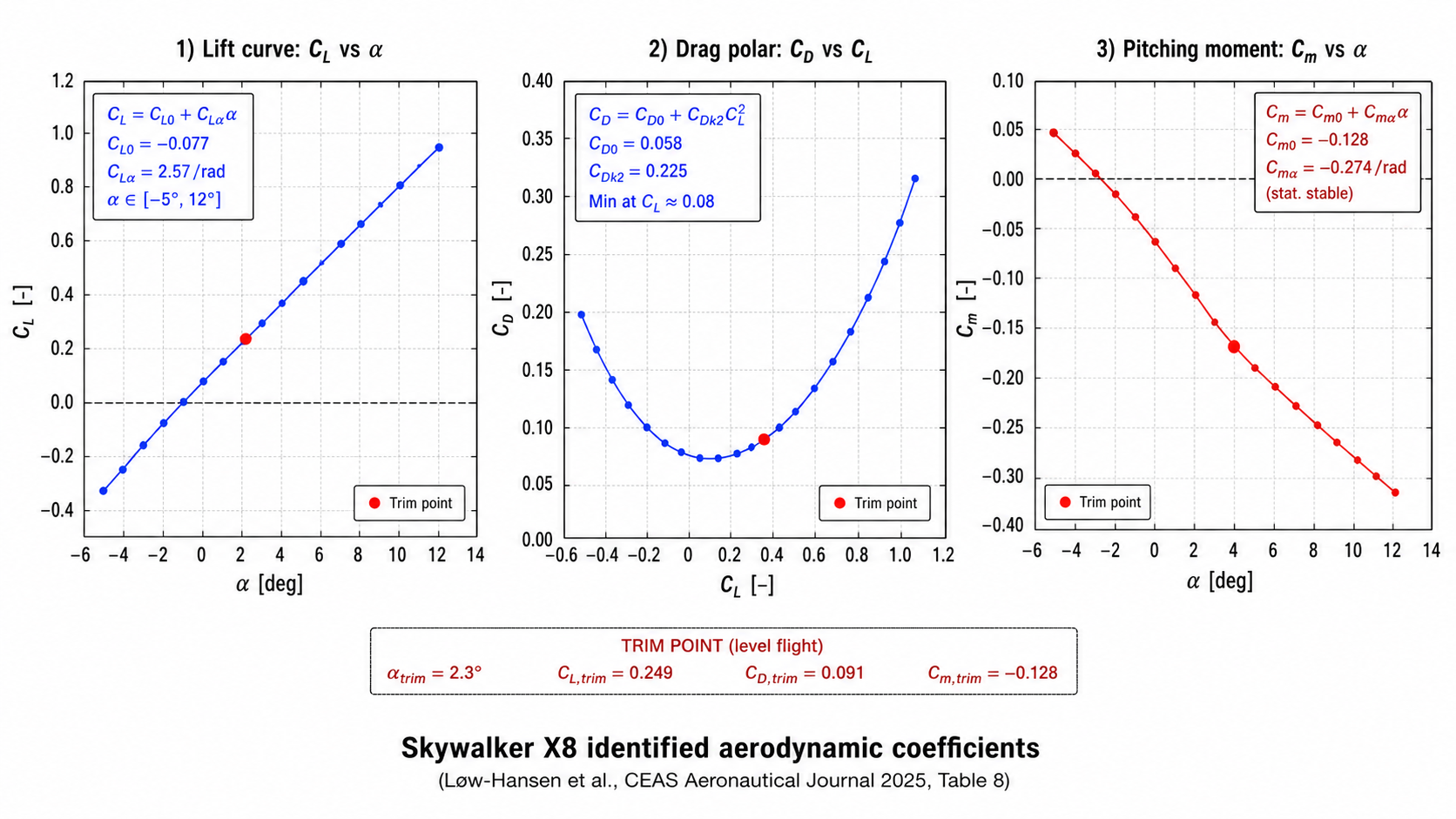
The three panels above plot the lift curve (C_L vs α, slope 2.57/rad, intercept −0.077), the asymmetric drag polar (C_D vs C_L, minimum near C_L = 0.08), and the pitching-moment curve (C_m vs α, negative slope confirming static stability) computed from the published coefficients. The red trim point is the published 18 m/s reference condition.
Identified coefficient values:
| Drag | Lift | Pitch | |||
|---|---|---|---|---|---|
| \(C_{D_0}\) | 0.058 | \(C_{L_0}\) | −0.077 | \(C_{m_0}\) | 0.027 |
| \(C_{D_q}\) | 0.480 | \(C_{L_\alpha}\) | 2.573 /rad | \(C_{m_\alpha}\) | −0.274 /rad |
| \(C_{D_{C_T}}\) | −0.217 | \(C_{L_q}\) | 17.119 | \(C_{m_q}\) | −1.608 |
| \(C_{D_{k_1}}\) | −0.034 | \(C_{L_{\delta_e}}\) | 1.369 | \(C_{m_{\delta_e}}\) | −0.276 |
| \(C_{D_{k_2}}\) | 0.225 |
| Side force | Roll | Yaw | |||
|---|---|---|---|---|---|
| \(C_{Y_0}\) | 0.011 | \(C_{l_0}\) | 0.007 | \(C_{n_0}\) | −6.3×10⁻⁴ |
| \(C_{Y_\beta}\) | −0.285 | \(C_{l_\beta}\) | −0.108 | \(C_{n_\beta}\) | 0.022 |
| \(C_{Y_p}\) | −0.270 | \(C_{l_p}\) | −0.313 | \(C_{n_p}\) | −0.009 |
| \(C_{Y_r}\) | 0.108 | \(C_{l_r}\) | 0.037 | \(C_{n_r}\) | −0.050 |
| \(C_{Y_{\delta_a}}\) | 0.097 | \(C_{l_{\delta_a}}\) | 0.102 | \(C_{n_{\delta_a}}\) | −0.007 |
The propeller-airframe drag coupling \(C_{D_{C_T}} = -0.217\) is the most distinctive feature: increased throttle reduces drag, indicating that the prop slipstream alters airflow over the elevons.
Engine model
The Hacker A40-12 KV610 motor + 14×8 Aeronaut CAM folding propeller is calibrated against two paper-published operating points:
| Condition | Thrust |
|---|---|
| Static, full throttle | 40 N |
| 44 % throttle, 18 m/s (paper trim) | 3.7 N |
A simple two-point quadratic model:
with \(T_{\max} = 40\) N, \(V_{\text{zero}} = 35\) m/s. The full
motor + cubic-CT(J) model from the paper (Tables 6, 7) is exposed via
:class:X8Propeller for high-fidelity studies.
Trim finder
tensoraerospace.aerospacemodel.skywalker_x8.nonlinear.trim(h, V)
solves \(\dot u = \dot w = \dot q = 0\) via Newton-Raphson:
| Condition | h, m | V, m/s | α | δ_e | δ_T |
|---|---|---|---|---|---|
| Paper Eq. 38 (6-DoF coupled) | 178 | 17.9 | 7.9° | -2.35° | 0.44 |
| Our pure-longitudinal trim | 178 | 18.0 | 7.6° | -2.0° | 0.64 |
The slight differences come from the paper's trim being a 6-DoF coupled solution with non-zero \(\beta = 1.2°\) and \(\delta_a = -2.16°\), while our trimmer solves the simpler pure-longitudinal case with \(\beta = 0\) and \(\delta_a = 0\). Residual norms reach machine precision (\(10^{-13}\)) in both cases.
Gymnasium env
Registered as "NonlinearSkywalkerX8-v0":
import gymnasium as gym
import tensoraerospace  # registers the env

# Trim-finder at any (altitude, V) — note SI units!
env = gym.make("NonlinearSkywalkerX8-v0",
    trim_at=(178.0, 18.0), number_time_steps=2000)

# Arbitrary 12-state initial condition (SI: m/s, rad, m)
import numpy as np
env = gym.make("NonlinearSkywalkerX8-v0",
    initial_state=np.array([18, 0, 1.5, 0,0,0, 0, 0.137, 0,
                            0, 0, -178.0]),
    number_time_steps=2000)
Action space:
* 3-channel [δ_e, δ_a, δ_T] (no rudder!)
* "virtual" (rad / [0, 1]) or "normalized" ([-1, +1]^3)
Scope and limitations
- High angle of attack / stall: The identified model is valid for ~ 0–12° α range (typical cruise envelope). Post-stall behaviour is not modelled — for full envelope including hand-launch and post-stall recovery, plug in the wind-tunnel data from Reinhardt et al. (2022, [9] in the paper).
- Motor electrical dynamics: The MVP uses a calibrated quadratic thrust model. The full motor + cubic-CT(J) electrical model from the paper (Sec. 2.3) gives transient inductance / current behaviour during throttle steps but is not used by default.
- Icing: The paper's primary motivation is icing research; an
ice-accretion damage subsystem can be plugged into the
damage_statehook (parity with the B-747 module). - Rudder: There is none. Yaw control is purely differential aileron + dihedral effect of bank.
Companion small-UAV identification papers
The Skywalker X8 paper (Table 2) catalogues 9 published small-fixed-wing
UAV identification studies. The X8 is the most recent and the most
thoroughly validated; if a different platform is needed, swap in the
coefficient tables from one of the references below using the same
module structure (params, aero, engine, dynamics, model).
| Platform | Wingspan | Mass | Reference |
|---|---|---|---|
| Telemaster | 1.8 m | 3.2 kg | Arifianto et al. (2015) |
| Hangar 9 PA-18 Super Cub | 2.7 m | 7.5 kg | Lu et al. (2018) |
| HobbyKing Bix3 | 1.5 m | 1.2 kg | Simmons et al. (2019) |
| Skywalker X8 | 2.10 m | 3.36 kg | Løw-Hansen 2025 ← this module |
| Ultra Stick 25e | 1.3 m | 2.0 kg | Dorobantu (2013) [already in tensoraerospace] |
| KHawk Zephyr3-R | 1.2 m | 2.2 kg | Matt et al. (2022) |
References
- Løw-Hansen B., Hann R., Gryte K., Johansen T. A., Deiler C. "Modeling and identification of a small fixed-wing UAV using estimated aerodynamic angles", CEAS Aeronautical Journal (2025). DOI: 10.1007/s13272-025-00816-3. Open-access PDF (DLR repository).
- Reinhardt D., Coates E. M., Johansen T. A. "Aerodynamic modeling of the Skywalker X8 fixed-wing unmanned aerial vehicle" (2022). Earlier velocity-based parameterisation.
- Beard R., McLain T. "Small Unmanned Aircraft: Theory and Practice", Princeton Univ. Press (2012). Sec. 2.4 propeller model.