Recipe 11 — IHDP on the nonlinear F-16
IHDP (Incremental Heuristic Dynamic Programming) is the library's neural actor + online-identified model baseline. It's the historical starting point the other adaptive-critic agents (IM-GDHP, ET-DHP) extend.
Agent docs. IHDP · Full notebook. example_ihdp_nonlinear_f16.ipynb · Related recipe. Recipe 06 — Online-adaptive agents.
When to use IHDP
| Property | IHDP |
|---|---|
| Online adaptation | ✓ (RLS model + actor gradient step every tick) |
| Needs a model? | Warm-start G_init, rest is identified online |
| Neural net in the loop | Yes — actor & critic MLPs |
| Interpretability | Moderate (NN critic is opaque, RLS model is inspectable) |
| Fault tolerance | Natural — RLS re-identifies the plant under faults |
Pick IHDP when you want a neural actor that adapts online and you don't need the two-head critic of IM-GDHP or the event-trigger machinery of ET-DHP.
Step 1 — Minimal config
import numpy as np
from tensoraerospace.agent.ihdp import IHDPAgent, IHDPConfig

cfg = IHDPConfig(
    dt=0.01,
    # actor / critic
    actor_hidden=(32, 32),
    critic_hidden=(64, 64),
    actor_lr=1e-3,
    critic_lr=5e-4,
    gamma=0.95,
    # online model (RLS)
    rls_forgetting=0.995,
    rls_cov_init=1e2,
    G_init=np.array([[-0.5]]),         # from a linearisation or PE excitation
    # safety
    u_magnitude_limit=15.0,
    u_rate_limit=60.0,
    seed=0,
)
Like iADP / AA-INDI, IHDP needs a reasonable G_init. See Recipe 06 for the PE-excitation warm-start pattern.
Step 2 — Step loop
Identical to the other online-adaptive agents:
agent = IHDPAgent(n_state=1, n_control=1, config=cfg)
env.reset()

for k in range(n_steps):
    obs = env.get_state()
    u = agent.predict(obs[controlled_channels], ref[:, k], k)
    obs, *_ = env.step(u)
    agent.learn(obs[controlled_channels], ref[:, k], k)
predict runs the actor NN forward; learn does the RLS update + one SGD step on actor and critic.
Step 3 — Expected behaviour on the nonlinear F-16
Tracking a smooth α schedule on NonlinearLongitudinalF16-v0:
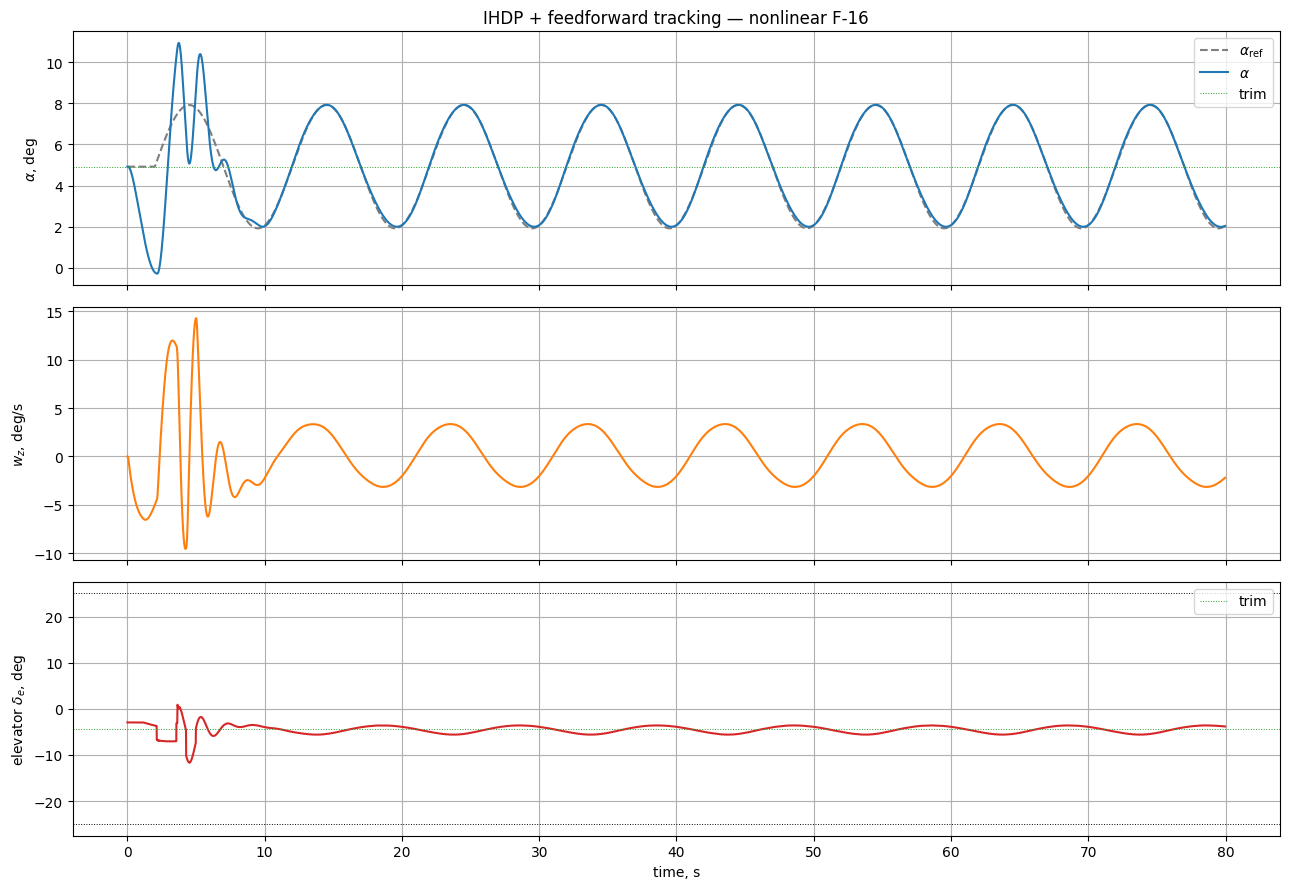
The plot is taken directly from the full example notebook — see example_ihdp_nonlinear_f16.ipynb for the exact env construction, reference signal and warm-start PE.
Step 4 — Save / load / publish to HuggingFace
run_dir = agent.save('./checkpoints')
restored = IHDPAgent.from_pretrained(run_dir)
agent.publish_to_hub('me/my-ihdp', folder_path=run_dir, access_token='hf_…')
Same contract as all five online-adaptive agents — see Recipe 08.
Pitfalls
- Actor collapses to zero. Check
G_initsign. Wrong sign makes every gradient step push the actor the wrong way. - Critic diverges. Lower
critic_lr(5e-4 is already conservative), or increaserls_forgettingcloser to 1 for a less noisy model signal. - Unstable early ticks. Increase
policy_eval_warmup_updates(in agents that expose it) so the critic sees a settled model before it starts training.
Where to go next
- Recipe 12 — IM-GDHP — dual-head critic, one level up in capability.
- Recipe 13 — ET-DHP — event-triggered variant for low-compute platforms.
- IHDP documentation — theory + full API.