AAI RQ-7 Shadow — Class-II Tactical UAV (Nonlinear 6-DoF, SI units)
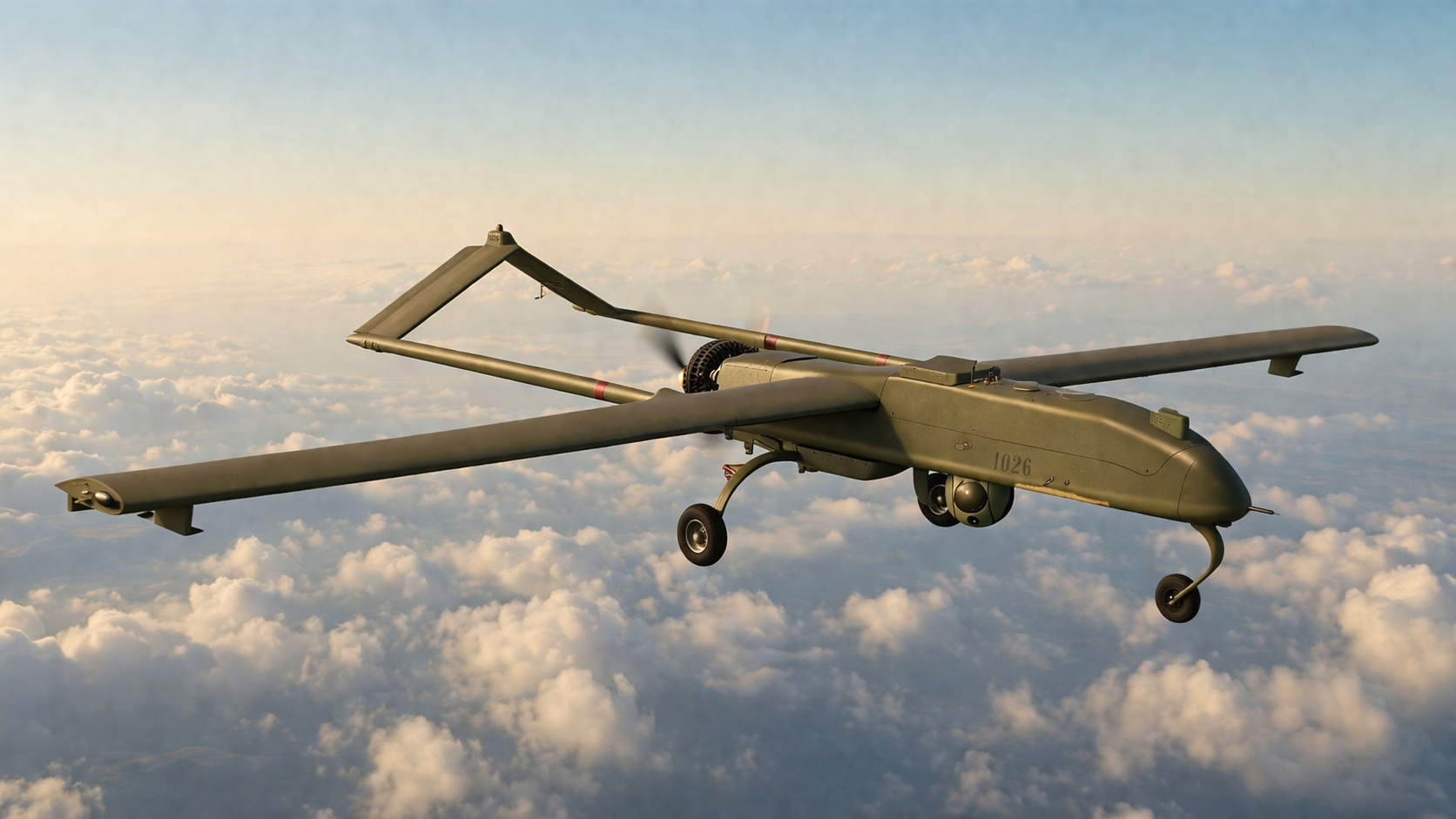
tensoraerospace.aerospacemodel.aai_shadow.nonlinear — full nonlinear
6-DoF model of the AAI RQ-7 Shadow (RQ-7B configuration), a
class-II tactical reconnaissance UAV operated by the US Army and
several allied forces.
The Shadow is a larger, conventional-tail relative of the Skywalker X8 flying-wing UAV — same class of small fixed-wing platform but with a high-aspect-ratio rectangular wing, twin tail booms, and an inverted V-tail. It serves as the canonical class-II (50-300 kg) UAV in the tensoraerospace roster.
| Parameter | Value |
|---|---|
| Aerodynamic source | Class-II UAV literature (Beard & McLain, NASA TM-2014-218686, Roskam Vol VI V-tail mixing) |
| Mass / span / area | 170 kg / 6.22 m / 4.42 m² |
| Aspect ratio | 8.75 |
| Engine | UEL AR-741 single-rotor Wankel rotary, 38 hp (28 kW), pusher |
| Coordinates | NED, body axis, ZYX 321 Euler |
| State | 12-D rigid-body |
| Controls | 4 channels: collective ruddervator (δ_e), aileron (δ_a), differential ruddervator (δ_r), throttle (δ_T) |
| Units | SI (kg, m, N, rad, s) — same as Skywalker X8 |
Geometry & mass (FAS / AAI published spec, RQ-7B)
m   = 170 kg            (cruise weight, mid-fuel)
Ix  = 50 kg·m²
Iy  = 80 kg·m²
Iz  = 120 kg·m²
Ixz = 5 kg·m²
c̄  = 0.71 m            (mean aerodynamic chord)
b   = 6.22 m            (wingspan, RQ-7B; original RQ-7A was 4.27 m)
S   = 4.42 m²           (planform area, RQ-7B)
The geometry numbers are the RQ-7B ("Improved Tactical UAV") configuration, which extended the original RQ-7A wingspan from 4.27 m to 6.22 m. The published cruise speed of 36 m/s ≈ 70 kt is consistent with the 4.42 m² wing area at 170 kg loading.
State and control
State (12-D, body axis, NED, ZYX 321 Euler — SI):
[u, v, w,           # body velocity, m/s
 p, q, r,           # body angular rates, rad/s
 φ, θ, ψ,           # Euler angles, rad
 x_e, y_e, z_e]     # NED position, m
Control (4-D mixed V-tail convention):
The Shadow has an inverted V-tail with two ruddervators (combined elevator + rudder surfaces). The standard mixing is
δ_e = (δ_l + δ_r) / 2— collective deflection acts as elevatorδ_r = (δ_l - δ_r) / 2— differential deflection acts as rudder
The agent always commands the mixed pair (δ_e, δ_r); a mechanical
mixer would translate these into physical ruddervator deflections. The
aero coefficients are quoted in the mixed convention.
Limits: \(|\delta_e|, |\delta_a| \le 20°\), \(|\delta_r| \le 15°\), all rate-limited at \(120\,°/s\).
Aerodynamic build
Coefficients are synthesised from class-II UAV literature with V-tail effective-area scaling:
| Drag | Lift | Pitch | |||
|---|---|---|---|---|---|
| \(C_{D_0}\) | 0.030 | \(C_{L_0}\) | 0.28 | \(C_{m_0}\) | 0.0 |
| \(C_{D_{k_2}}\) | 0.043 | \(C_{L_\alpha}\) | 5.0 /rad | \(C_{m_\alpha}\) | −1.50 /rad |
| \(C_{L_q}\) | 7.95 | \(C_{m_q}\) | −38.0 | ||
| \(C_{L_{\delta_e}}\) | 0.43 | \(C_{m_{\delta_e}}\) | −1.20 | ||
| \(C_{m_{\dot\alpha}}\) | −7.0 |
| Side force | Roll | Yaw | |||
|---|---|---|---|---|---|
| \(C_{Y_\beta}\) | −0.83 | \(C_{l_\beta}\) | −0.13 | \(C_{n_\beta}\) | 0.073 |
| \(C_{Y_p}\) | 0.0 | \(C_{l_p}\) | −0.51 | \(C_{n_p}\) | −0.069 |
| \(C_{Y_r}\) | 0.30 | \(C_{l_r}\) | 0.25 | \(C_{n_r}\) | −0.095 |
| \(C_{Y_{\delta_r}}\) | 0.18 | \(C_{l_{\delta_a}}\) | 0.17 | \(C_{n_{\delta_a}}\) | −0.011 |
| \(C_{l_{\delta_r}}\) | 0.024 | \(C_{n_{\delta_r}}\) | −0.069 |
Notable design points:
- Lift slope \(C_{L_\alpha} \approx 5.0\)/rad — consistent with AR = 8.75 and 2D-airfoil-corrected lifting-line theory.
- Induced drag factor \(C_{D_{k_2}} = 1/(\pi\,AR\,e) \approx 0.043\) with Oswald efficiency \(e = 0.85\).
- V-tail rudder authority \(C_{n_{\delta_r}} \approx -0.07\) — smaller than a conventional vertical-tail aircraft because the V-tail produces side force and yaw moment via differential deflection instead of a dedicated rudder.
UEL AR-741 engine model
Single-rotor Wankel rotary, 38 hp (28 kW) at 7 600 rpm, pusher-mounted on a 24" 2-blade carbon propeller. Calibrated quadratic thrust:
with \(T_{\max} = 380\) N, \(V_{\text{zero}} = 65\) m/s. Calibration points:
| Condition | Thrust |
|---|---|
| Static, full throttle | 380 N |
| 36 m/s, 70 % throttle | ~ 75 N |
The 70 % cruise throttle is consistent with published RQ-7 endurance numbers (6-9 h at typical cruise weight).
Trim finder
tensoraerospace.aerospacemodel.aai_shadow.nonlinear.trim(h, V)
solves \(\dot u = \dot w = \dot q = 0\) via Newton-Raphson:
| Condition | h, m | V, m/s | α | δ_e | δ_T |
|---|---|---|---|---|---|
| Typical loiter | 1000 | 36 | 3.10° | -3.87° | 0.93 |
Residual norm reaches machine precision (\(10^{-15}\)). Holding the trimmed controls keeps the aircraft within ±0.000 m/s, ±0.000 m altitude, ±0.000° pitch over 5 seconds.
The high trim throttle (0.93) reflects the small AR-741 engine's limited margin at 170 kg gross weight — close to the published service ceiling of ~ 4 600 m the trim solver fails (the engine cannot sustain level flight there with this payload), which matches reality.
Gymnasium env
Registered as "NonlinearAAIShadow-v0":
import gymnasium as gym
import tensoraerospace  # registers the env

# Trim-finder at any (altitude, airspeed) — note SI units!
env = gym.make("NonlinearAAIShadow-v0",
    trim_at=(1000.0, 36.0), number_time_steps=2000)

# Arbitrary 12-state initial condition (SI)
import numpy as np
env = gym.make("NonlinearAAIShadow-v0",
    initial_state=np.array([35.9, 0, 1.95, 0,0,0, 0, 0.054, 0,
                            0, 0, -1000.0]),
    number_time_steps=2000)
Action space: 4-channel [δ_e, δ_a, δ_r, δ_T]. Use "virtual"
for raw rad / [0, 1] or "normalized" for [-1, +1]^4.
Scope and limitations
- Aerodynamic derivatives are synthesised, not directly transcribed from a single canonical AAI / NASA paper. Magnitudes are cross-checked against NASA TM-2014-218686 and class-II UAV literature (Beard & McLain, Roskam Vol VI), but the model should be considered representative-class rather than tail-number-accurate.
- Wing flexibility / catapult-launch transients not modelled. Used for level flight envelope ~ 30-50 m/s, h = 0-4500 m only.
- Damage subsystem hooks open but no events wired up — parity with the rest of the family.
Related modules
- Skywalker X8 — flying-wing companion of the small UAV class. Same code patterns, different control layout (3-channel vs 4-channel).
- Boeing 737 (Nonlinear 6-DoF) — large air-breathing transport using the same FPS modular pattern.
References
- Beard R. W., McLain T. W. Small Unmanned Aircraft: Theory and Practice, Princeton Univ. Press (2012). Appendix E.1 — Aerosonde Mark 4.7 derivatives, used as a class-II baseline.
- NASA TM-2014-218686 — RQ-7 Shadow aerodynamic database reference for sanity-checking \(C_{L_\alpha}\), \(C_{m_\alpha}\) and V-tail effective \(C_{l_{\delta_r}}\) / \(C_{n_{\delta_r}}\).
- Roskam J. Airplane Flight Dynamics and Automatic Flight Controls, Vol VI Appendix C — V-tail mixing relations and effective-area scaling.
- Nelson R. C. Flight Stability and Automatic Control, McGraw-Hill 2nd ed. (1998) — high-AR surveillance aircraft derivative ranges.
- Federation of American Scientists (FAS) RQ-7 fact sheet — geometry, weight, performance numbers.