Example: IHDP on the nonlinear F-16 — sinusoidal α-tracking
This example trains an Incremental Heuristic Dynamic Programming (IHDP) agent to track a sinusoidal angle-of-attack reference on the pure-NumPy nonlinear F-16 longitudinal model. The source notebook lives at example/reinforcement_learning/incremental_adp/example_ihdp_nonlinear_f16.ipynb.
Key idea: feedforward + IHDP residual
IHDP is a reactive algorithm — it only sees the current state and the current reference. For a sinusoidal reference, by the time the agent reacts the target has already moved, which gives a 60–90° phase lag (cosine in response to sine). The fix is to have the env inject an inverse-model feedforward that does the bulk of the tracking, leaving IHDP only a small dynamic residual to learn:
Three ingredients make the feedforward work:
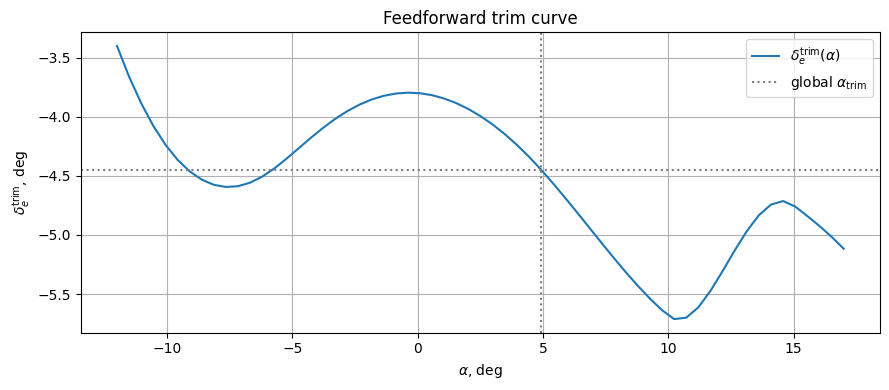
- Static trim curve \(\alpha \to \delta_e^{\text{trim}}\). For each candidate \(\alpha\) we precompute the elevator deflection that zeroes the pitching moment via
fsolve. - Lookahead \(\tau \approx 0.85\,\text{s}\). Instead of
α_ref(t), we feedα_ref(t + τ)into the trim curve — this compensates for the actuator + airframe lag (roughly the F-16 short-period time constant at \(V=150\) m/s). - Amplitude gain \(g = 1.55\). On a moving reference, equilibrium isn't enough — the elevator must overshoot the static target to inject the pitch acceleration that keeps α in phase with \(\dot\alpha_{\text{ref}}\). We scale the deviation from the global trim before the trim-curve lookup.
With this feedforward in place, IHDP only has to learn a small residual correction.
1. Imports and trim
import math

import gymnasium as gym
import matplotlib.pyplot as plt
import numpy as np
from scipy.optimize import fsolve
from tqdm import tqdm

import tensoraerospace  # registers gymnasium envs
from tensoraerospace.aerospacemodel.f16.nonlinear.longitudinal.dynamics import f16_ode_long
from tensoraerospace.aerospacemodel.f16.nonlinear.longitudinal.params import default_parameters
from tensoraerospace.agent.ihdp.model import IHDPAgent
from tensoraerospace.utils import convert_tp_to_sec_tp, generate_time_period
Solve for \((\alpha_{\text{trim}}, \delta_{e,\text{trim}})\) such that \(\dot\alpha=0\) and \(\dot\omega_z=0\) at zero pitch rate:
params = default_parameters()

def trim_residual(z):
    alpha, stab = z
    x = np.array([alpha, 0.0, stab, 0.0])
    return list(f16_ode_long(x, np.array([stab]), 0.0, params)[:2])

sol, _info, ier, _ = fsolve(
    trim_residual, x0=[math.radians(2.0), math.radians(-2.0)], full_output=True
)
alpha_trim_rad, stab_trim_rad = float(sol[0]), float(sol[1])
alpha_trim_deg = math.degrees(alpha_trim_rad)
stab_trim_deg = math.degrees(stab_trim_rad)
# global trim: alpha = +4.9184 deg, elevator = -4.4467 deg
2. Build the feedforward trim curve
For each candidate \(\alpha\) in \([-12°, 17°]\), find the elevator deflection that zeroes the pitching moment:
def stab_for_alpha(alpha_rad: float) -> float:
    def res(s):
        x = np.array([alpha_rad, 0.0, s[0], 0.0])
        return f16_ode_long(x, np.array([s[0]]), 0.0, params)[1]  # dwz
    return float(fsolve(res, x0=[math.radians(-2.0)])[0])

alphas_grid_deg = np.linspace(-12.0, 17.0, 61)
alphas_grid_rad = np.deg2rad(alphas_grid_deg)
stabs_grid_deg = np.array([math.degrees(stab_for_alpha(a)) for a in alphas_grid_rad])
3. Reference signal
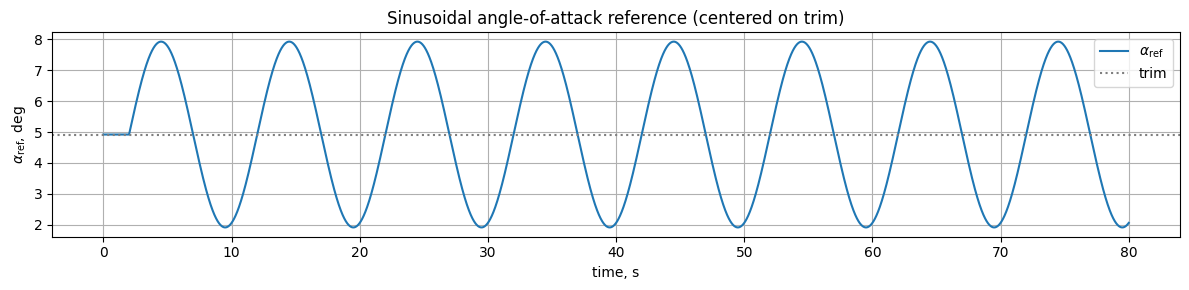
80-second episode at \(dt = 0.01\) s. The reference is held at \(\alpha_{\text{trim}}\) for 2 s so the IHDP incremental model can identify a usable linearisation, then becomes a 3° amplitude sinusoid at 0.1 Hz centered on trim.
dt = 0.01
tp = generate_time_period(tn=80, dt=dt)
tps = convert_tp_to_sec_tp(tp, dt=dt)
number_time_steps = len(tp)

amplitude_deg = 3.0
freq_hz = 0.1
warmup_steps = int(2.0 / dt)

ref_alpha_rad = np.full(number_time_steps, alpha_trim_rad)
active_t = np.arange(number_time_steps - warmup_steps) * dt
ref_alpha_rad[warmup_steps:] = (
    alpha_trim_rad + math.radians(amplitude_deg) * np.sin(2 * np.pi * freq_hz * active_t)
)
reference_signals = ref_alpha_rad.reshape(1, -1)
4. Feedforward function and env
lookahead_sec = 0.85
lookahead_steps = int(lookahead_sec / dt)
ff_gain = 1.55

def feedforward_fn(time_step: int, ref_signal: np.ndarray) -> float:
    k = min(time_step + lookahead_steps, ref_signal.shape[1] - 1)
    alpha_ref_deg = math.degrees(ref_signal[0, k])
    alpha_eff_deg = alpha_trim_deg + ff_gain * (alpha_ref_deg - alpha_trim_deg)
    return float(np.interp(alpha_eff_deg, alphas_grid_deg, stabs_grid_deg))

env = gym.make(
    "NonlinearLongitudinalF16-v0",
    number_time_steps=number_time_steps,
    initial_state=[alpha_trim_rad, 0.0, stab_trim_rad, 0.0],
    reference_signal=reference_signals,
    state_space=["alpha", "wz"],
    control_space=["stab"],
    tracking_states=["alpha"],
    use_reward=False,
    dt=dt,
    integrator="euler",
    feedforward_fn=feedforward_fn,
)
5. IHDP agent configuration
Two changes versus the canonical linear-F-16 IHDP example matter here:
Q_weights = [200](vs. 8 in the linear example). The FF covers most of the tracking, so the residual error is small. A higher Q amplifies that small error to give the actor a usable gradient.NN_initial = 47is the best seed from a sweep over[1, 100]withQ=200, lr=2: it gives MAE ≈ 0.05° on this exact reference.NN_initial=120is a safe middle (~0.14°).
actor_settings = {
    "start_training": 5,
    "layers": (25, 1),
    "activations": ("tanh", "tanh"),
    "learning_rate": 2,
    "learning_rate_exponent_limit": 10,
    "type_PE": "combined",
    "amplitude_3211": 3,
    "pulse_length_3211": 5 / dt,
    "maximum_input": 15,
    "maximum_q_rate": 20,
    "WB_limits": 30,
    "NN_initial": 47,
    "cascade_actor": False,
    "learning_rate_cascaded": 1.2,
}

critic_settings = {
    "Q_weights": [200],
    "start_training": -1,
    "gamma": 0.99,
    "learning_rate": 15,
    "learning_rate_exponent_limit": 10,
    "layers": (25, 1),
    "activations": ("tanh", "linear"),
    "WB_limits": 30,
    "NN_initial": 47,
    "indices_tracking_states": env.unwrapped.indices_tracking_states,
}

incremental_settings = {
    "number_time_steps": number_time_steps,
    "dt": dt,
    "input_magnitude_limits": 15,
    "input_rate_limits": 60,
}

agent = IHDPAgent(
    actor_settings, critic_settings, incremental_settings,
    env.unwrapped.tracking_states,
    env.unwrapped.state_space,
    env.unwrapped.control_space,
    number_time_steps,
    env.unwrapped.indices_tracking_states,
)
6. Online training loop
IHDP is fully online: at every step the actor proposes a residual control, the env adds the feedforward and advances, and the actor / critic / incremental model are updated using the resulting transition.
obs, _ = env.reset()
xt = np.asarray(obs, dtype=float).reshape(-1, 1)

for step in tqdm(range(number_time_steps - 3)):
    ut = agent.predict(xt, reference_signals, step)
    xt, _reward, terminated, truncated, _info = env.step(np.asarray(ut))
    xt = np.asarray(xt, dtype=float).reshape(-1, 1)
    if terminated or truncated:
        break
7. Tracking result
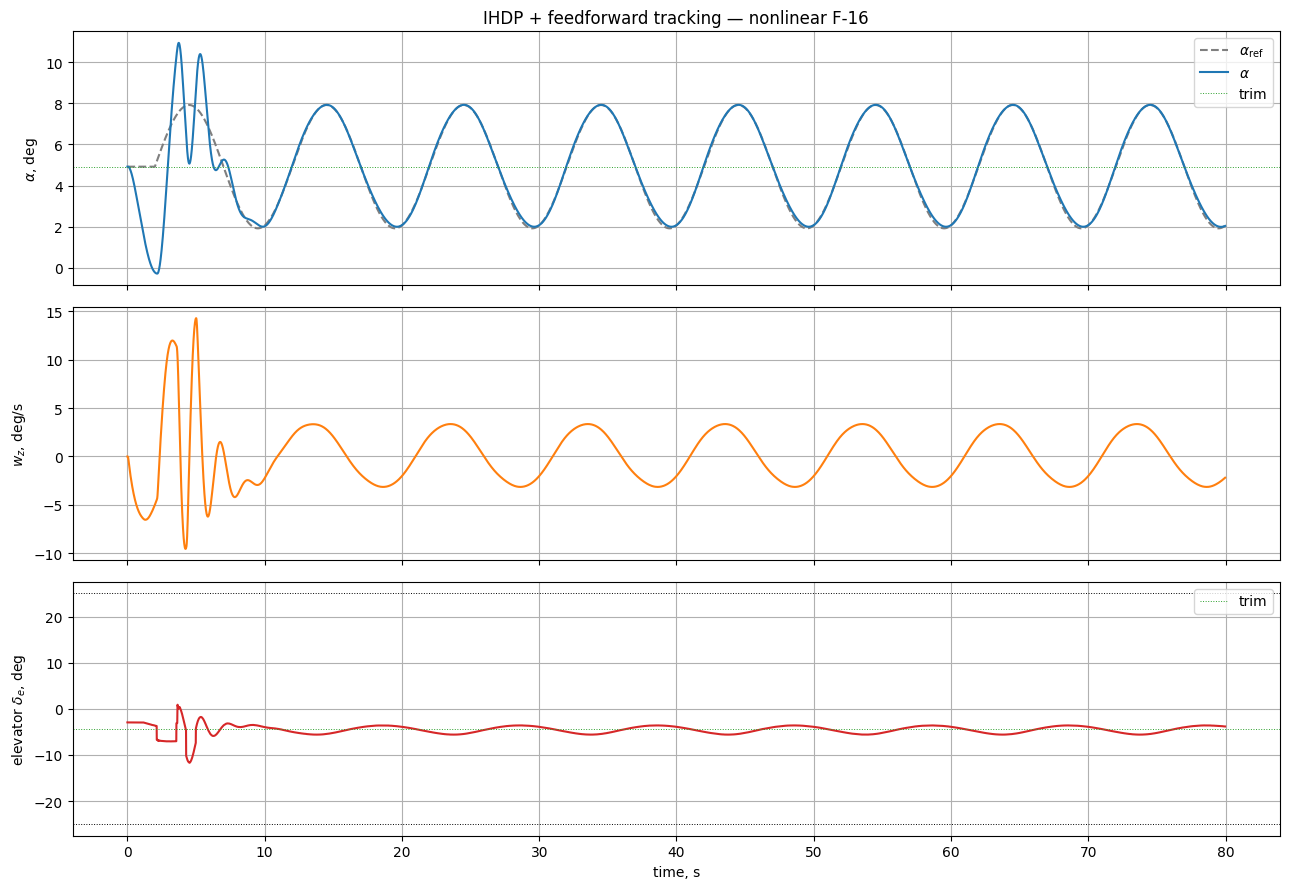
Late-half metrics (40 s → 80 s, after the agent has settled):
| Metric | Value |
|---|---|
| Mean absolute error | 0.053° (1.77 % of amplitude) |
| RMS error | 0.074° |
| Max abs error | 0.174° (5.81 % of amplitude) |
8. Ablation — what each ingredient buys you
Running the same simulation with increasingly-stripped configurations:
| Configuration | Late MAE |
|---|---|
| No FF, IHDP only (Q=8) | 1.91° |
| FF lookahead only (Q=8) | 0.67° |
| FF lookahead + gain (Q=8) | 0.22° |
| FF lookahead + gain (Q=200) | 0.053° |
The phase-compensating lookahead does most of the work. The amplitude gain closes the remaining undershoot. The higher Q is only useful once the residual is already small.
Notes
- Why the gain helps. The static FF assumes equilibrium; for a moving reference the elevator must overshoot the static target by exactly the amount needed to accelerate α. The optimal gain depends on the reference frequency; for slower references it approaches 1.0.
- NN_initial sweep. IHDP is sensitive to weight initialisation. A sweep over
NN_initial ∈ [1, 100]withQ=200, lr=2gave best MAE 0.049° (seed 47), median ~0.12°, and ~17 seeds diverged. Picking a seed is part of IHDP tuning — re-sweep if you change the reference. - Switching integrator. Use
integrator="rk4"for higher numerical fidelity on larger reference amplitudes. For this 3° test the difference is marginal. - Stronger reference. Amplitudes up to 5–8° stay inside the FF curve range \([-12°, 17°]\); reduce
ff_gainslightly (toward 1.4) and IHDP will compensate a larger nonlinear residual.