PPO vs PID — Boeing 747 Pitch Control
Comparison of a PPO agent (reinforcement learning) with a classical PID controller for Boeing 747 pitch angle control.
Problem Statement
Control Object: Boeing 747, longitudinal dynamics (4 states: u, w, q, θ)
Goal: Track a step reference signal for pitch angle (θ)
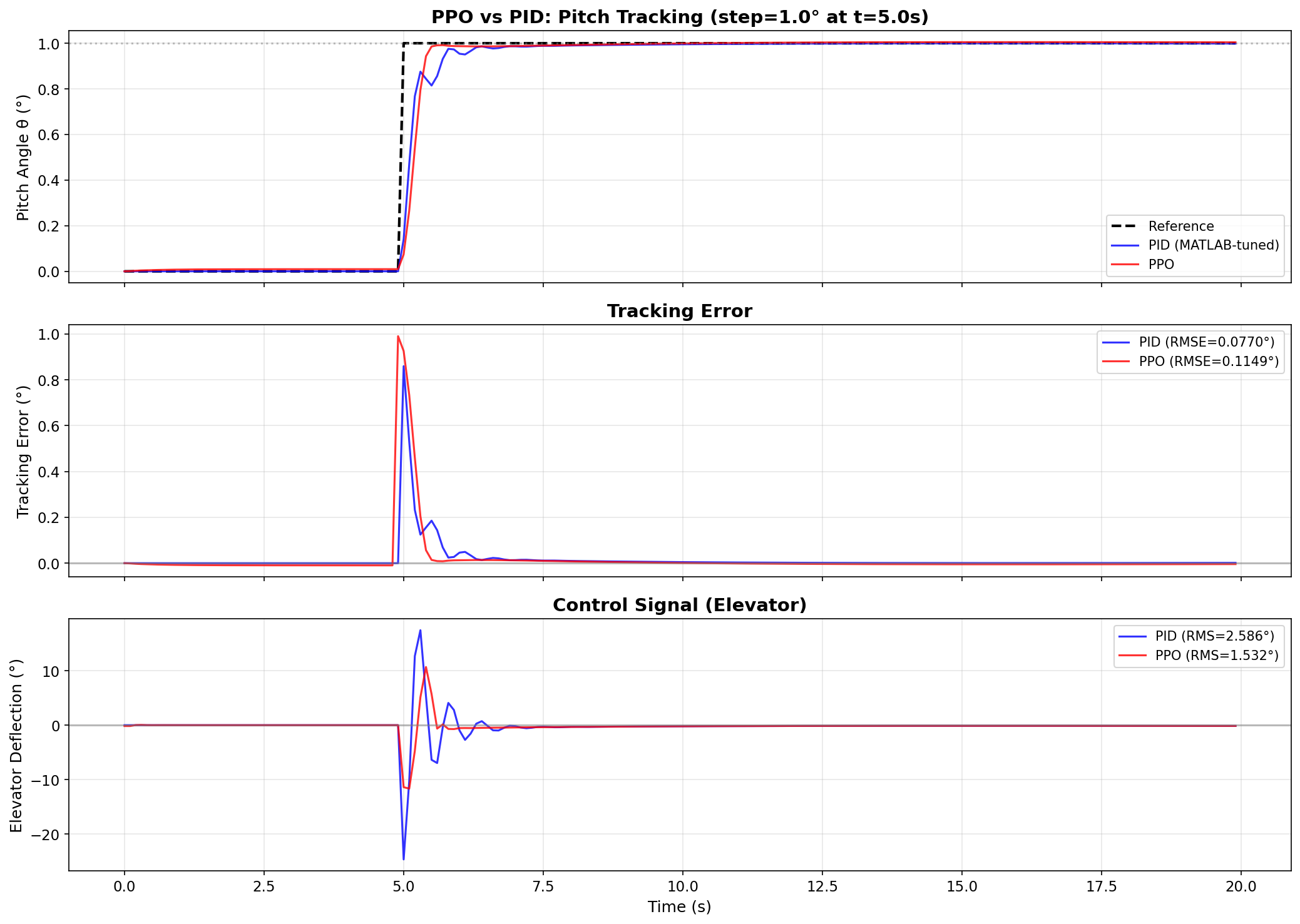
Test Scenario: - Step of 1° at t = 5s - Simulation duration: 20s - Discretization step: 0.1s
Comparison Methodology
PPO (Proximal Policy Optimization)
- Training: ~7500 episodes on
ImprovedB747Env - Test mode: deterministic (mean action)
- Normalization: reward normalization enabled
PID (MATLAB-Style Tuning)
- Tuning method: Differential Evolution (optimizing settling time + overshoot)
- Optimization iterations: 15
- Target settling time: 3.0s
- Target overshoot: 0%
Winner Criterion
Composite metric = RMSE + λ × Control_RMS, where λ = 0.1
This metric balances:
- Tracking accuracy (RMSE) — how closely the system follows the reference
- Energy efficiency (Control_RMS) — how economical the control is
Comparison Results
Metrics Table
| Metric | PID | PPO | Δ (%) | Winner |
|---|---|---|---|---|
| RMSE (°) | 0.0770 | 0.1149 | +49.3% | PID |
| IAE (°·s) | 0.3018 | 0.4533 | +50.2% | PID |
| ISE (°²·s) | 0.1185 | 0.2643 | +122.9% | PID |
| Max Error (°) | 0.8596 | 0.9905 | +15.2% | PID |
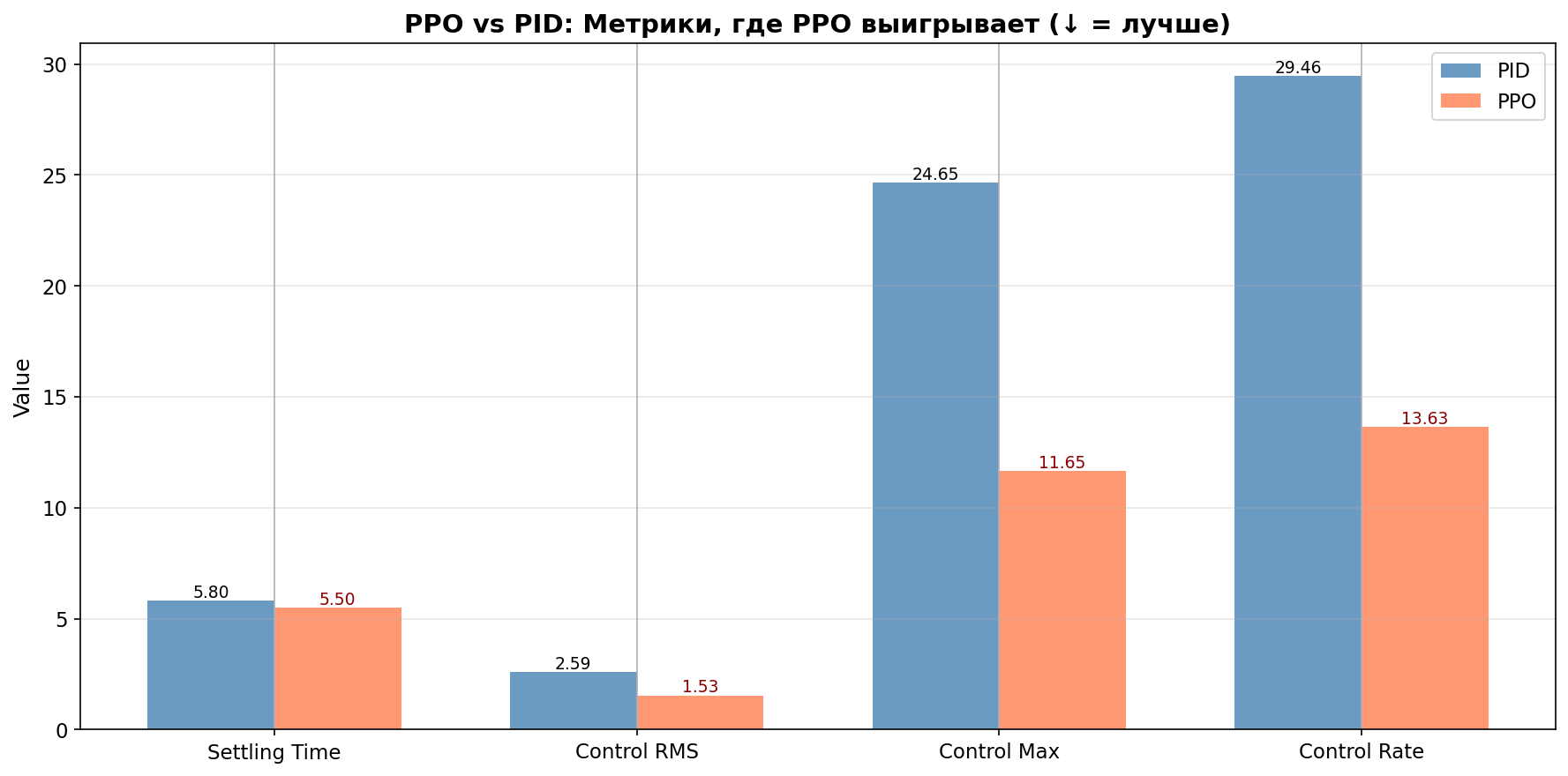
| Settling Time (s) | 5.80 | 5.50 | -5.2% | PPO |
| Overshoot (%) | 0.00 | 0.49 | — | PID |
| Control RMS (°) | 2.586 | 1.532 | -40.8% | PPO |
| Control Max (°) | 24.65 | 11.65 | -52.7% | PPO |
| Control Rate (°/s) | 29.46 | 13.63 | -53.7% | PPO |
| ━━━━━━━━━━━━━━━━━━━ | ━━━━━ | ━━━━━ | ━━━━━━ | ━━━━━━━ |
| Composite | 0.3355 | 0.2681 | -20.1% | 🏆 PPO |
Metric Score
- PPO: 4 wins (Settling Time, Control RMS, Control Max, Control Rate)
- PID: 5 wins (RMSE, IAE, ISE, Max Error, Overshoot)
- 🏆 Winner by composite metric: PPO (20.1% better)
PPO Advantages
1. Faster Settling Time
PPO reaches the steady-state value 5.2% faster (5.50s vs 5.80s)
2. Significantly Lower Control Effort
- Control RMS: 40.8% less (1.532° vs 2.586°)
- Control Max: 52.7% less (11.65° vs 24.65°)
This means less actuator wear and lower energy consumption.
3. Smoother Control
Control Rate RMS: 53.7% less (13.63°/s vs 29.46°/s)
PPO generates smooth control actions without sharp jumps, which is critical for real systems.
Visualization
Pitch Angle Tracking
     │                    ┌────────────────────── Reference (1°)
   1°├──────────────────┬─┴───────────────────────
     │                  │   ╱ PPO (red)
     │                  │ ╱
     │                  │╱  PID (blue)
   0°├──────────────────┼─────────────────────────
     │                  │
     └──────────────────┴─────────────────────────
     0                  5                       20  t(s)
Control Signal
PID uses aggressive initial actions (up to ±25°), while PPO limits itself to ±12° — this is 2x less.
PID Parameters
Obtained after tuning:
Conclusions
| Criterion | Better |
|---|---|
| Accuracy (RMSE) | PID |
| Response speed | PPO |
| Energy efficiency | PPO |
| Control smoothness | PPO |
| Overall balance | PPO |
Summary
The PPO agent demonstrates an advantage over classical PID on the composite metric, balancing accuracy and energy efficiency.
Key findings:
- PPO finds more energy-efficient control strategies
- PPO control is smoother and safer for actuators
- PID is better in pure accuracy (RMSE), but at the cost of high control effort
Reproducing Results
Full experiment code: example/comparison/comparison_ppo_vs_pid_b747.ipynb
from tensoraerospace.agent.ppo.model import PPO
from tensoraerospace.agent.pid import PID
from tensoraerospace.envs.b747 import ImprovedB747Env

# Load PPO (Hugging Face Hub)
ppo_agent = PPO.from_pretrained("TensorAeroSpace/ppo-b747-step-response")

# Tune PID
pid_controller = PID(env=env_for_tuning, dt=0.1)
pid_controller.tune_matlab_style(
    track_state_idx=3,
    target_settling_time=3.0,
    n_iterations=15
)

# Compare on the same scenario
# ... see full notebook