Recipe 06 — Online-adaptive agents
Deploy IHDP, IM-GDHP, ET-DHP, AA-INDI, or iADP. All five share the same three-step lifecycle: warm-start → predict/learn loop → save/reload. This recipe gives you the skeleton and points at the worked notebook for each agent.
Related. Recipe 04 (decision tree) · iADP · AA-INDI · IHDP · IM-GDHP · ET-DHP.
The three-step lifecycle
- Warm-start the incremental model (and the kernel matrix, for iADP) from a short offline identification.
- Step-wise online loop —
agent.predict(x, ref, k)→env.step(u)→agent.learn(x_next, ref, k). - Save / reload at any moment; the saved state is bit-identical on reload (Recipe 08).
No training phase in the deep-RL sense. The "learning" happens inside learn() every control tick.
Step 1 — Warm-start F̃, G̃ via a short PE excitation
The one trap all five agents share: they depend on a non-trivial control-effectiveness estimate G̃. With G̃ ≈ 0:
- INDI-style (AA-INDI):
G_pinv = pinv(0)explodes — actuator saturates. - LQR-style (iADP):
γ·G^T P Xvanishes — no control applied.
Solution. 300-step multi-sine, fit scalar G via LS:
env_pe = make_env(300); obs, _ = env_pe.reset()
wz_hist, u_hist = [float(obs[1])], [0.0]
for t in range(300):
    u = 2.0*math.sin(2*math.pi*0.7*t*dt) + 1.0*math.sin(2*math.pi*1.5*t*dt)
    obs, *_ = env_pe.step(np.array([u]))
    wz_hist.append(float(obs[1])); u_hist.append(float(u))

dwz, du = np.diff(wz_hist), np.diff(u_hist)
A_pe = np.column_stack([dwz[:-1], du[:-1]])
F_wz, G_wz = np.linalg.lstsq(A_pe, dwz[1:], rcond=None)[0]

F_init = np.array([[F_wz, 0.0], [0.0, 1.0]])   # reference row stationary
G_init = np.array([[G_wz], [0.0]])             # elevator drives only wz row
On the nonlinear F-16 you should get F_wz ≈ 1.00, G_wz ≈ -0.0014 (per ° elevator, discrete-time).
Step 2 — (iADP only) DARE warm-start for P̃
The single biggest accuracy win after the (Q, R, γ) tune:
from scipy.linalg import solve_discrete_are

Q, R, gamma = 30_000.0, 0.1, 0.9
Q_aug = Q * np.array([[1.0, -1.0], [-1.0, 1.0]])
P_init = solve_discrete_are(
    np.sqrt(gamma) * F_init, np.sqrt(gamma) * G_init,
    Q_aug, np.array([[R]]),
)
See the iADP F-16 example for the full story (why the discount needs the √γ substitution, why it beats ad-hoc block initials).
Step 3 — Step loop
Identical for all five agents:
agent = IADPAgent(n_state=1, n_control=1, config=cfg)   # or AAINDIAgent, IHDPAgent, …
env.reset()

for k in range(n_steps):
    obs = env.get_state()
    u = agent.predict(obs[controlled_channels], ref[:, k], k)
    obs, *_ = env.step(u)
    agent.learn(obs[controlled_channels], ref[:, k], k)
predict(obs, ref, k) returns the commanded action and caches state for learn(). learn(next_obs, ref, k) does the RLS step and, on stride, the policy update.
Expected behaviour (iADP on nonlinear F-16, 0.12 Hz sinusoid):
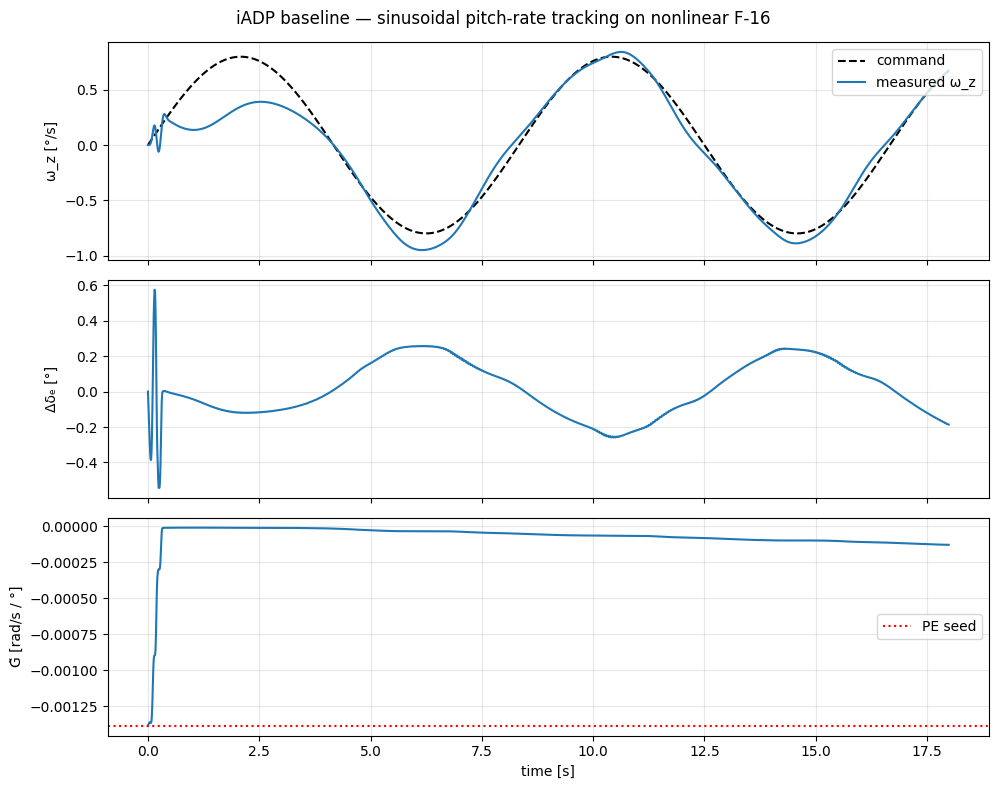
The measured ω_z tracks the command to within ~12 % of amplitude (0.09 °/s RMSE on a 0.8 °/s sinusoid). Elevator command stays well inside ±0.5°. G̃ drifts from the PE seed toward the locally valid gain.
Step 4 — Save / reload
run_dir = agent.save('./checkpoints')
restored = IADPAgent.from_pretrained(run_dir)
agent.publish_to_hub('me/my-iadp', folder_path=run_dir, access_token='hf_…')
Details in Recipe 08.
When to pick which
| Scenario | Pick |
|---|---|
| Abrupt actuator damage during flight | AA-INDI — VFF-RLS contracts forgetting factor on large residuals, fastest abrupt-fault recovery. |
| Interpretable LQT cost, few hyperparams | iADP — (Q, R, γ) knobs + DARE warm-start + soft-update blend. |
Neural actor with dual critic (J, λ) |
IM-GDHP — richer critic, needs more compute. |
| Event-triggered updates for embedded | ET-DHP — Lipschitz-based trigger rule. |
| Classical ADP | IHDP — historical baseline. |
Tuning pointers
gamma_rls— closer to 1 means longer memory. Start at0.995for unnoisy sim;0.9999for noisy real-world.phi_init— initial RLS covariance. Default1.0is safe. Too small → slow adapt; too large → noisy first ticks.- (iADP)
policy_eval_regularization— scale with state magnitude². Default1e-4for O(1) states; for rad/s states use1e-10. - (iADP)
policy_eval_blend—0.1removes the per-LS-tick sawtooth on the elevator trace.
Fault-tolerance in practice
Online-adaptive agents recover from plant changes only when the input keeps them excited. A constant reference yields no Δx/Δu data for the RLS. Mitigate with a small command dither, or freeze the RLS (gamma_rls = 1.0) when the residual is quiet.
See Recipe 09 for a head-to-head iADP-vs-AA-INDI walkthrough with an actual 50 % elevator loss.
Where to go next
- Recipe 07 — Optuna hyperparameter search — automate the tuning.
- Recipe 08 — Save/load/publish to HuggingFace — the persistence contract in depth.
- Recipe 09 — Fault-tolerance — comparing adaptive agents on a common fault profile.