Recipe 05 — Training a deep-RL agent end-to-end
Step-by-step skeleton of a PPO / SAC / DSAC run on one of the library's envs. We point to the three complete worked notebooks already shipped in the repo, and show the short version you can paste into a new script.
Related. Recipe 04 to pick which family; Recipe 07 for tuning; Recipe 08 for publishing.
The five steps
- Prepare the training env (
use_reward=True). - Construct the agent with hyperparameters.
- Train for
n_episodesrollouts. - Evaluate deterministically on a held-out reference.
- Save / publish.
Step 1 — Training env
import gymnasium as gym
import numpy as np

import tensoraerospace  # registers envs
from tensoraerospace.utils import generate_time_period
from tensoraerospace.signals.standard import unit_step

dt = 0.01
tp = generate_time_period(tn=20, dt=dt)

def make_train_env():
    ref = np.reshape(unit_step(tp=tp, degree=5, time_step=2.0, output_rad=True), (1, -1))
    return gym.make(
        'LinearLongitudinalF16-v0',
        number_time_steps=len(tp),
        use_reward=True,                  # ← required for RL
        initial_state=[[0], [0], [0]],
        reference_signal=ref,
        state_space=['theta', 'alpha', 'q'],
        output_space=['theta', 'alpha', 'q'],
        tracking_states=['alpha'],
    )
Tip. Randomise initial_state and step time across episodes inside make_train_env; agents trained on a single trajectory overfit fast.
Step 2 — Construct the agent
from tensoraerospace.agent.ppo import PPO

agent = PPO(
    env=make_train_env(),
    gamma=0.99,
    max_episodes=200,
    rollout_len=2048,
    clip_pram=0.2,
    actor_lr=1e-3,
    critic_lr=5e-3,
    seed=0,
)
SAC and DSAC take the same positional env= and similar hyperparameters. See the agent pages under Agents for full knob lists.
Step 3 — Train
The simplest path:
Training on the F-16 from scratch is unforgiving — the reward landscape is flat for most of the parameter space and entropy collapses before the policy has explored. The most reliably-converged deep-RL demo in the repo is DSAC on the normalised B747, where the reward is denser and the action space pre-normalised:
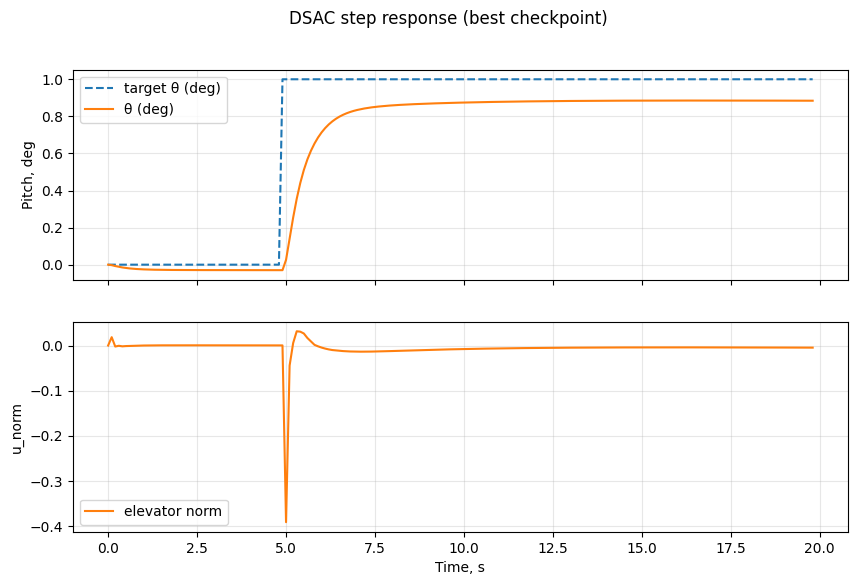
That plot is the eval output of eval_dsac_b747_step_response.ipynb, evaluating an agent trained for ~1000 episodes with train-dsac-b747-step-response.py. Reproducing it yourself needs ~30 min on a CPU; a CUDA GPU cuts that to ~5 min.
If SAC / PPO don't converge for your env, the usual culprits are:
- Reward too sparse. Shape a dense tracking reward like
-||y - y_r||²instead of thresholded signals. - Action not normalised. The
_improvedenvs (ImprovedB747-v0, etc.) pre-normalise the action to[-1, 1]. Prefer them when you can. - Training horizon too short.
max_episodes = 30in the PPO default gets you a warm-up, not a policy. Raise to 200+ for anything non-trivial.
Step 4 — Evaluate
Hold out a reference the agent hasn't seen:
eval_env = make_eval_env()               # different step time or amplitude
obs, _ = eval_env.reset()
returns = 0.0
for _ in range(len(tp) - 2):
    action = agent.select_action(obs, deterministic=True)
    obs, r, terminated, truncated, _ = eval_env.step(action)
    returns += r
print(f'eval return: {returns:.2f}')
Use tensoraerospace.benchmark.function for overshoot, settling_time, static_error so agents are comparable.
Step 5 — Save / reload
agent.save('./checkpoints/ppo_f16')
# later
from tensoraerospace.agent.ppo import PPO
agent2 = PPO.load('./checkpoints/ppo_f16', env=make_eval_env())
For the five online-adaptive agents (IHDP, IM-GDHP, ET-DHP, AA-INDI, iADP) the persistence API is richer (full HuggingFace Hub round-trip) — see Recipe 08.
Worked notebooks to copy from
| Task | Notebook |
|---|---|
| DSAC on B747 step response (source of plot above) | example/agent/dsac/example-dsac-b747.md |
| DSAC on B747 sinusoid tracking | example/agent/dsac/train-dsac-b747-tracking.md |
| PPO on B747 (normalised env) | example/reinforcement_learning/deep_rl/example_a2c_b747_improved.ipynb and adjacent PPO notebooks |
| SAC on linear F-16 | example/agent/sac/example-sac-f16.md — slower to converge, useful for architecture reference |
| SAC on B747 | example/agent/sac/example-sac-b747.md |
Pitfalls
- Training signal is too narrow. Always randomise the reference across episodes.
- Episode length =
number_time_steps - 2. The env pads two ticks at the end. - Action magnitude mismatch. PPO/SAC output normalised [-1, 1]; env wraps to physical units automatically. If you write a custom agent, respect
env.action_space.low / high.
Where to go next
- Recipe 06 — Online-adaptive agents — when you can't afford full training.
- Recipe 07 — Optuna hyperparameter search — automate the tuning.
- Recipe 08 — Save/load/publish to HuggingFace — ship the trained model.