Soft Actor‑Critic (SAC)
SAC is an off-policy actor-critic with entropy maximization: it learns a stochastic policy while increasing expected reward and entropy (exploration). Our implementation employs twin Q-networks, a target critic, Gaussian/deterministic policy options, a replay buffer, soft updates, and optional automatic entropy tuning.
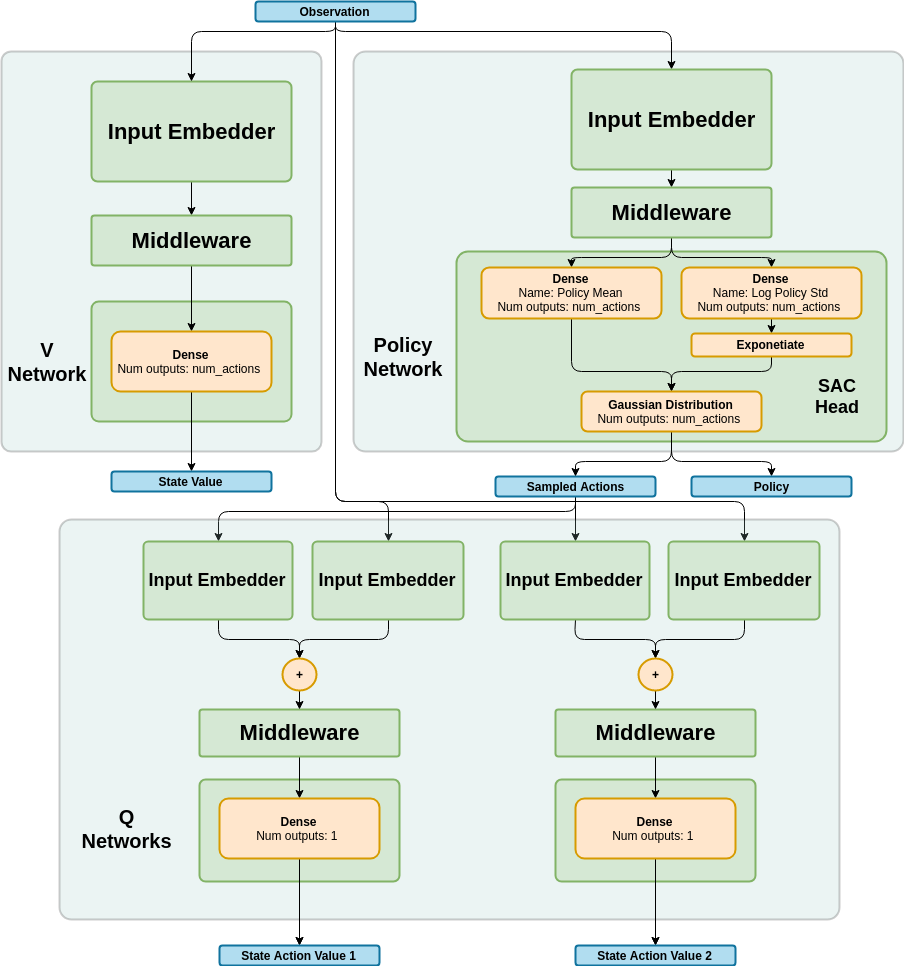
Components
- Twin Q-networks:
QNetwork(state, action) -> (Q1, Q2)plus targetcritic_target - Policy:
GaussianPolicy(default) orDeterministicPolicy(no entropy term) - Replay buffer:
ReplayMemoryfor mini-batch sampling - Soft target update:
soft_update(target, source, tau) - Automatic entropy tuning: optimizes
alphatoward \(H_{\text{target}} = -\dim(\mathcal{A})\)
Theory (as implemented)
- Soft Q target (double Q + entropy):
-
Critic update (MSE to target): \(\mathcal{L}_{Q_i} = \mathbb{E}[(Q_i(s,a) - Q_{\text{targ}})^2]\)
-
Policy update (reparameterization):
- Automatic \(\alpha\) tuning (optional):
Quick start
import gymnasium as gym
from tensoraerospace.agent.sac.sac import SAC

env = gym.make('LinearLongitudinalF16-v0', number_time_steps=2000)
agent = SAC(env,
            updates_per_step=1,
            batch_size=64,
            memory_capacity=100000,
            lr=3e-4,
            gamma=0.99,
            tau=0.005,
            alpha=0.2,
            policy_type='Gaussian',
            target_update_interval=1,
            automatic_entropy_tuning=True,
            hidden_size=256,
            device='cpu')

agent.train(num_episodes=100)
agent.save('./runs')
Tip
For continuous action spaces keep GaussianPolicy with automatic_entropy_tuning=True to stabilize exploration.
Unified training interface
All TensorAeroSpace RL agents share a common train() signature defined on
BaseRLModel:
def train(
    self,
    num_episodes: int = 100,
    *,
    max_steps: Optional[int] = None,
    save_best: bool = False,
    save_path: Optional[str] = None,
    verbose: bool = True,
    **kwargs,
) -> dict
For SAC the algorithm-specific options accepted via **kwargs are:
save_best_with_gradients(bool): include optimizer gradients in best-model checkpoints.
Example:
stats = agent.train(
    num_episodes=100,
    max_steps=500,
    save_best=True,
    save_path='./runs/sac_best',
)
print(stats['best_reward'], len(stats['episode_rewards']))
Practical tips
- Increase
batch_sizeandmemory_capacityfor steadier gradients - Choose
tauaround 0.005–0.02 for soft target updates - With a deterministic policy set
alpha=0and disable auto tuning - When using
DeterministicPolicywithaction_space=None, note thataction_scaleandaction_biasare nowtorch.Tensorvalues (not Python floats)
Gymnasium 5-tuple API
This implementation uses the modern Gymnasium 5-tuple step API internally:
If you are migrating from older code that used the 4-tuple API (next_state, reward, done, info = env.step(action)), ensure your environment is compatible with Gymnasium and returns the 5-tuple.
API reference
SAC(env, updates_per_step=1, batch_size=32, memory_capacity=10000000, lr=0.0003, policy_lr=0.0003, gamma=0.99, tau=0.005, alpha=0.2, policy_type='Gaussian', target_update_interval=1, automatic_entropy_tuning=False, hidden_size=256, device='cpu', verbose_histogram=False, seed=42, log_dir=None, log_every_updates=1, wandb_project=None, wandb_entity=None, wandb_run_name=None, wandb_tags=None, wandb_config=None)

Bases: BaseRLModel
Soft Actor-Critic (SAC) algorithm for reinforcement learning.
Parameters:
| Name | Type | Description | Default |
|---|---|---|---|
env
|
Any
|
Environment (Gym API compatible). |
required |
updates_per_step
|
int
|
Updates per interaction step. |
1
|
batch_size
|
int
|
Mini-batch size. |
32
|
memory_capacity
|
int
|
Replay buffer capacity. |
10000000
|
lr
|
float
|
Learning rate. |
0.0003
|
gamma
|
float
|
Discount coefficient. |
0.99
|
tau
|
float
|
Soft update coefficient for target network. |
0.005
|
alpha
|
float
|
Entropy coefficient (for policy). |
0.2
|
policy_type
|
str
|
Policy type ("Gaussian" or "Deterministic"). |
'Gaussian'
|
target_update_interval
|
int
|
Target network update interval. |
1
|
automatic_entropy_tuning
|
bool
|
Automatic entropy tuning. |
False
|
hidden_size
|
int
|
Hidden layer size of networks. |
256
|
device
|
str | device
|
Device for computations. |
'cpu'
|
verbose_histogram
|
bool
|
Histogram logging in TensorBoard. |
False
|
seed
|
int
|
Random number generator seed. |
42
|
Attributes:
| Name | Type | Description |
|---|---|---|
critic |
Critic network. |
|
critic_optim |
Optimizer for updating critic weights. |
|
critic_target |
Target critic network. |
|
policy |
Union[GaussianPolicy, DeterministicPolicy]
|
Agent policy. |
policy_optim |
Optimizer for updating policy weights. |
Initialize SAC agent, networks, replay buffer, and optimizers.
select_action(state, evaluate=False)

Select action based on current state.
Parameters:
| Name | Type | Description | Default |
|---|---|---|---|
state
|
ndarray
|
Current state of the agent. |
required |
evaluate
|
bool
|
Evaluation mode flag. |
False
|
Returns:
| Name | Type | Description |
|---|---|---|
action |
ndarray
|
Selected action. |
select_action_batch(states, *, evaluate=False, return_tensor=False)

Select actions for a batch of states.
This is the recommended API for vectorized environments.
Parameters:
| Name | Type | Description | Default |
|---|---|---|---|
states
|
Union[ndarray, Tensor]
|
Batch of states of shape (N, obs_dim). Can be numpy or torch. |
required |
evaluate
|
bool
|
If True, use deterministic evaluation action. |
False
|
return_tensor
|
bool
|
If True, return a torch Tensor on agent device, else numpy. |
False
|
Returns:
| Type | Description |
|---|---|
Union[ndarray, Tensor]
|
Actions with shape (N, act_dim). |
update_parameters(memory, batch_size, updates)

Update network parameters based on a mini-batch from memory.
Parameters:
| Name | Type | Description | Default |
|---|---|---|---|
memory
|
ReplayMemory
|
Memory for storing transitions. |
required |
batch_size
|
int
|
Mini-batch size. |
required |
updates
|
int
|
Number of updates. |
required |
Returns:
| Name | Type | Description |
|---|---|---|
qf1_loss |
float
|
Loss value for the first Q-network. |
qf2_loss |
float
|
Loss value for the second Q-network. |
policy_loss |
float
|
Loss value for the policy. |
alpha_loss |
float
|
Loss value for the alpha coefficient. |
alpha_tlogs |
float
|
Value of the alpha coefficient. |
train(num_episodes=1, *, max_steps=None, save_best=False, save_path=None, verbose=True, **kwargs)

Train SAC for the given number of episodes (unified interface).
Parameters:
| Name | Type | Description | Default |
|---|---|---|---|
num_episodes
|
int
|
Number of training episodes. |
1
|
max_steps
|
Optional[int]
|
Optional per-episode step cap. |
None
|
save_best
|
bool
|
If True, save a checkpoint whenever a new best episode reward is reached. |
False
|
save_path
|
Optional[str]
|
Destination for best-reward checkpoints. |
None
|
verbose
|
bool
|
If True, show a tqdm progress bar. |
True
|
**kwargs
|
Any
|
Algorithm-specific options. Recognized keys:
|
{}
|
Returns:
| Name | Type | Description |
|---|---|---|
dict |
dict
|
Training metrics with keys |
dict
|
|
train_vector(*, total_steps, warmup_steps=10000, log_every=2000, reward_window=200, save_best=False, save_path=None, save_best_with_gradients=False)

Train SAC on a vectorized (batched) environment.
Expected env API (Gymnasium-like, batched): reset() -> (obs[N, obs_dim], info) step(action[N, act_dim]) -> (obs, reward[N], terminated[N], truncated[N], info)
Notes
- If env has auto_reset=True, it may reset done envs internally. We still use terminated/truncated from the current step for episode accounting.
- For replay bootstrap we use terminated only (not truncated), consistent with train().
close()

Flush and close TensorBoard writer.
get_param_env()

Return serializable configuration of environment and policy.
save(path=None, save_gradients=False)

Save PyTorch model to the specified directory.
Parameters:
| Name | Type | Description | Default |
|---|---|---|---|
path
|
str | Path | None
|
Save path. If None, creates a folder with current date and time in the working directory. |
None
|
save_gradients
|
bool
|
Save optimizer states for continuing training (Adam moments, etc.). |
False
|
Returns:
| Type | Description |
|---|---|
None
|
None |
__load(path, load_gradients=False)
classmethod

Load a SAC agent from checkpoint folder.
from_pretrained(repo_name, access_token=None, version=None, load_gradients=False)
classmethod

Load pretrained model from local directory or Hugging Face.
Parameters:
| Name | Type | Description | Default |
|---|---|---|---|
repo_name
|
str
|
Path to local folder with weights or repository name in format "namespace/repo_name" on Hugging Face. |
required |
access_token
|
Optional[str]
|
Access token for private HF repository. |
None
|
version
|
Optional[str]
|
Revision/branch/tag of HF repository. |
None
|
load_gradients
|
bool
|
Load optimizer states for continuing training. |
False
|
Returns:
| Name | Type | Description |
|---|---|---|
SAC |
SAC
|
Initialized agent. |
ReplayMemory(capacity, seed)

Replay buffer for off-policy reinforcement learning algorithms.
Parameters:
| Name | Type | Description | Default |
|---|---|---|---|
capacity
|
int
|
Maximum number of transitions to store. |
required |
seed
|
int
|
Random seed used for sampling. |
required |
Attributes:
| Name | Type | Description |
|---|---|---|
capacity |
int
|
Maximum capacity. |
buffer |
List
|
Stored transitions. |
position |
int
|
Current write position. |
Initialize replay buffer with fixed capacity and seed.
Parameters:
| Name | Type | Description | Default |
|---|---|---|---|
capacity
|
int
|
Maximum number of transitions. |
required |
seed
|
int
|
Random seed for sampling. |
required |
push(state, action, reward, next_state, done)

Add a transition to the replay buffer.
Parameters:
| Name | Type | Description | Default |
|---|---|---|---|
state
|
ndarray
|
Current state. |
required |
action
|
ndarray
|
Action taken. |
required |
reward
|
Union[float, ndarray]
|
Reward received. |
required |
next_state
|
ndarray
|
Next state. |
required |
done
|
Union[bool, float]
|
Episode termination flag (bool) or mask (0.0/1.0). |
required |
sample(batch_size)

Sample a batch of transitions.
Parameters:
| Name | Type | Description | Default |
|---|---|---|---|
batch_size
|
int
|
Batch size. |
required |
Returns:
| Type | Description |
|---|---|
ndarray
|
Tuple[np.ndarray, np.ndarray, np.ndarray, np.ndarray, np.ndarray]: |
ndarray
|
|
__len__()

Return the current number of stored transitions.
Returns:
| Name | Type | Description |
|---|---|---|
int |
int
|
Buffer size. |
save_buffer(env_name, suffix='', save_path=None)

Save the replay buffer to disk.
Parameters:
| Name | Type | Description | Default |
|---|---|---|---|
env_name
|
str
|
Environment name used in the default path. |
required |
suffix
|
str
|
Optional filename suffix. |
''
|
save_path
|
str
|
Optional explicit save path. If None, a default
path under |
None
|
load_buffer(save_path)

Load a replay buffer from disk.
Parameters:
| Name | Type | Description | Default |
|---|---|---|---|
save_path
|
str
|
Path to a previously saved buffer. |
required |
ValueNetwork(num_inputs, hidden_dim)

Bases: Module
Neural network for value function approximation.
Parameters:
| Name | Type | Description | Default |
|---|---|---|---|
num_inputs
|
int
|
Number of input features. |
required |
hidden_dim
|
int
|
Hidden layers dimension. |
required |
Attributes:
| Name | Type | Description |
|---|---|---|
linear1 |
Linear
|
First linear layer. |
linear2 |
Linear
|
Second linear layer. |
linear3 |
Linear
|
Third linear layer. |
Initialize ValueNetwork.
Parameters:
| Name | Type | Description | Default |
|---|---|---|---|
num_inputs
|
int
|
Number of input features. |
required |
hidden_dim
|
int
|
Hidden layers dimension. |
required |
forward(state)

Forward pass of neural network.
Parameters:
| Name | Type | Description | Default |
|---|---|---|---|
state
|
Tensor
|
Input state tensor. |
required |
Returns:
| Type | Description |
|---|---|
Tensor
|
torch.Tensor: Output value tensor. |
QNetwork(num_inputs, num_actions, hidden_dim)

Bases: Module
Neural network for Q function evaluation.
Parameters:
| Name | Type | Description | Default |
|---|---|---|---|
num_inputs
|
int
|
Number of input features. |
required |
num_actions
|
int
|
Number of actions. |
required |
hidden_dim
|
int
|
Hidden layers dimension. |
required |
Attributes:
| Name | Type | Description |
|---|---|---|
linear1 |
Linear
|
First linear layer for Q1. |
linear2 |
Linear
|
Second linear layer for Q1. |
linear3 |
Linear
|
Third linear layer for Q1. |
linear4 |
Linear
|
First linear layer for Q2. |
linear5 |
Linear
|
Second linear layer for Q2. |
linear6 |
Linear
|
Third linear layer for Q2. |
Initialize twin Q-network architecture.
Parameters:
| Name | Type | Description | Default |
|---|---|---|---|
num_inputs
|
int
|
State dimension. |
required |
num_actions
|
int
|
Action dimension. |
required |
hidden_dim
|
int
|
Hidden layer width. |
required |
forward(state, action)

Forward pass for Q-value estimation.
Parameters:
| Name | Type | Description | Default |
|---|---|---|---|
state
|
Tensor
|
State tensor. |
required |
action
|
Tensor
|
Action tensor. |
required |
Returns:
| Type | Description |
|---|---|
Tuple[Tensor, Tensor]
|
Tuple[torch.Tensor, torch.Tensor]: |
GaussianPolicy(num_inputs, num_actions, hidden_dim, action_space=None)

Bases: Module
Gaussian policy used by SAC.
Parameters:
| Name | Type | Description | Default |
|---|---|---|---|
num_inputs
|
int
|
Number of input features. |
required |
num_actions
|
int
|
Number of actions. |
required |
hidden_dim
|
int
|
Hidden layer dimension. |
required |
action_space
|
Optional[Space]
|
Action space. Defaults to None. |
None
|
Attributes:
| Name | Type | Description |
|---|---|---|
linear1 |
Linear
|
First linear layer. |
linear2 |
Linear
|
Second linear layer. |
mean_linear |
Linear
|
Linear layer for mean value. |
log_std_linear |
Linear
|
Linear layer for log standard deviation. |
action_scale |
Tensor
|
Action scale. |
action_bias |
Tensor
|
Action bias. |
Initialize Gaussian policy network and action scaling.
Parameters:
| Name | Type | Description | Default |
|---|---|---|---|
num_inputs
|
int
|
State dimension. |
required |
num_actions
|
int
|
Action dimension. |
required |
hidden_dim
|
int
|
Hidden layer width. |
required |
action_space
|
Space | None
|
Optional gym space to derive scaling/bias. |
None
|
DeterministicPolicy(num_inputs, num_actions, hidden_dim, action_space=None)

Bases: Module
Deterministic policy used by SAC (e.g., for evaluation).
Parameters:
| Name | Type | Description | Default |
|---|---|---|---|
num_inputs
|
int
|
Number of input features. |
required |
num_actions
|
int
|
Number of actions. |
required |
hidden_dim
|
int
|
Hidden layer dimension. |
required |
action_space
|
Optional[Space]
|
Action space used to scale/bias actions. |
None
|
Attributes:
| Name | Type | Description |
|---|---|---|
linear1 |
Linear
|
First linear layer. |
linear2 |
Linear
|
Second linear layer. |
mean |
Linear
|
Linear layer producing the mean action. |
noise |
Tensor
|
Noise tensor for exploration. |
action_scale |
Tensor | float
|
Action scaling factor. |
action_bias |
Tensor | float
|
Action bias. |
Initialize deterministic policy network for SAC evaluation.
Parameters:
| Name | Type | Description | Default |
|---|---|---|---|
num_inputs
|
int
|
State dimension. |
required |
num_actions
|
int
|
Action dimension. |
required |
hidden_dim
|
int
|
Hidden layer width. |
required |
action_space
|
Space | None
|
Optional gym space to derive scaling/bias. |
None
|