Recipe 14 — AA-INDI on the nonlinear F-16
AA-INDI (Active-Adaptive Incremental Nonlinear Dynamic Inversion) pairs the classical INDI control law with VFF-RLS identification of the control-effectiveness matrix G and a lightweight sensor-filter stand-in. It's the library's strongest fault-tolerance baseline: the variable forgetting factor contracts under large residuals, so the identifier catches up with a halved elevator within a few hundred ms.
Agent docs. AA-INDI · Full notebook. example_aaindi_nonlinear_f16.ipynb · Related recipe. Recipe 09 — Fault-tolerance.
When to use AA-INDI
- Actuator-fault tolerance is a primary requirement (damaged surfaces, icing, jamming).
- You want an inverse-dynamics controller (INDI) without writing the full nonlinear model — just a warm-start
G. - You prefer a non-neural online controller that's easy to audit.
| Property | AA-INDI vs iADP |
|---|---|
| Control law | Pseudo-inverse of G̃, classical INDI |
| Adaptation trigger | Variable forgetting factor λ (contracts on fault) |
| Outer loop | PI on reference tracking error (optional) |
| Hyperparameters | ~10 knobs |
Step 1 — Minimal config
import numpy as np
from tensoraerospace.agent.aa_indi import AAINDIAgent, AAINDIConfig

cfg = AAINDIConfig(
    dt=0.01,
    # reference model — shapes the commanded rate before INDI inverts
    ref_wn=2.5,
    ref_zeta=0.9,
    # actuator limits (hard safety)
    u_magnitude_limit=15.0,
    u_rate_limit=60.0,
    # VFF-RLS: forgetting factor contracts under large residuals
    vff_forgetting_min=0.97,
    vff_forgetting_max=0.9999,
    vff_eps_sensitivity=0.1,
    vff_cov_init=1.0,
    # sensor filter (low-pass differentiator + bias estimator)
    sensor_cutoff_hz=15.0,
    bias_forgetting=0.995,
    enable_bias_correction=False,
    # warm-start of G; sign and order of magnitude matter
    G_init=np.array([[-0.5]]),
    # optional outer PI on reference tracking error
    ref_error_kp=0.6,
    ref_error_ki=0.0,
    seed=0,
)
The ref_error_kp / ref_error_ki knobs add an outer PI loop that closes steady-state tracking error — useful for rate commands that have non-zero steady-state.
Step 2 — Step loop
Identical to the other online-adaptive agents:
agent = AAINDIAgent(n_state=1, n_control=1, config=cfg)
env.reset()

for k in range(n_steps):
    obs = env.get_state()
    u = agent.predict(obs[controlled_channels], ref[:, k], k)
    obs, *_ = env.step(u)
    agent.learn(obs[controlled_channels], ref[:, k], k)
predict() applies the reference filter + INDI inversion + outer PI. learn() does the VFF-RLS update on (Δu, Δẏ) and the bias-estimator step.
Step 3 — Expected behaviour under a 50 % elevator fault
Classical AA-INDI demo: pitch-rate tracking with a 50 % elevator effectiveness loss injected at t = 10 s.
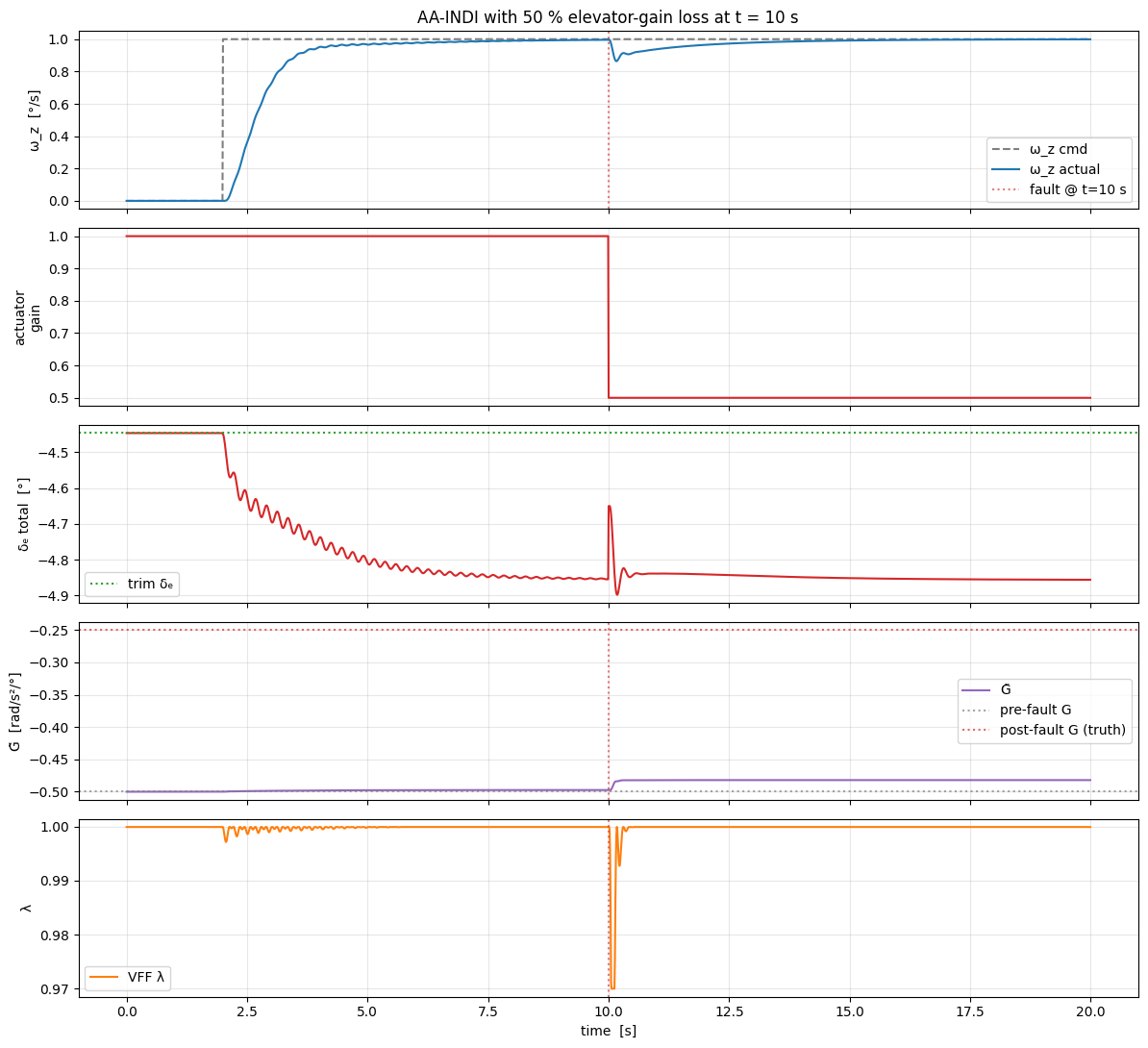
Key signatures to look for:
- ω_z keeps tracking through the fault event; small transient bump, then back on the command.
- λ (forgetting factor) contracts toward
vff_forgetting_minright after the fault — visible on the diagnostic trace of the full notebook. - G̃ re-identifies to the halved value within a few hundred ms.
Source: example_aaindi_nonlinear_f16.ipynb. Recipe 09 runs AA-INDI head-to-head against iADP on the same fault profile.
Step 4 — Save / load / publish to HuggingFace
run_dir = agent.save('./checkpoints')
restored = AAINDIAgent.from_pretrained(run_dir)
agent.publish_to_hub('me/my-aaindi', folder_path=run_dir, access_token='hf_…')
Mid-episode saves are bit-identical on reload — see Recipe 08.
Pitfalls
- Wrong sign of
G_init. INDI invertsG, so a sign flip drives the actuator the wrong way and the plant diverges. Check the PE-excitation warm-start gives you the sign you expect. - Persistent steady-state error on rate commands. Raise
ref_error_kp(0.3 → 0.8 is the typical range); add a bit ofref_error_kifor integral action. - Bias correction destabilises on noisy envs.
enable_bias_correction=Trueis off by default for the F-16 sim; turn on only if your sensor has a measurable DC bias.
Where to go next
- Recipe 09 — Fault-tolerance — head-to-head against iADP on the same fault profile.
- Recipe 11 — IHDP — neural-actor alternative with simpler hyperparameters.
- AA-INDI documentation — theory + full API.