ImprovedB747Env – Boeing 747 longitudinal pitch tracking (normalized, RL‑friendly)
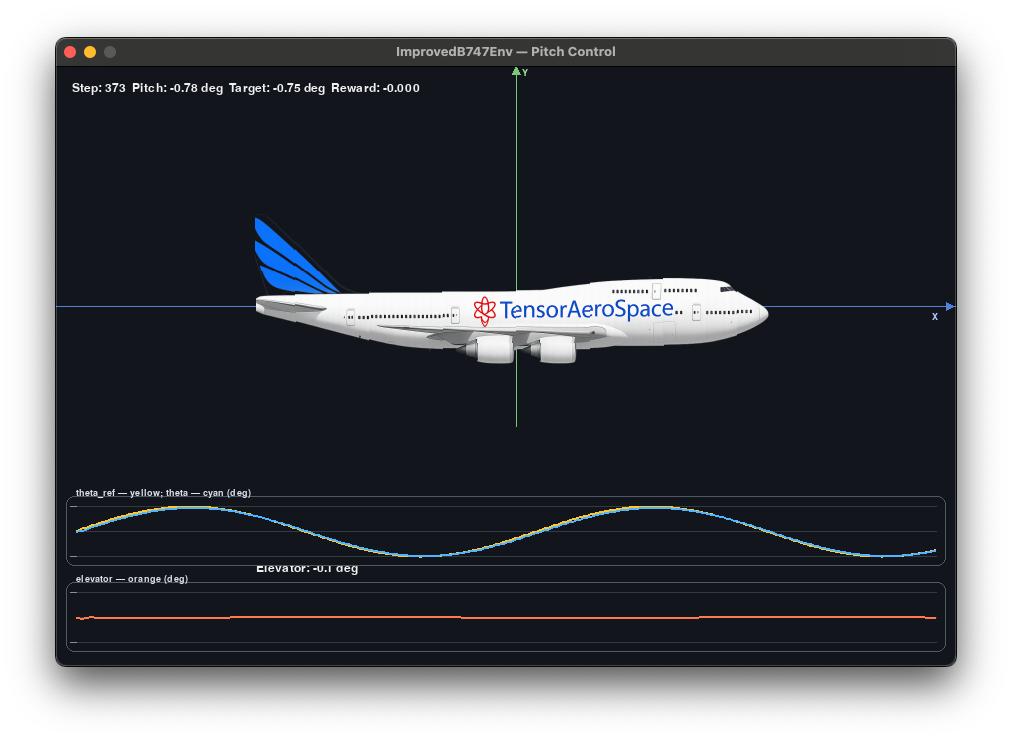
This page documents the ImprovedB747Env environment used for training and evaluating reinforcement learning controllers for the longitudinal channel of the Boeing 747. The environment provides a normalized observation and action interface, a shaped reward for precise and smooth pitch tracking, and realistic termination conditions.
The reference implementation lives in tensoraerospace/envs/b747.py (class ImprovedB747Env).
Summary
- Observation space: 4D, normalized to [-1, 1]
- Action space: 1D, normalized to [-1, 1] (elevator deflection command)
- Goal: track a time‑varying pitch reference while keeping control smooth and economical
- Reward: quadratic costs on pitch tracking error, pitch‑rate mismatch to reference dynamics, absolute input, input rate and input jerk (with scaling)
- Termination: exceeding safe pitch envelope or reaching time horizon
Observation and Action
Let \(\theta\) be the current pitch angle (rad), \(q\) the pitch rate (rad/s), and \(\theta_{ref}(t)\) the target pitch.
The observation at step \(t\) is a 4‑vector:
where
- \(\theta_{max} = 20^{\circ}\) (converted to rad internally),
- \(q_{max} = 5^{\circ}/\text{s}\) (converted to rad/s internally),
- \(u_{t-1}\in[-1,1]\) is the previously applied normalized elevator command.
Important: The observation vector is already normalized and ready to use. Index [0] contains the normalized pitch tracking error, which is directly usable for proportional control.
The action is a single normalized command \(u_t \in [-1,1]\). It maps to a physical elevator deflection (deg):
which is converted to radians before passing to the underlying model.
Reward function
The environment uses a shaped reward with five terms promoting accuracy and smoothness while penalizing excessive actuation. The per‑step reward is
with the default weights and scale:
Note: The implementation includes a cross-term weight \(w_{cross}\) (currently set to 0.0) for potential future use in coupling pitch and pitch-rate errors.
The error terms are defined as
where \(\dot\theta_{ref}(t)\) is a finite‑difference derivative of the reference pitch computed with the simulation time step \(\Delta t\). The input smoothness terms use
Notes:
- A larger \(w_\theta\) emphasizes precise pitch tracking.
- \(w_q\) damps response relative to the reference slope, reducing overshoot/oscillation.
- \(w_u, w_{\Delta}, w_{\Delta^2}\) regularize energy usage and command smoothness, suppressing chattering.
- The overall scale \(s\) keeps rewards in a compact numerical range for RL stability.
Termination and truncation
- Safety termination: if \(|\theta| > \theta_{max}\), the episode terminates early and a large penalty (\(-100\)) is applied at that step.
- Truncation: the episode truncates when the configured horizon (number of time steps) is reached.
Episode dynamics
At each step:
- The agent outputs \(u_t\in[-1,1]\).
- The environment clamps \(u_t\) to \([-1,1]\), maps it to \(\delta_e^{\circ}\), converts to rad and advances the internal aircraft model.
- The observation \(\mathbf{o}_{t+1}\) is built using normalized signals.
- The reward \(r_t\) is computed as above.
- Termination/truncation is checked.
Usage example
import numpy as np
from tensoraerospace.envs.b747 import ImprovedB747Env
from tensoraerospace.signals.standard import sinusoid_vertical_shift
from tensoraerospace.utils import generate_time_period, convert_tp_to_sec_tp

dt = 0.1
tn = 200
tp = generate_time_period(tn=tn, dt=dt)
tps = convert_tp_to_sec_tp(tp, dt=dt)
number_time_steps = len(tp)

# reference: smooth sinusoidal pitch in radians (amplitude 1 deg)
reference_signal = np.reshape(
    sinusoid_vertical_shift(
        tp=np.asarray(tps), frequency=0.05, amplitude=np.deg2rad(1.0), vertical_shift=0.0
    ),
    (1, -1),
)

# Initial state: [u, w, q, theta]
initial_state = np.array([[0], [0], [0], [0]], dtype=np.float32)

env = ImprovedB747Env(
    initial_state=initial_state,
    reference_signal=reference_signal,
    number_time_steps=number_time_steps,
    initial_elevator_deg=0.0,
    use_initial_action_on_first_step=True,
    dt=dt,
)
# Ensure model discretization matches the environment step
env.unwrapped.model.discretisation_time = dt

obs, info = env.reset()
done = False
while not done:
    # simple proportional control on normalized pitch error in [-1, 1]
    u = float(np.clip(2.0 * float(obs[0]), -1.0, 1.0))
    obs, reward, terminated, truncated, info = env.step(np.array([u], dtype=np.float32))
    done = bool(terminated or truncated)
Pretrained SAC agent example
Use a pretrained SAC agent from HuggingFace:
import numpy as np
from tensoraerospace.agent.sac import SAC
from tensoraerospace.envs.b747 import ImprovedB747Env
from tensoraerospace.signals.standard import sinusoid_vertical_shift
from tensoraerospace.utils import generate_time_period, convert_tp_to_sec_tp

# Build env (short, consistent with example)
dt = 0.1
tn = 200
tp = generate_time_period(tn=tn, dt=dt)
tps = convert_tp_to_sec_tp(tp, dt=dt)
reference_signal = np.reshape(
    sinusoid_vertical_shift(
        tp=np.asarray(tps), frequency=0.05, amplitude=np.deg2rad(1.0), vertical_shift=0.0
    ),
    (1, -1),
)
initial_state = np.array([[0], [0], [0], [0]], dtype=np.float32)
env = ImprovedB747Env(
    initial_state=initial_state,
    reference_signal=reference_signal,
    number_time_steps=len(tp),
    dt=dt,
    initial_elevator_deg=0.0,
    use_initial_action_on_first_step=True,
)
env.unwrapped.model.discretisation_time = dt

# Load agent and run one episode
agent = SAC.from_pretrained("TensorAeroSpace/sac-b747")
obs, info = env.reset()
done = False
ret = 0.0
while not done:
    action = agent.select_action(obs, evaluate=True)
    obs, reward, terminated, truncated, info = env.step(action)
    done = bool(terminated or truncated)
    ret += float(reward)
print(f"Return: {ret:.2f}")
Implementation hints
- The class overlays a simple HUD and (optionally) a 2D sprite in the renderer; this has no effect on the physics or reward.
- Observation normalization bounds (\(\theta_{max}, q_{max}\)) and elevator limits are defined inside the class and can be tuned if needed.
- Reward weights are exposed as instance attributes (
w_pitch,w_q,w_cross,w_action,w_smooth,w_jerk,reward_scale) and can be changed to match specific control objectives. - The internal state representation follows the order
[u, w, q, theta](SI units: m/s, m/s, rad/s, rad), but observations are normalized to[-1, 1].
References
tensoraerospace/envs/b747.py– full environment implementation- Boeing 747 longitudinal dynamics model:
tensoraerospace/aerospacemodel/b747.py