Recipe 13 — ET-DHP on the nonlinear F-16
ET-DHP (Event-Triggered Dual Heuristic Programming) adds a Lipschitz-based trigger on top of IM-GDHP: the controller only pushes a new action when the state has drifted far enough from the last trigger point to justify the re-computation. On an embedded controller this cuts the per-tick compute by an order of magnitude.
Agent docs. ET-DHP · Full notebook. example_etdhp_nonlinear_f16.ipynb · Related recipe. Recipe 12 — IM-GDHP.
When to use ET-DHP
- Low-power / embedded deployments where you can't afford a full NN forward pass every millisecond.
- Bandwidth-limited command links where each control update has a non-zero transmission cost (drones, satellites).
The trade-off: between triggers the actuator holds the last value. On a plant with fast dynamics this can look like a small sawtooth on the state trace. Tune the trigger threshold to the plant's bandwidth.
Step 1 — Minimal config
import numpy as np
from tensoraerospace.agent.et_dhp import ETDHPAgent, ETDHPConfig

cfg = ETDHPConfig(
    dt=0.01,
    # same actor / critic as IM-GDHP
    actor_hidden=(32, 32),
    critic_hidden=(64, 64),
    actor_lr=1e-3,
    critic_lr=5e-4,
    gamma=0.95,
    lambda_weight=0.5,
    # RLS identifier
    rls_forgetting=0.995,
    rls_cov_init=1e2,
    G_init=np.array([[-0.5]]),
    # event trigger: fire when ||x_t - x_last_trigger|| > trigger_threshold * Lipschitz_constant
    trigger_threshold=0.02,
    lipschitz_estimate=10.0,
    u_magnitude_limit=15.0,
    u_rate_limit=60.0,
    seed=0,
)
The trigger threshold is the key knob. Smaller → more frequent updates → tighter tracking at higher compute cost. Typical starting range: 0.01–0.05 scaled by your state's typical magnitude.
Step 2 — Step loop
Same three-step pattern as the other online-adaptive agents:
agent = ETDHPAgent(n_state=1, n_control=1, config=cfg)
env.reset()

for k in range(n_steps):
    obs = env.get_state()
    u = agent.predict(obs[controlled_channels], ref[:, k], k)
    obs, *_ = env.step(u)
    agent.learn(obs[controlled_channels], ref[:, k], k)
Internally, predict() either runs the full actor+critic forward (on trigger) or returns the cached action. learn() always runs the RLS update so the model stays fresh even between triggers.
Step 3 — Expected behaviour on the nonlinear F-16
α-step tracking with an active trigger:
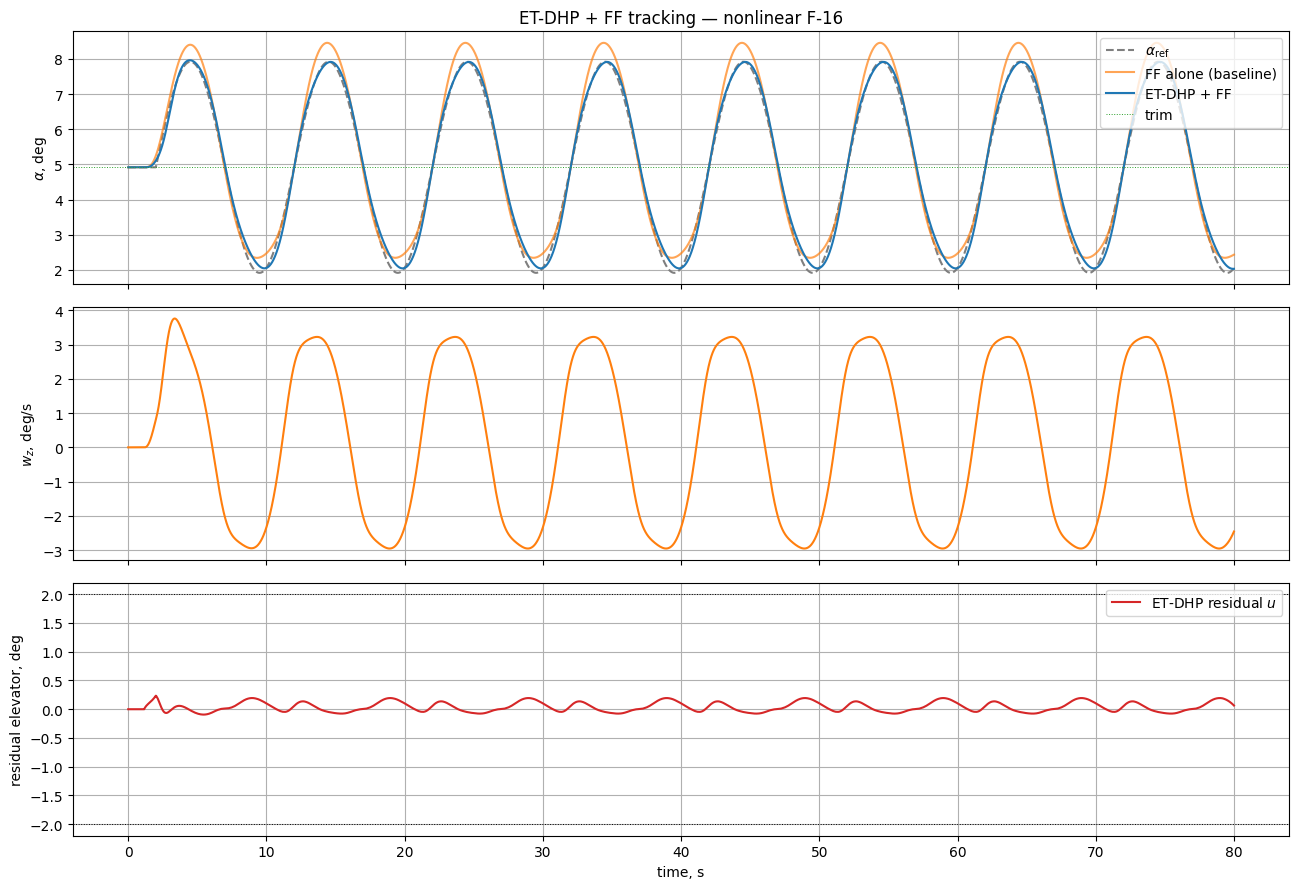
You should see:
- Tracking that looks similar to IM-GDHP (same actor / critic structure).
- A sparse distribution of trigger events on one of the diagnostic traces — usually fewer than 10 % of the total ticks will actually fire the NN.
- A slightly blockier elevator command because the actuator holds between triggers.
See example_etdhp_nonlinear_f16.ipynb for the trigger-count log and step-by-step analysis.
Step 4 — Save / load / publish to HuggingFace
run_dir = agent.save('./checkpoints')
restored = ETDHPAgent.from_pretrained(run_dir)
agent.publish_to_hub('me/my-etdhp', folder_path=run_dir, access_token='hf_…')
Pitfalls
- Trigger never fires.
trigger_thresholdis too large for your state magnitudes — halve it until the tracking error bites. - Trigger fires every tick. Threshold too small; may as well use IM-GDHP (no compute saving).
- Tracking degrades under fast references. Raise
lipschitz_estimateto make the threshold tighter at high state-change rates.
Where to go next
- Recipe 14 — AA-INDI — non-neural fault-tolerant alternative.
- Recipe 09 — Fault-tolerance — head-to-head against iADP and AA-INDI.
- ET-DHP documentation — theory + full API.