Recipe 12 — IM-GDHP on the nonlinear F-16
IM-GDHP (Incremental Model Global Dual Heuristic Programming) upgrades IHDP with a dual-head critic that predicts both the value J and its gradient λ = ∂J/∂x. The extra gradient head gives the actor a cleaner training signal and — in the F-16 demo — faster convergence with less overshoot.
Agent docs. IM-GDHP · Full notebook. example_im_gdhp_nonlinear_f16.ipynb · Related recipe. Recipe 11 — IHDP.
When to use IM-GDHP
Pick IM-GDHP when IHDP's single-head critic can't reliably track the cost-to-go gradient — usually that shows up as jittery actor gradients or slow convergence on fast references. The extra critic head is cheap: ~50 % more NN ops per tick, still dwarfed by the RLS step.
| Property | IM-GDHP vs IHDP |
|---|---|
| Critic output | (J, λ) vs J only |
| Actor gradient | Closed-form from λ |
| Parameter count | ~2× critic |
| Convergence | Faster, smoother |
Step 1 — Minimal config
import numpy as np
from tensoraerospace.agent.im_gdhp import IMGDHPAgent, IMGDHPConfig

cfg = IMGDHPConfig(
    dt=0.01,
    actor_hidden=(32, 32),
    critic_hidden=(64, 64),
    actor_lr=1e-3,
    critic_lr=5e-4,
    gamma=0.95,
    # dual head weighting: loss = λ_weight·||λ_true - λ_pred||² + (1-λ_weight)·||J_true - J_pred||²
    lambda_weight=0.5,
    # RLS identifier
    rls_forgetting=0.995,
    rls_cov_init=1e2,
    G_init=np.array([[-0.5]]),
    u_magnitude_limit=15.0,
    u_rate_limit=60.0,
    seed=0,
)
Step 2 — Step loop
Identical to IHDP:
agent = IMGDHPAgent(n_state=1, n_control=1, config=cfg)
env.reset()

for k in range(n_steps):
    obs = env.get_state()
    u = agent.predict(obs[controlled_channels], ref[:, k], k)
    obs, *_ = env.step(u)
    agent.learn(obs[controlled_channels], ref[:, k], k)
Internally, learn() does one RLS step, then updates the dual-head critic using both J and the finite-difference λ estimate, then takes one actor gradient step in the direction suggested by the critic's λ head.
Step 3 — Expected behaviour on the nonlinear F-16
Slow α tracking with an aggressive actor_lr:
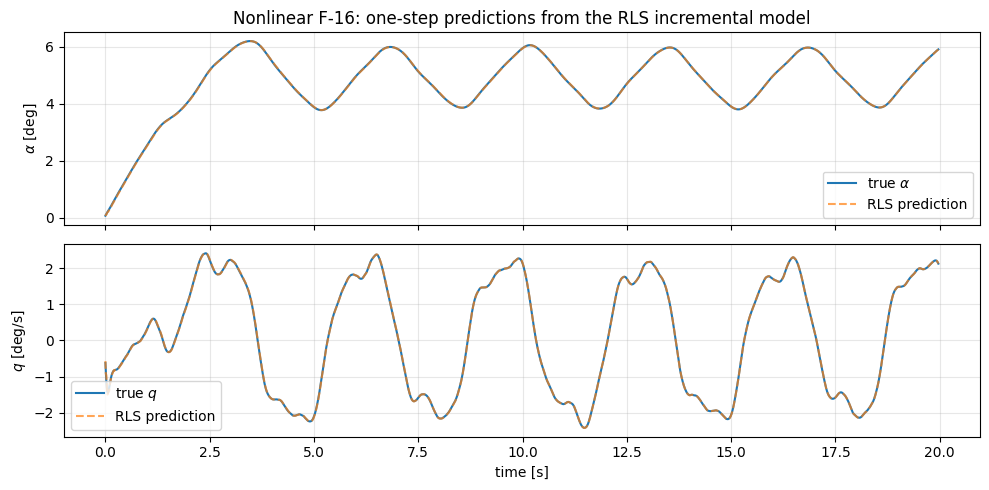
The commanded α is the stepped schedule; measured α follows with little overshoot. The elevator command stays smooth because the λ-head gives a cleaner gradient than the finite-difference alternative. Source: example_im_gdhp_nonlinear_f16.ipynb.
Step 4 — Save / load / publish to HuggingFace
run_dir = agent.save('./checkpoints')
restored = IMGDHPAgent.from_pretrained(run_dir)
agent.publish_to_hub('me/my-imgdhp', folder_path=run_dir, access_token='hf_…')
Same contract as the other four — see Recipe 08.
Pitfalls
lambda_weight = 0falls back to IHDP. If you're getting IHDP behaviour despite using IM-GDHP, check this knob.lambda_weight = 1ignoresJ. The actor gradient becomes brittle ifλ-head prediction is noisy.0.3–0.7is the useful range.- Critic loss oscillates. Lower
critic_lror raiserls_forgetting(≥ 0.999) to smooth the model estimates the critic is chasing.
Where to go next
- Recipe 13 — ET-DHP — event-triggered cousin of IM-GDHP.
- Recipe 14 — AA-INDI — non-neural alternative with stronger fault-tolerance guarantees.
- IM-GDHP documentation — theory + full API.