ELV Launch Vehicle — Longitudinal Dynamics
ELV (Expendable Launch Vehicle) is a carrier rocket for orbital payload delivery. Its longitudinal flight channel is implemented as a linear state-space model and a compatible Gymnasium environment.
-
Quick start
Launch the environment or the model within minutes.
-
Model API
Python class documentation for the ELV model.
-
Gymnasium environment
Ready environment for RL agents.
-
Theory
State equations and numerical parameters.
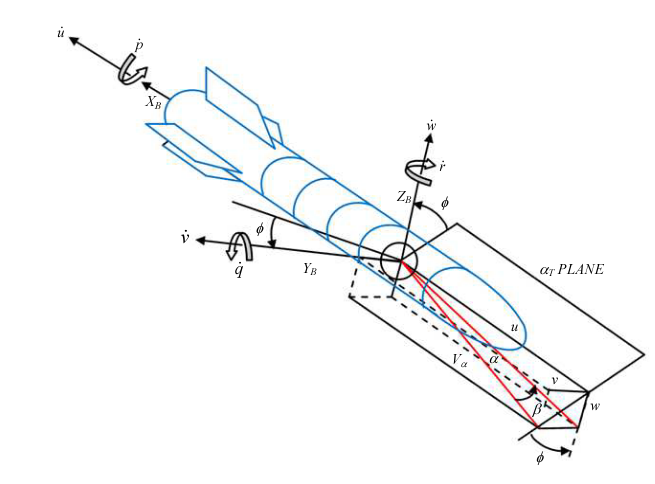
Control object structure
The model is defined in the state space:
where:
The typical matrix structure is:
- w: normal speed, m/s
- q: pitch rate, rad/s
- θ: pitch angle, rad
- η: control input (pitch actuator), rad
- z_w, z_q, z_θ — partial derivatives of normal force \(Z\) with respect to \(w, q, \theta\)
- m_w, m_q, m_θ — partial derivatives of pitch moment \(M\) with respect to \(w, q, \theta\)
- z_η, m_η — partial derivatives with respect to the control input \(\eta\)
Units
Angles and angular rates are in radians. API methods can return values in degrees.
Mathematical model
Numerical matrices (example linearization):
Derivatives (numerical values)
- Matrix A (derivatives):
| Coefficient | Value |
|---|---|
| z_w | -100.858 |
| z_q | 1.0 |
| z_θ | -0.1256 |
| m_w | 14.7805 |
| m_q | 0.0 |
| m_θ | 0.01958 |
- Input η (column B):
| Coefficient | Value |
|---|---|
| z_η | 0.0 |
| m_η | 3.4558 |
Actuator limits
Default control limits:
- Maximum magnitude: \(\pm 25^\circ\)
- Maximum rate: \(60^\circ/\text{s\)
Internal computations operate in radians; limits are converted accordingly.
Sources
- Aliyu, Bhar & Funmilayo, A. & Okwo, Odooh & Sholiyi, Olusegun. (2019). State‑Space Modelling of a Rocket for Optimal Control System Design. Journal of Aircraft and Spacecraft Technology. 3. 128‑137. 10.3844/jastsp.2019.128.137. Link
- Aliyu, Bhar. (2011). Expendable Launch Vehicle Flight Control — Design & Simulation with Matlab/Simulink. Link
Reward
The default reward function returns the negative absolute tracking error for the pitch angle:
Higher reward (closer to 0) indicates better tracking performance. A custom reward function can be passed via the reward_func parameter.
Quick start
import gymnasium as gym
import numpy as np

from tensoraerospace.envs import LinearLongitudinalELVRocket
from tensoraerospace.utils import generate_time_period
from tensoraerospace.signals.standard import unit_step

dt = 0.01
tp = generate_time_period(tn=20, dt=dt)
number_time_steps = len(tp)
reference_signals = unit_step(degree=5, tp=tp, time_step=10, output_rad=True).reshape(1, -1)

env = gym.make(
    'LinearLongitudinalELVRocket-v0',
    number_time_steps=number_time_steps,
    initial_state=[[0],[0],[0]],
    reference_signal=reference_signals,
)

state, info = env.reset()
for _ in range(200):
    action = np.array([[0.1]])
    state, reward, terminated, truncated, info = env.step(action)
    if terminated or truncated:
        break
import numpy as np
from tensoraerospace.aerospacemodel import ELVRocket

dt = 0.01
number_time_steps = 200

x0 = np.array([0.0, 0.0, 0.0])  # [w, q, theta]

model = ELVRocket(
    x0=x0,
    number_time_steps=number_time_steps,
    selected_state_output=["w", "q", "theta"],
    dt=dt,
)

for t in range(number_time_steps - 1):
    u = np.array([[0.05]])  # control (rad)
    x_next = model.run_step(u)
Python API
ELVRocket(x0, number_time_steps, selected_state_output=None, t0=0, dt=0.01)

Bases: ModelBase
ELV rocket in longitudinal control channel.
Parameters:
| Name | Type | Description | Default |
|---|---|---|---|
x0
|
ndarray | list[float]
|
Initial state of the control object. |
required |
number_time_steps
|
int
|
Number of time steps. |
required |
selected_state_output
|
optional
|
Selected states of the control object. Defaults to None. |
None
|
t0
|
int
|
Initial time. Defaults to 0. |
0
|
dt
|
float
|
Discretization frequency. Defaults to 0.01. |
0.01
|
Action space
ele: elevator [rad]
State space (order): alpha: Angle of attack [rad] q: Pitch angular velocity [rad/s] theta: Pitch [rad]
Output space (order): alpha: Angle of attack [rad] q: Pitch angular velocity [rad/s] theta: Pitch [rad]
Note
The stored A/B matrices are linearised about a trim point and
the first state is the angle of attack alpha (in radians), not the
body-frame normal velocity w (in m/s). The coefficient A[0, 0]= -100.858 is a typical Z_alpha-type stability derivative; the
corresponding coefficient for w in SI units would be several
orders of magnitude smaller. Labels were kept consistent with that
physical meaning.
import_linear_system()

Load (set) stored linearised system matrices.
The matrices are defined for the state vector x = [alpha, q, theta]
(angle of attack in radians, pitch rate in rad/s, pitch angle in
radians) and the control u = [ele] (elevator deflection in
radians). The coefficients are classical stability derivatives for a
rocket's longitudinal short-period mode, so the first state has units
of radians of angle of attack, not m/s of body-frame normal velocity.
initialise_system(x0, number_time_steps)

Initialize the system and allocate history buffers.
Parameters:
| Name | Type | Description | Default |
|---|---|---|---|
x0
|
ndarray | list[float]
|
Initial state. |
required |
number_time_steps
|
int
|
Number of simulation steps. |
required |
run_step(ut_0)

Run one discrete-time simulation step.
Parameters:
| Name | Type | Description | Default |
|---|---|---|---|
ut_0
|
ndarray
|
Control vector. |
required |
Returns:
| Type | Description |
|---|---|
ndarray
|
np.ndarray: Next state at time t+1. |
update_system_attributes()

Update time-dependent attributes after each simulation step.
get_state(state_name, to_deg=False, to_rad=False)

Return the time history of a state.
Parameters:
| Name | Type | Description | Default |
|---|---|---|---|
state_name
|
str
|
State name. |
required |
to_deg
|
bool
|
Convert radians to degrees. |
False
|
to_rad
|
bool
|
Convert degrees to radians. |
False
|
Returns:
| Type | Description |
|---|---|
ndarray
|
np.ndarray: State history array. |
get_control(control_name, to_deg=False, to_rad=False)

Return the time history of a control input.
Parameters:
| Name | Type | Description | Default |
|---|---|---|---|
control_name
|
str
|
Control signal name. |
required |
to_deg
|
bool
|
Convert radians to degrees. |
False
|
to_rad
|
bool
|
Convert degrees to radians. |
False
|
Returns:
| Type | Description |
|---|---|
ndarray
|
np.ndarray: Control history array. |
get_output(state_name, to_deg=False, to_rad=False)

Return the time history of an output signal.
Parameters:
| Name | Type | Description | Default |
|---|---|---|---|
state_name
|
str
|
Output name. |
required |
to_deg
|
bool
|
Convert radians to degrees. |
False
|
to_rad
|
bool
|
Convert degrees to radians. |
False
|
Returns:
| Type | Description |
|---|---|
ndarray
|
np.ndarray: Output history array. |
plot_output(output_name, time, lang='rus', to_deg=False, to_rad=False, figsize=(10, 10))

Plot an output signal over time.
Parameters:
| Name | Type | Description | Default |
|---|---|---|---|
output_name
|
str
|
Output name. |
required |
time
|
ndarray
|
Time vector. |
required |
lang
|
str
|
Axis label language ('rus' or 'eng'). Defaults to 'rus'. |
'rus'
|
to_deg
|
bool
|
Convert radians to degrees. |
False
|
to_rad
|
bool
|
Convert degrees to radians. |
False
|
figsize
|
tuple
|
Figure size. |
(10, 10)
|
Returns:
| Type | Description |
|---|---|
Figure
|
matplotlib.figure.Figure: Figure object. |
LinearLongitudinalELVRocket(initial_state, reference_signal, number_time_steps, tracking_states=None, state_space=None, control_space=None, output_space=None, reward_func=None, dt=0.01)

Bases: Env
Simulation of ELVRocket control object for training AI agents.
State order: [alpha, q, theta] in SI units (rad, rad/s, rad). Action: elevator in radians.
Parameters:
| Name | Type | Description | Default |
|---|---|---|---|
initial_state
|
Union[ndarray, list[float]]
|
Initial state [alpha, q, theta] in SI units (radians). |
required |
reference_signal
|
Union[ndarray, Callable]
|
Reference signal (radians for angular states). |
required |
number_time_steps
|
int
|
Number of simulation steps. |
required |
tracking_states
|
Optional[List[str]]
|
Tracked states. |
None
|
state_space
|
Optional[List[str]]
|
State space. |
None
|
control_space
|
Optional[List[str]]
|
Control space. |
None
|
output_space
|
Optional[List[str]]
|
Full output space (including noise). |
None
|
reward_func
|
Optional[Callable]
|
Reward function (WIP status). |
None
|
Initialize ELV longitudinal environment.
reward(state, ref_signal, ts)
staticmethod

Evaluate control performance.
Parameters:
| Name | Type | Description | Default |
|---|---|---|---|
state
|
_type_
|
Current state. |
required |
ref_signal
|
_type_
|
Reference state. |
required |
ts
|
_type_
|
Time step. |
required |
Returns:
| Name | Type | Description |
|---|---|---|
reward |
float
|
Control performance evaluation. |
step(action)

Execute a simulation step.
Parameters:
| Name | Type | Description | Default |
|---|---|---|---|
action
|
ndarray
|
Array of control signals in radians. |
required |
Returns:
| Name | Type | Description |
|---|---|---|
next_state |
ndarray
|
Next state of the control object. |
reward |
ndarray
|
Evaluation of control algorithm actions. |
done |
bool
|
Simulation status, whether completed or not. |
logging |
any
|
Additional information (not used). |
reset(seed=None, options=None)

Reset simulation environment to initial conditions.
Parameters:
| Name | Type | Description | Default |
|---|---|---|---|
seed
|
int
|
Seed for random number generator. |
None
|
options
|
dict
|
Additional options for initialization. |
None
|
render()

Visual display of actions in the environment. Status: WIP.
Raises:
| Type | Description |
|---|---|
NotImplementedError
|
Rendering is not implemented for this environment. |