DQN (Deep Q-Network)
DQN is the classic reinforcement learning method approximating the Q-function with a neural network. The implementation uses a target network for stability and prioritized experience replay (PER) for more informative updates.
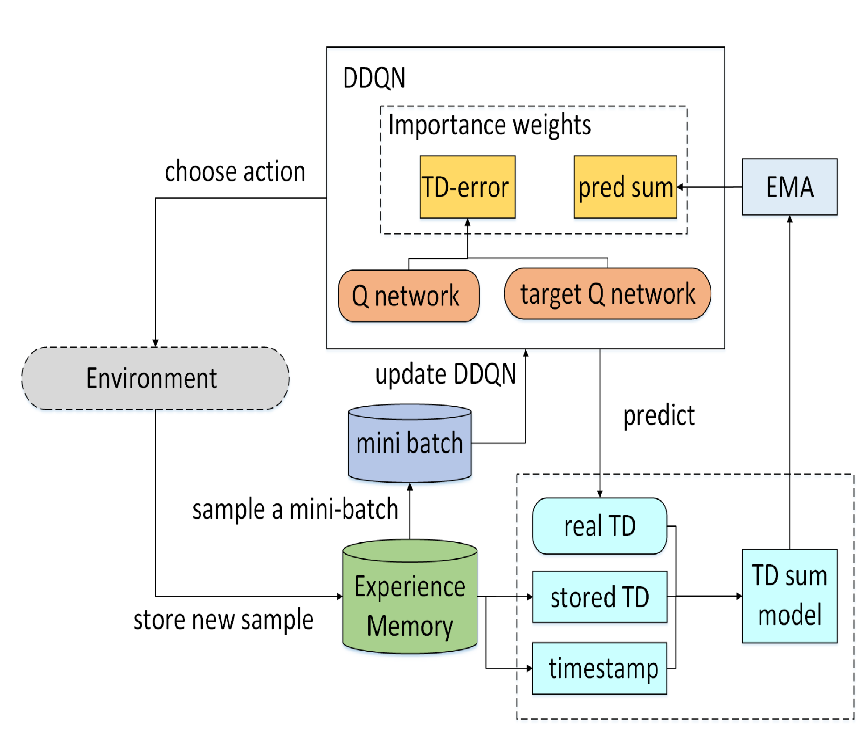
Components
- Main Q-network: estimates \(Q_\theta(s,a)\) and selects actions
- Target network: \(Q_{\theta^-}\) provides target values, updated less frequently
- Replay buffer (PER): stores transitions and returns prioritized mini-batches
- Action selection: \(\epsilon\)-greedy strategy
Theory
1) Bellman Optimality Equation
The optimal Q-function satisfies:
Stochastic gradient descent on an MSE objective solves:
2) Double DQN vs classical DQN
- Vanilla DQN overestimates because the \(\max\) uses the same network. Double DQN decouples selection and evaluation:
This reduces overestimation and stabilizes training.
3) Target network update
- The target network \(Q_{\theta^-}\) copies the online network every
target_update_itersteps:
A fixed target over a short horizon reduces target drift.
4) Prioritized experience replay (PER) and SumTree
- Transition priority i:
- Sampling probability:
- Importance-sampling weights:
-
Priority update after training: \(p_i \leftarrow |\delta_i| + \varepsilon_{\text{margin}}\)
-
The SumTree structure enables \(\mathcal{O}(\log N)\) priority updates/sampling.
5) \(\epsilon\)-greedy policy and schedule
- With probability \(\epsilon\) pick a random action; otherwise \(\arg\max_a Q_\theta(s,a)\).
- Exploration decays: \(\epsilon \leftarrow \max(\text{min\_epsilon}, \epsilon \cdot \text{epsilon\_decay})\).
6) Training loop
- Collect experience (first K steps without training).
- Every
replay_periodsteps sample a PER mini-batch, compute \(y\), TD errors \(\delta\), IS weights, and update \(\theta\) via weighted MSE. - Update priorities \(p_i\) and the parameter \(\beta\).
- Every
target_update_itersteps: \(\theta^- \leftarrow \theta\).
Pseudocode:
predict_q = Q_theta(s_batch)
best_action = argmax_a predict_q
target_q = Q_theta_minus(s_next_batch)
y = r_batch + gamma * target_q[range, best_action]

# TD error and priorities
delta = y - predict_q[range, a_batch]
priority = clip(|delta| + margin, 0, abs_error_upper) ** alpha

# importance weights and weighted MSE
w = ((buffer_size * P(i)) ** -beta) / max_w
loss = mean(w * (y - Q_theta(s_batch, a_batch))^2)
update theta by SGD

# update priorities, increase beta, periodically update target
7) Stabilization tricks
- Gradient normalization/clipping
- Limit TD error (
abs_error_upperin code) - Prefer Huber loss over MSE (here we use weighted MSE)
- Regular target updates, sufficiently large buffer
8) Mapping to implementation parameters
alpha— prioritization exponent (0 → uniform, 1 → pure TD error)beta,beta_increment_per_sample— IS weight strength and annealingtarget_update_iter— target network sync periodreplay_period— training frequencyepsilon,epsilon_decay,min_epsilon— \(\epsilon\) schedulemargin(\varepsilon),abs_error_upper— priority shaping
Quick start
import gymnasium as gym
import numpy as np

from tensoraerospace.agent.dqn.model import Model, DQNAgent

env = gym.make('LinearLongitudinalF16-v0', number_time_steps=2000)
num_actions = env.action_space.n

model = Model(num_actions)
target_model = Model(num_actions)

agent = DQNAgent(
    model=model,
    target_model=target_model,
    env=env,
    train_nums=10000,
    epsilon=1.0,
    epsilon_dacay=0.995,
    min_epsilon=0.05,
)

agent.train()
Tip
For continuous action spaces use discretization or switch to DDPG/SAC.
Unified training interface
DQN supports the shared unified train() signature from BaseRLModel:
# Legacy call (still works):
agent.train()

# Unified call – overrides self.train_nums to num_episodes * max_steps:
agent.train(num_episodes=100, max_steps=200)
When num_episodes and max_steps are both omitted, the agent uses
the train_nums step budget set at construction time.
API reference
Model(num_actions)

Bases: Module
DQN with two hidden layers of 32.
Only the number of actions is required to preserve the original signature. The first linear layer is lazily initialized to infer the input features at runtime from the first forward pass.
Parameters:
| Name | Type | Description | Default |
|---|---|---|---|
num_actions
|
int
|
Number of actions. |
required |
Initialize network layers.
Parameters:
| Name | Type | Description | Default |
|---|---|---|---|
num_actions
|
int
|
Number of discrete actions. |
required |
forward(x)

Compute Q-values for a batch of observations.
predict(inputs)

Forward function. Returns Q-values for actions.
Parameters:
| Name | Type | Description | Default |
|---|---|---|---|
inputs
|
ndarray
|
Batch of input data (numpy array [B, obs_dim]). |
required |
Returns:
| Type | Description |
|---|---|
ndarray
|
numpy array [B, num_actions] with Q-values. |
action_value(obs)

Select greedy action and return Q-values for the first item.
Parameters:
| Name | Type | Description | Default |
|---|---|---|---|
obs
|
ndarray
|
Batch of input data. |
required |
Returns:
| Name | Type | Description |
|---|---|---|
best_action |
Union[ndarray, int]
|
Best action(s). If batch size is 1 -> int, else ndarray. |
q_values |
ndarray
|
Q-values of the first element in the batch for compatibility. |
SumTree(capacity)

Binary search tree class for prioritized replay buffer agent.
Parameters:
| Name | Type | Description | Default |
|---|---|---|---|
capacity
|
int
|
Buffer size. |
required |
Initialize sum tree for prioritized replay.
Parameters:
| Name | Type | Description | Default |
|---|---|---|---|
capacity
|
int
|
Maximum number of transitions to store. |
required |
total_p
property

Number of records in buffer.
Returns:
| Type | Description |
|---|---|
int
|
Number of records in buffer. |
add(priority, transition)

Function for adding object to buffer.
Parameters:
| Name | Type | Description | Default |
|---|---|---|---|
priority
|
int
|
Priority of added transition. |
required |
transition
|
Any
|
Transition vector S, A, R, S'. |
required |
update(idx, priority)

Function for updating object priority with given index.
Parameters:
| Name | Type | Description | Default |
|---|---|---|---|
idx
|
int
|
Transition index. |
required |
priority
|
int
|
Priority of updated transition. |
required |
get_leaf(s)

Function for getting object by given priority.
Parameters:
| Name | Type | Description | Default |
|---|---|---|---|
s
|
int
|
Priority by which transition is selected. |
required |
Returns:
| Name | Type | Description |
|---|---|---|
idx |
int
|
Transition index. |
priority |
int
|
Priority of updated transition. |
transitions |
Any
|
Required transition. |
DQNAgent(model, target_model, env, learning_rate=0.0012, epsilon=0.1, epsilon_dacay=0.995, min_epsilon=0.01, gamma=0.9, batch_size=8, target_update_iter=400, train_nums=5000, buffer_size=200, replay_period=20, alpha=0.4, beta=0.4, beta_increment_per_sample=0.001, log_dir=None, verbose_histogram=False, seed=1, wandb_project=None, wandb_entity=None, wandb_run_name=None, wandb_tags=None, wandb_config=None)

DQN Agent.
Parameters:
| Name | Type | Description | Default |
|---|---|---|---|
model
|
Module
|
Deep Q-network model. |
required |
target_model
|
Module
|
Target deep Q-network model. |
required |
env
|
Env
|
Gym/Gymnasium environment. |
required |
learning_rate
|
float
|
Learning rate. |
0.0012
|
epsilon
|
float
|
Environment exploration probability. |
0.1
|
epsilon_dacay
|
float
|
Epsilon reduction coefficient per episode. |
0.995
|
min_epsilon
|
float
|
Minimum epsilon value. |
0.01
|
gamma
|
float
|
Discount coefficient. |
0.9
|
batch_size
|
int
|
Mini-batch size. |
8
|
target_update_iter
|
int
|
Target network update period (steps). |
400
|
train_nums
|
int
|
Number of training steps. |
5000
|
buffer_size
|
int
|
Replay buffer size. |
200
|
replay_period
|
int
|
Buffer sampling period. |
20
|
alpha
|
float
|
Prioritization degree. |
0.4
|
beta
|
float
|
Importance sampling coefficient. |
0.4
|
beta_increment_per_sample
|
float
|
Beta increment per sample. |
0.001
|
Initialize DQN agent and replay buffer.
Parameters:
| Name | Type | Description | Default |
|---|---|---|---|
model
|
Any
|
Online Q-network. |
required |
target_model
|
Any
|
Target Q-network. |
required |
env
|
Any
|
Gym/Gymnasium environment. |
required |
learning_rate
|
float
|
Optimizer learning rate. |
0.0012
|
epsilon
|
float
|
Initial epsilon for exploration. |
0.1
|
epsilon_dacay
|
float
|
Multiplicative epsilon decay. |
0.995
|
min_epsilon
|
float
|
Minimum epsilon value. |
0.01
|
gamma
|
float
|
Discount factor. |
0.9
|
batch_size
|
int
|
Training batch size. |
8
|
target_update_iter
|
int
|
Steps between target updates. |
400
|
train_nums
|
int
|
Total training steps to run. |
5000
|
buffer_size
|
int
|
Replay buffer capacity. |
200
|
replay_period
|
int
|
Sampling period from buffer. |
20
|
alpha
|
float
|
PER priority exponent. |
0.4
|
beta
|
float
|
PER importance sampling exponent. |
0.4
|
beta_increment_per_sample
|
float
|
Increment for beta per sample. |
0.001
|
log_dir
|
str | None
|
Directory for TensorBoard logs. |
None
|
verbose_histogram
|
bool
|
Whether to log histograms extensively. |
False
|
seed
|
int
|
Random seed for numpy and torch. Defaults to 1. |
1
|
train(num_episodes=None, *, max_steps=None, save_best=False, save_path=None, verbose=True, **kwargs)

Train the DQN agent (unified interface).
DQN is frame-based internally. num_episodes is treated as an
episode target that is multiplied by max_steps to derive a
total training-step budget. When max_steps is omitted, the
original self.train_nums budget set at construction is used.
Parameters:
| Name | Type | Description | Default |
|---|---|---|---|
num_episodes
|
Optional[int]
|
Target number of episodes. Converted to a
step budget via |
None
|
max_steps
|
Optional[int]
|
Approximate maximum steps per episode. |
None
|
save_best
|
bool
|
Reserved for API consistency. |
False
|
save_path
|
Optional[str]
|
Reserved for API consistency. |
None
|
verbose
|
bool
|
Reserved for symmetry. |
True
|
**kwargs
|
Any
|
Currently unused. |
{}
|
Returns:
| Name | Type | Description |
|---|---|---|
dict |
dict
|
Empty dict for API compatibility. |
train_step()

Function for training step.
Returns:
| Name | Type | Description |
|---|---|---|
losses |
float
|
Losses after one training step. |
sum_tree_sample(k)

Get batch for training.
Parameters:
| Name | Type | Description | Default |
|---|---|---|---|
k
|
int
|
Size of batch to get. |
required |
Returns:
| Name | Type | Description |
|---|---|---|
idxes |
int
|
Indices of objects from batch. |
is_weights |
float
|
Priorities of objects from batch. |
evaluation(wrapped_env, render=False)

Get batch for training.
Parameters:
| Name | Type | Description | Default |
|---|---|---|---|
wrapped_env
|
Any
|
Wrapped environment (for rendering/frame capture). |
required |
render
|
bool
|
Whether to visualize environment or not. |
False
|
Returns:
| Name | Type | Description |
|---|---|---|
ep_reward |
float
|
Total reward per episode. |
close()

Close resources (e.g., SummaryWriter).
store_transition(priority, obs, action, reward, next_state, done)

Store a transition in the replay buffer.
rand_based_sample(k)

Placeholder for rank-based prioritized sampling (not implemented).
get_action(best_action)

Epsilon-greedy action selection.
update_target_model()

Target neural network update function.
get_target_value(obs)

Compute Q-values using the target network.
e_decay()

Function for reducing network exploration probability.
save(path=None, save_gradients=False)

Save PyTorch models to the specified directory.
Parameters:
| Name | Type | Description | Default |
|---|---|---|---|
path
|
str | Path | None
|
Save path. If None, saves into current cwd under folder "dqn_agent". |
None
|
save_gradients
|
bool
|
Save optimizer states to continue training. |
False
|
load(path, env, *, load_gradients=False, model_factory=None)
classmethod

Load a DQNAgent from a directory created by :meth:save.
Parameters:
| Name | Type | Description | Default |
|---|---|---|---|
path
|
Union[str, Path]
|
Directory that contains |
required |
env
|
Any
|
A Gymnasium-compatible environment. The environment is required because it is not serialised alongside the weights. |
required |
load_gradients
|
bool
|
If |
False
|
model_factory
|
Optional[Callable[[], Any]]
|
Optional zero-argument factory for custom DQN
network classes. Built-in |
None
|
Returns:
| Name | Type | Description |
|---|---|---|
DQNAgent |
DQNAgent
|
Fully initialised agent with loaded weights. |
from_pretrained(repo_name, env, access_token=None, version=None, load_gradients=False, model_factory=None)
classmethod

Load pretrained model from local directory or Hugging Face Hub.
Parameters:
| Name | Type | Description | Default |
|---|---|---|---|
repo_name
|
str
|
Path to local folder with weights or repository
name in format |
required |
env
|
Any
|
A Gymnasium-compatible environment (required for reconstruction). |
required |
access_token
|
Optional[str]
|
Access token for private HF repository. |
None
|
version
|
Optional[str]
|
Revision / branch / tag of HF repository. |
None
|
load_gradients
|
bool
|
If |
False
|
model_factory
|
Optional[Callable[[], Any]]
|
Optional zero-argument factory for custom DQN network classes. |
None
|
Returns:
| Name | Type | Description |
|---|---|---|
DQNAgent |
DQNAgent
|
Initialised agent with loaded weights. |
publish_to_hub(repo_name, folder_path, access_token=None)

Publish saved model to Hugging Face Hub.
Parameters:
| Name | Type | Description | Default |
|---|---|---|---|
repo_name
|
str
|
Repository id on Hugging Face Hub
(e.g. |
required |
folder_path
|
Union[str, Path]
|
Local folder that contains saved weights
(as written by :meth: |
required |
access_token
|
Optional[str]
|
HF access token. If |
None
|