Boeing 747 — Longitudinal Dynamics
The Boeing 747 is a double-deck wide-body passenger aircraft. The library provides its longitudinal flight channel as a linear state-space model together with a Gymnasium environment for training control agents.
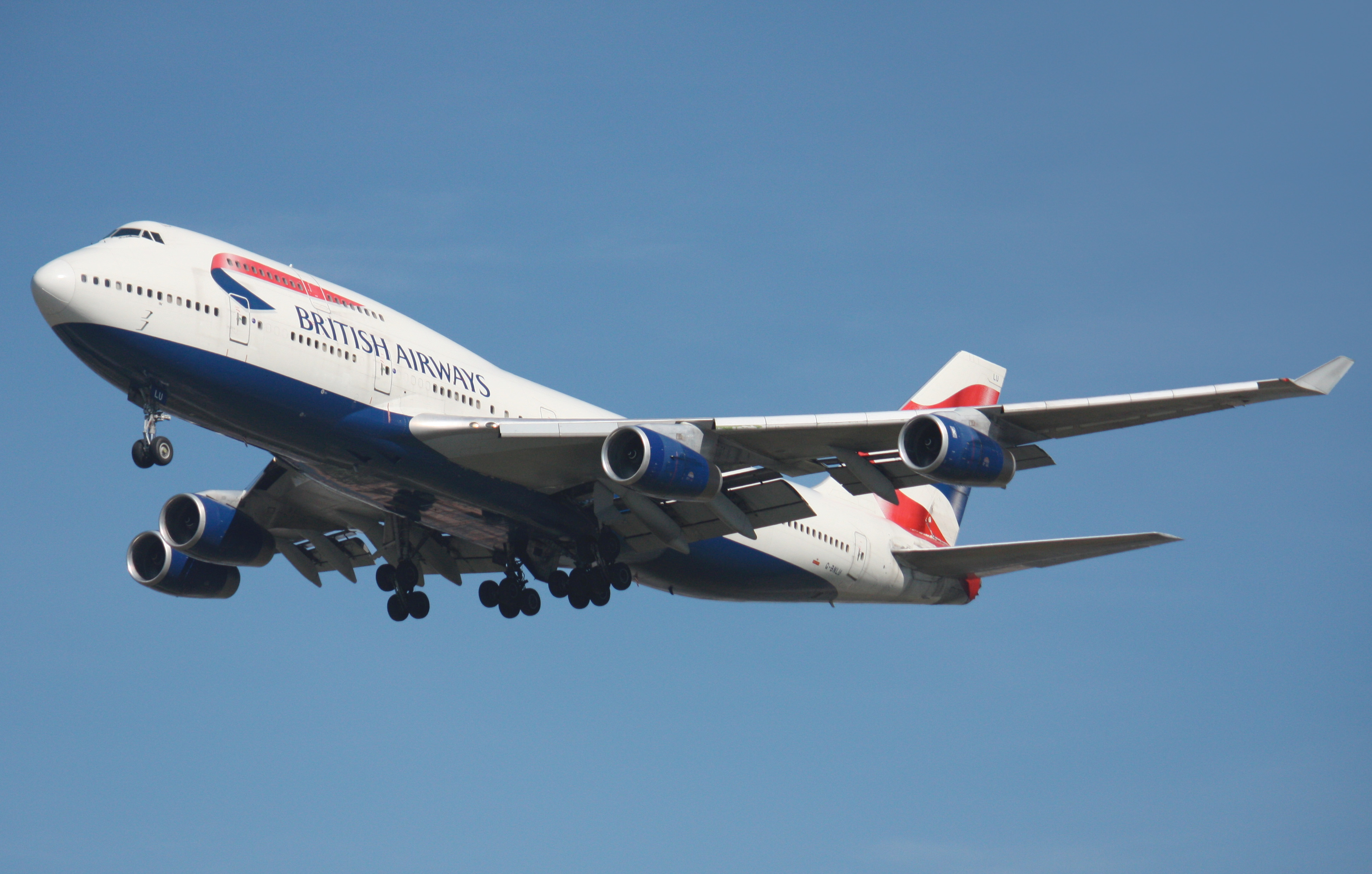
-
Quick start
Launch the environment or the model within minutes.
-
Model API
Python class documentation for the B747 longitudinal dynamics.
-
Gymnasium environment
Ready environment for RL agents.
-
Theory
State equations and numerical parameters.
Performance specs (reference)
| Parameter | Value |
|---|---|
| Length, m | 70.7 |
| Wingspan, m | 64.4 |
| Aircraft height, m | 19.4 |
| Wing area, m² | 541.2 |
| Normal takeoff weight, kg | 11467 |
Control object structure
The model is defined in the state space and describes the evolution of longitudinal motion variables when controlled by the elevator.
where the state vector and control input are:
The typical matrix structure is:
- u: longitudinal speed, m/s
- w: normal (vertical) speed, m/s
- q: pitch rate, rad/s
- θ: pitch angle, rad
- η: elevator (stabilator) deflection, rad
- x_u, x_w, x_q, x_θ — partial derivatives of longitudinal force \(X\) with respect to \(u, w, q, \theta\)
- z_u, z_w, z_q, z_θ — partial derivatives of normal force \(Z\) with respect to \(u, w, q, \theta\)
- m_u, m_w, m_q, m_θ — partial derivatives of pitch moment \(M\) with respect to \(u, w, q, \theta\)
- x_η, z_η, m_η — partial derivatives with respect to the control input \(\eta\) (stabilator deflection)
Units
Inside the models, angles and angular rates are in radians. API methods allow retrieving data in degrees.
Mathematical model
Because the plant has no internal disturbances, the output \(y\) is not used (\(C\) is diagonal, \(D\) is zero).
Numerical matrices (example linearization):
Actuator limits
The default control limits are:
- Maximum magnitude: \(\pm 25^\circ\)
- Maximum rate: \(60^\circ/\text{s}\)
Internal computations use radians; the limits are converted accordingly.
Sources
- Heffley R. K., Jewell W. F. Aircraft handling qualities data. – NASA, 1972. – No. AD‑A277031. Link
- Abd Elwahab S. et al. Evaluation of Boeing 747‑E lateral autopilot using flying and handling qualities specifications // ICCCCEE 2017. IEEE. Link
Quick start
import gymnasium as gym
import numpy as np

from tensoraerospace.envs import LinearLongitudinalB747
from tensoraerospace.utils import generate_time_period
from tensoraerospace.signals.standard import unit_step

dt = 0.01
tp = generate_time_period(tn=20, dt=dt)
number_time_steps = len(tp)
reference_signals = unit_step(degree=5, tp=tp, time_step=10, output_rad=True).reshape(1, -1)

env = gym.make(
    'LinearLongitudinalB747-v0',
    number_time_steps=number_time_steps,
    initial_state=[[0],[0],[0],[0]],  # u, w, q, theta (will be mapped)
    reference_signal=reference_signals,
)

state, info = env.reset()
for _ in range(200):
    action = np.array([[0.1]])
    state, reward, terminated, truncated, info = env.step(action)
    if terminated or truncated:
        break
import numpy as np
from tensoraerospace.aerospacemodel import LongitudinalB747

dt = 0.01
number_time_steps = 200

x0 = np.array([0.0, 0.0, 0.0, 0.0])  # [u, w, q, theta]

model = LongitudinalB747(
    x0=x0,
    number_time_steps=number_time_steps,
    selected_state_output=["u", "w", "q", "theta"],
    dt=dt,
)

for t in range(number_time_steps - 1):
    u = np.array([[0.05]])  # stabilator deflection (rad)
    x_next = model.run_step(u)
Python API
LongitudinalB747(x0, number_time_steps, selected_state_output=None, t0=0, dt=0.01)

Bases: ModelBase
Boeing 747 in longitudinal control channel.
Parameters:
| Name | Type | Description | Default |
|---|---|---|---|
x0
|
ndarray
|
Initial state of the control object. |
required |
number_time_steps
|
int
|
Number of time steps. |
required |
selected_state_output
|
optional
|
Selected states of the control object. Defaults to None. |
None
|
t0
|
int
|
Initial time. Defaults to 0. |
0
|
dt
|
float
|
Discretization frequency. Defaults to 0.01. |
0.01
|
Action space
ele: elevator [deg]
State space
u: Longitudinal aircraft velocity [m/s] w: Normal aircraft velocity [m/s] q: Pitch angular velocity [deg/s] theta: Pitch [deg]
Output space
u: Longitudinal aircraft velocity [m/s] w: Normal aircraft velocity [m/s] q: Pitch angular velocity [deg/s] theta: Pitch [deg]
import_linear_system()

Load (set) stored linearized system matrices.
Sets A, B, C, D matrices for the Boeing 747 longitudinal linear model.
initialise_system(x0, number_time_steps)

Initialize the system and allocate history buffers.
Parameters:
| Name | Type | Description | Default |
|---|---|---|---|
x0
|
ndarray
|
Initial state. |
required |
number_time_steps
|
int
|
Number of simulation steps. |
required |
run_step(ut_0)

Run one discrete-time simulation step.
Parameters:
| Name | Type | Description | Default |
|---|---|---|---|
ut_0
|
ndarray
|
Control vector. |
required |
Returns:
| Type | Description |
|---|---|
ndarray
|
np.ndarray: Next state at time t+1. |
update_system_attributes()

Update internal state and step counter after each simulation step.
get_state(state_name, to_deg=False, to_rad=False)

Return the time history of a state.
Parameters:
| Name | Type | Description | Default |
|---|---|---|---|
state_name
|
str
|
State name. |
required |
to_deg
|
bool
|
Convert radians to degrees. |
False
|
to_rad
|
bool
|
Convert degrees to radians. |
False
|
Returns:
| Type | Description |
|---|---|
ndarray
|
np.ndarray: State history array. |
get_control(control_name, to_deg=False, to_rad=False)

Return the time history of a control input.
Parameters:
| Name | Type | Description | Default |
|---|---|---|---|
control_name
|
str
|
Control signal name. |
required |
to_deg
|
bool
|
Convert radians to degrees. |
False
|
to_rad
|
bool
|
Convert degrees to radians. |
False
|
Returns:
| Type | Description |
|---|---|
ndarray
|
np.ndarray: Control history array. |
get_output(state_name, to_deg=False, to_rad=False)

Return output time history for the specified output name.
Parameters:
| Name | Type | Description | Default |
|---|---|---|---|
state_name
|
str
|
Output name. |
required |
to_deg
|
bool
|
Convert radians to degrees. |
False
|
to_rad
|
bool
|
Convert degrees to radians. |
False
|
Returns:
| Type | Description |
|---|---|
ndarray
|
np.ndarray: Output history array. |
plot_output(output_name, time, lang='rus', to_deg=False, to_rad=False, figsize=(10, 10))

Plot an output signal over time.
Parameters:
| Name | Type | Description | Default |
|---|---|---|---|
output_name
|
str
|
Output name. |
required |
time
|
ndarray
|
Time vector. |
required |
lang
|
str
|
Axis label language ('rus' or 'eng'). |
'rus'
|
to_deg
|
bool
|
Convert radians to degrees. |
False
|
to_rad
|
bool
|
Convert degrees to radians. |
False
|
figsize
|
tuple
|
Figure size. |
(10, 10)
|
Returns:
| Type | Description |
|---|---|
Figure
|
matplotlib.figure.Figure: Figure object. |
Raises:
| Type | Description |
|---|---|
Exception
|
If invalid formatting is requested or the signal is not found. |
LinearLongitudinalB747(initial_state, reference_signal, number_time_steps, tracking_states=None, state_space=None, control_space=None, output_space=None, reward_func=None, use_reward=True, dt=0.01, render_mode=None)

Bases: Env
Simulation of LongitudinalB747 control object in Gym for training.
Parameters:
| Name | Type | Description | Default |
|---|---|---|---|
initial_state
|
ndarray
|
Initial state. |
required |
reference_signal
|
ndarray
|
Reference signal. |
required |
number_time_steps
|
int
|
Number of simulation steps. |
required |
tracking_states
|
list[str] | None
|
Tracked states. |
None
|
state_space
|
list[str] | None
|
State space. |
None
|
control_space
|
list[str] | None
|
Control space. |
None
|
output_space
|
list[str] | None
|
Full output space (including noise). |
None
|
reward_func
|
Callable | None
|
Reward function (WIP status). |
None
|
use_reward
|
bool
|
Whether to use reward. |
True
|
dt
|
float
|
Discretization frequency. |
0.01
|
Notes
- Action units expected by the environment are degrees (deg).
- Actions are converted to radians (rad) before being passed to the underlying model.
Initialize LinearLongitudinalB747 environment.
Parameters:
| Name | Type | Description | Default |
|---|---|---|---|
initial_state
|
ndarray
|
Initial state. |
required |
reference_signal
|
ndarray
|
Reference signal. |
required |
number_time_steps
|
int
|
Number of simulation steps. |
required |
tracking_states
|
list[str] | None
|
Tracked states. Defaults to ["theta", "q"]. |
None
|
state_space
|
list[str] | None
|
State space. Defaults to ["theta", "q"]. |
None
|
control_space
|
list[str] | None
|
Control space. Defaults to ["stab"]. |
None
|
output_space
|
list[str] | None
|
Full output space. Defaults to ["theta", "q"]. |
None
|
reward_func
|
Callable | None
|
Reward function. Defaults to None. |
None
|
use_reward
|
bool
|
Whether to use reward. Defaults to True. |
True
|
dt
|
float
|
Discretization frequency. Defaults to 0.01. |
0.01
|
render_mode
|
str | None
|
|
None
|
reward(state, ref_signal, ts, action=None)
staticmethod

Control evaluation.
Parameters:
| Name | Type | Description | Default |
|---|---|---|---|
state
|
ndarray
|
Current state. |
required |
ref_signal
|
ndarray
|
Reference state. |
required |
ts
|
int
|
Time step. |
required |
Returns:
| Name | Type | Description |
|---|---|---|
float |
float
|
Control evaluation (negative MSE). |
step(action)

Execute simulation step.
Parameters:
| Name | Type | Description | Default |
|---|---|---|---|
action
|
ndarray
|
Control signal array for selected actuators in degrees. |
required |
Returns:
| Name | Type | Description |
|---|---|---|
next_state |
ndarray
|
Next state of control object. |
reward |
ndarray
|
Evaluation of control algorithm actions. |
done |
bool
|
Simulation status, completed or not. |
logging |
any
|
Additional information (not used). |
reset(seed=None, options=None)

Reset simulation environment to initial conditions.
Parameters:
| Name | Type | Description | Default |
|---|---|---|---|
seed
|
int
|
Seed for random number generator. |
None
|
options
|
dict
|
Additional initialization options. |
None
|
Returns:
| Name | Type | Description |
|---|---|---|
tuple |
Tuple[ndarray, Dict[str, Any]]
|
Observation array and info dictionary. |
render(mode=None)

Render a lightweight telemetry snapshot.
The legacy B747 environment does not have a graphical viewer. To keep
render_mode="human" usable, human mode prints one concise state line;
ansi returns the same line as a string for tests and logs.