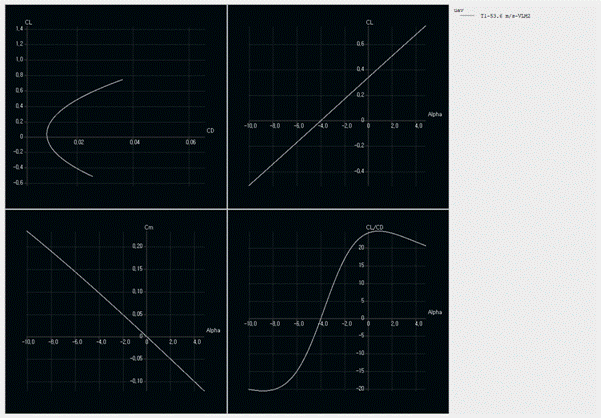
Plane Analysis: Aerodynamic Analysis
Goal
Build the aircraft geometry (wing/tail), set the inertial characteristics, and perform an aerodynamic computation to obtain polars and integral coefficients.
Step-by-Step Plan
- Open Wing and Plane Design → Define New Plane (or press F3).
- In the Define section, specify span, chords, sweep, airfoils, and the position of components along the x/y/z axes.
- Go to Plane inertia and set the mass; moments of inertia will be calculated automatically (override manually if needed).
- Open Analysis → Define an Analysis and set the calculation parameters: Polar Type, Method, Inertia/Ref dimension, density/viscosity (Aero data), additional drag (Extra drag).
- Run the analysis, review the polar curves and key metrics (efficiency, moment coefficients, neutral point location).
Tips
Tip: If the aircraft will operate in different regimes, create several analyses with distinct settings (mass, Re, M) and compare the results.
To build the aircraft, go to Wing and Plane Design and press F3 or select Define New Plane.
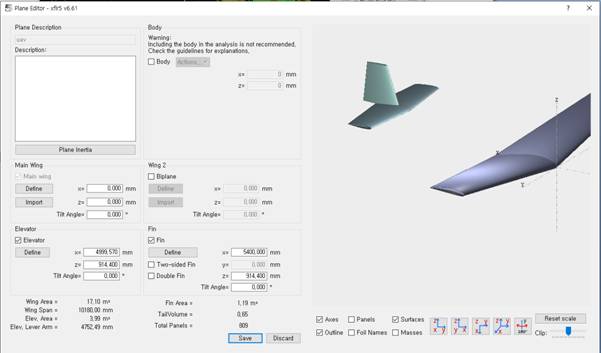
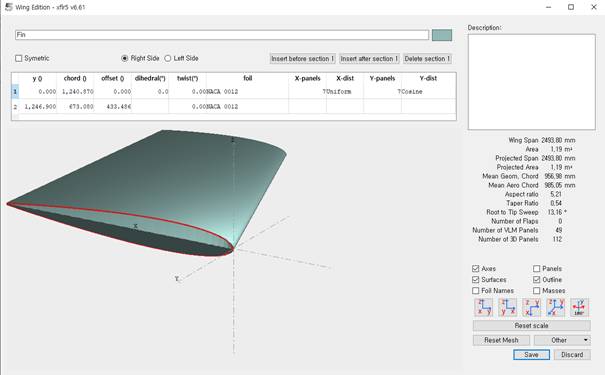
Define is used to specify wing span, chord length, sweep, and airfoil; it also provides the main parameters (area, aspect ratio, mean aerodynamic chord) for the Main Wing, Elevator, Fin, as well as the position of the components along the x, y, and z axes.
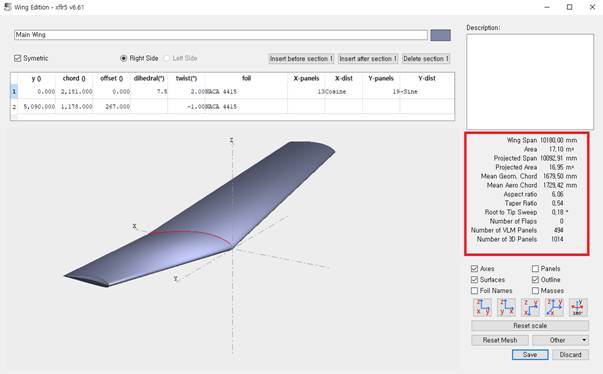
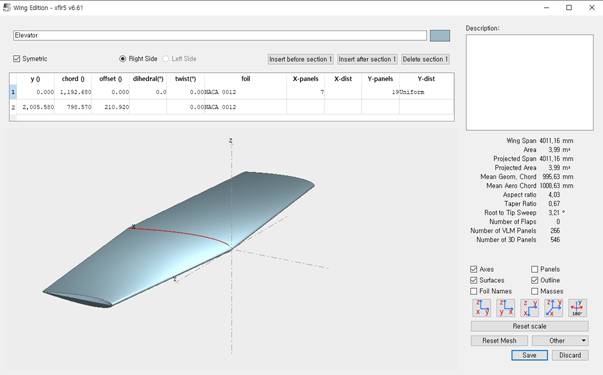
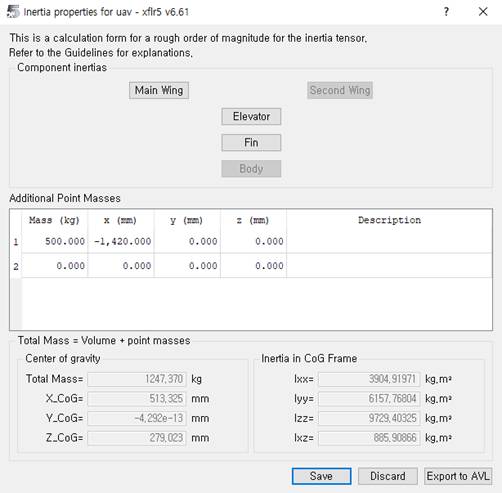
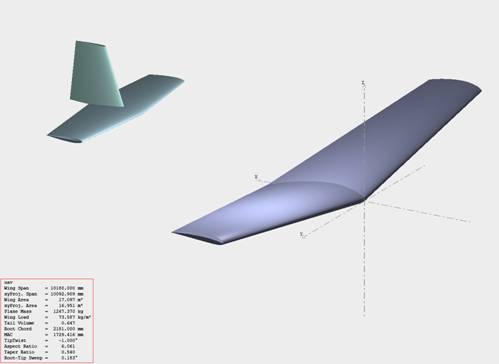
To compute the aerodynamic characteristics, set the mass and (if necessary) the moments of inertia on the Plane inertia tab. After the mass is specified, inertia values are calculated automatically; the aircraft sketch appears in the workspace along with the primary physical and geometric characteristics on the left.
Next, in the Analysis tab → Define an Analysis, configure the run parameters.
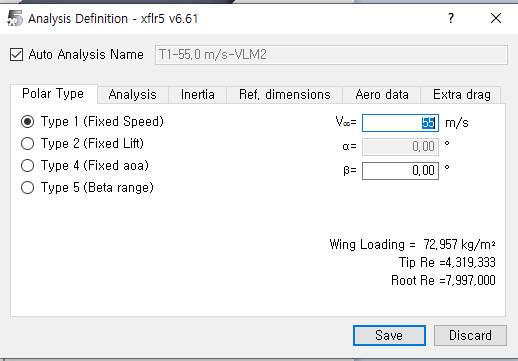
Polar Type selects the type of polars, Analysis — the computation method, Inertia — the option to set custom moments of inertia, Ref dimension — the similarity criterion, Aero data — density and kinematic viscosity, Extra drag — additional drag.
From the results you can see whether the aircraft is statically stable, at which angles the maximum efficiency is achieved, and how the pitching moment behaves.