Heuristic Dynamic Programming (HDP)
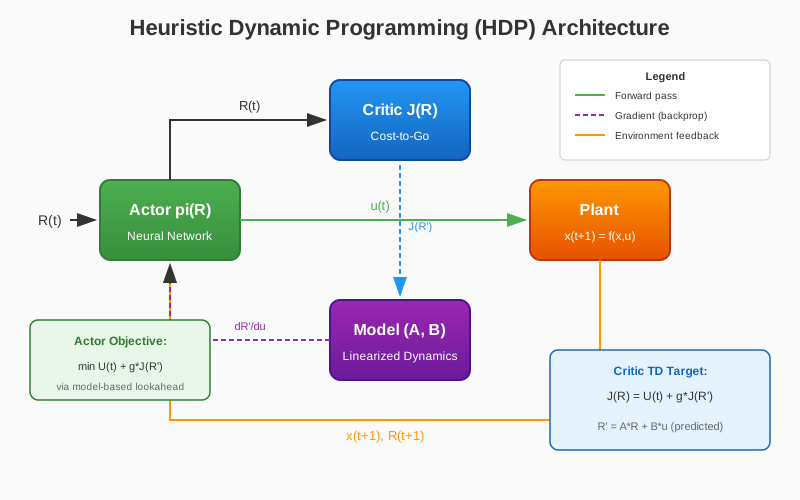
HDP (Heuristic Dynamic Programming) is a model-based member of the Adaptive Critic Designs (ACD) family. Unlike model-free approaches (like DDPG or SAC), HDP leverages a known or learned linearized system model (matrices A, B) to perform one-step lookahead for actor improvement. The critic network learns the scalar cost-to-go function \( J(R) \), and the actor is optimized by backpropagating through the model to minimize expected future cost.
Key Ideas
- Model-Based Critic: The critic \( J(R) \) estimates the cost-to-go as a function of the observable state \( R(t) = [x(t), \theta_{ref}(t), q_{ref}(t)] \)
- One-Step Lookahead: The actor is improved by minimizing \( U(t) + \gamma J(R_{t+1}) \) where \( R_{t+1} \) is predicted using the linearized model
- Temporal Difference Learning: The critic is trained via TD(0) on \( J(R_t) \approx U_t + \gamma J(R_{t+1}) \)
- No Action Input to Critic: Unlike ADHDP or DDPG, HDP's critic does not take the action as input — it only depends on the state \( R \)
Architecture
| Component | Role | Implementation |
|---|---|---|
| Actor \( \pi(R) \) | Generates control signal \( u(t) \) | DeterministicActor (MLP with tanh output) |
| Critic \( J(R) \) | Estimates scalar cost-to-go | JCritic (MLP → scalar) |
| Model \( (A, B) \) | Linearized dynamics for lookahead | Matrices from env.model.filt_A, env.model.filt_B |
Algorithm
Training Loop
For each episode:
    Reset environment → x(0)
    For each step t:
        1. Construct R(t) = [x(t), θ_ref(t), q_ref(t)]
        2. Actor: u(t) = π(R(t)) [+ exploration noise]
        3. Execute u(t) in environment → x(t+1), U(t)
        4. Construct R(t+1) = [x(t+1), θ_ref(t+1), q_ref(t+1)]

        # Critic Update (TD Learning)
        5. J_target = U(t) + γ · J(R(t+1))   [bootstrap if not terminal]
        6. L_critic = MSE(J(R(t)), J_target)
        7. Update critic via gradient descent

        # Actor Update (Model-Based Lookahead)
        8. R'(t+1) = A · R(t) + B · π(R(t))   [model prediction]
        9. L_actor = U(t) + γ · J(R'(t+1))
        10. Update actor via gradient descent (through model & critic)
Mathematical Formulation
Critic Loss (TD Target):
Actor Loss (One-Step Lookahead):
Where: - \( U_t \) is the immediate cost (negative reward) - \( \gamma \) is the discount factor - \( A, B \) are the linearized system matrices
Cost Function
The utility \( U(t) \) is typically a quadratic tracking cost:
| Weight | Meaning |
|---|---|
| \( w_\theta \) | Pitch angle tracking penalty |
| \( w_q \) | Pitch rate tracking penalty |
| \( w_u \) | Control effort penalty |
| \( w_{\Delta u} \) | Control smoothness penalty |
Quick Start
import numpy as np
from tensoraerospace.agent.hdp import HDP
from tensoraerospace.envs.b747 import ImprovedB747Env

def step_reference(steps: int, deg: float = 5.0) -> np.ndarray:
    """Generate step reference signal for pitch tracking."""
    ref = np.zeros((1, steps), dtype=np.float32)
    ref[:, steps // 5:] = np.deg2rad(deg)
    return ref

num_steps = 800

env = ImprovedB747Env(
    initial_state=np.array([0.0, 0.0, 0.0, 0.0], dtype=float),
    reference_signal=step_reference(num_steps, deg=5.0),
    number_time_steps=num_steps,
    dt=0.02,
)

agent = HDP(
    env,
    gamma=0.99,
    actor_lr=3e-4,
    critic_lr=3e-4,
    hidden_size=256,
    exploration_std=0.1,
    device="cpu",
    # Tracking cost weights
    dhp_w_theta=5.0,
    dhp_w_q=0.2,
    dhp_w_u=0.01,
    dhp_w_du=0.02,
    # Optional: use a PD baseline for stability
    dhp_use_baseline=False,
)

# Train the agent
agent.train(num_episodes=100, max_steps=num_steps)

# Save the trained model
agent.save("./hdp_b747_model")
Hyperparameters
Core Parameters
| Parameter | Default | Description |
|---|---|---|
gamma |
0.99 | Discount factor for future costs |
actor_lr |
3e-4 | Actor network learning rate |
critic_lr |
3e-4 | Critic network learning rate |
hidden_size |
256 | Hidden layer size for both networks |
exploration_std |
0.1 | Gaussian noise std for exploration |
Tracking Cost Weights
| Parameter | Default | Description |
|---|---|---|
dhp_w_theta |
5.0 | Weight for pitch tracking error |
dhp_w_q |
0.2 | Weight for pitch rate tracking error |
dhp_w_u |
0.01 | Weight for control magnitude |
dhp_w_du |
0.02 | Weight for control rate (smoothness) |
dhp_use_env_cost |
True | Use environment cost if available |
Stabilization Options
| Parameter | Default | Description |
|---|---|---|
dhp_use_baseline |
False | Use PD/PID baseline controller |
dhp_baseline_type |
"pd" | Baseline type: "pd" or "pid" |
dhp_baseline_kp |
0.6 | Proportional gain |
dhp_baseline_kd |
0.2 | Derivative gain |
dhp_residual_scale |
1.0 | Scale of learned residual policy |
Training Schedule
| Parameter | Default | Description |
|---|---|---|
dhp_warmstart_actor_episodes |
0 | Episodes to warmstart actor from baseline |
dhp_critic_cycle_episodes |
0 | Episodes to train critic only (alternating) |
dhp_action_cycle_episodes |
0 | Episodes to train actor only (alternating) |
Comparison with Other ACD Designs
| Design | Critic Output | Actor Improvement | Model Needed |
|---|---|---|---|
| HDP | \( J(R) \) | Model-based lookahead | Yes |
| DHP | \( \lambda = \partial J / \partial R \) | Direct gradient | Yes |
| GDHP | \( J(R), \lambda \) | Both J and gradients | Yes |
| ADHDP | \( J(R, a) \) | Critic gradients w.r.t action | No |
When to Use HDP
Use HDP when you have access to a reasonably accurate linearized model of the plant. It typically converges faster than model-free methods for systems where the linear approximation holds well around the operating point.
Supported Environments
ImprovedB747Env— Boeing 747 longitudinal dynamics with tracking reference
Example: Step Response Tracking
The HDP agent can be trained to track step reference signals for pitch angle:
# Evaluate trained agent
obs, _ = env.reset()
done = False
theta_history = []

while not done:
    action = agent.select_action(obs, evaluate=True)
    obs, reward, terminated, truncated, info = env.step(action)
    done = terminated or truncated
    theta_history.append(obs[3])  # pitch angle

import matplotlib.pyplot as plt
plt.plot(theta_history, label='Actual θ')
plt.plot(env.reference_signal[0, :len(theta_history)], '--', label='Reference')
plt.xlabel('Time step')
plt.ylabel('Pitch angle (rad)')
plt.legend()
plt.title('HDP Pitch Tracking')
plt.show()
API Reference
HDP(env, *, gamma=0.99, actor_lr=0.0003, critic_lr=0.0003, hidden_size=256, device='cpu', seed=42, exploration_std=0.1, dhp_w_theta=5.0, dhp_w_q=0.2, dhp_w_u=0.01, dhp_w_du=0.02, dhp_use_env_cost=True, dhp_use_baseline=False, dhp_baseline_type='pd', dhp_baseline_kp=0.6, dhp_baseline_ki=0.0, dhp_baseline_kd=0.2, dhp_pid_use_normalized_theta=True, dhp_pid_mode='norm', dhp_residual_scale=1.0, dhp_warmstart_actor_episodes=0, dhp_warmstart_actor_epochs=2, dhp_warmstart_actor_disable_baseline_after=True, dhp_critic_cycle_episodes=0, dhp_action_cycle_episodes=0, log_dir=None, log_every_updates=100, **kwargs)

Bases: ADP
Heuristic Dynamic Programming (HDP) agent — model-based Adaptive Critic Design.
HDP is a model-based reinforcement learning algorithm from the Adaptive Critic Designs (ACD) family. It uses a known linearized system model (matrices A, B) to perform one-step lookahead for actor improvement. The critic network learns a scalar cost-to-go function J(R), while the actor is optimized by backpropagating through the model to minimize expected future cost.
The algorithm follows the framework from Prokhorov & Wunsch (1997): - Critic learns: J(R_t) ≈ U_t + γ J(R_{t+1}) - Actor minimizes: U_t + γ J(A·R_t + B·π(R_t)) via model-based lookahead
Example
import numpy as np from tensoraerospace.agent.hdp import HDP from tensoraerospace.envs.b747 import ImprovedB747Env
def step_reference(steps, deg=5.0): ... ref = np.zeros((1, steps), dtype=np.float32) ... ref[:, steps // 5:] = np.deg2rad(deg) ... return ref
env = ImprovedB747Env( ... initial_state=np.array([0.0, 0.0, 0.0, 0.0]), ... reference_signal=step_reference(800, deg=5.0), ... number_time_steps=800, ... dt=0.02, ... ) agent = HDP(env, gamma=0.99, hidden_size=256) agent.train(num_episodes=100)
References
- Prokhorov D.V., Wunsch D.C. "Adaptive Critic Designs." IEEE Trans. Neural Networks, vol. 8, no. 5, pp. 997-1007, 1997.
- Werbos P.J. "Approximate dynamic programming for real-time control and neural modeling." Handbook of Intelligent Control, 1992.
Attributes:
| Name | Type | Description |
|---|---|---|
actor |
Neural network that outputs control action π(R). |
|
critic |
Module
|
Neural network that estimates cost-to-go J(R). |
env |
The Gymnasium-compatible environment. |
|
gamma |
Discount factor for future costs. |
Note
HDP requires an environment with:
- env.model.filt_A, env.model.filt_B: linearized system matrices
- env.reference_signal: pitch reference trajectory array
Initialize the HDP agent.
Parameters:
| Name | Type | Description | Default |
|---|---|---|---|
env
|
Any
|
Gymnasium-compatible environment. Must provide:
- |
required |
gamma
|
float
|
Discount factor for future costs. Controls the trade-off between immediate and future costs. Range: [0, 1]. Default: 0.99. |
0.99
|
actor_lr
|
float
|
Learning rate for the actor network optimizer (Adam). Default: 3e-4. |
0.0003
|
critic_lr
|
float
|
Learning rate for the critic network optimizer (Adam). Default: 3e-4. |
0.0003
|
hidden_size
|
int
|
Number of neurons in each hidden layer of both actor and critic networks. Both networks use two hidden layers with Tanh activation. Default: 256. |
256
|
device
|
Union[str, device]
|
Torch device for computation ('cpu', 'cuda', 'mps', or torch.device instance). Default: 'cpu'. |
'cpu'
|
seed
|
int
|
Random seed for reproducibility. Affects PyTorch, NumPy, and exploration noise. Default: 42. |
42
|
exploration_std
|
float
|
Standard deviation of Gaussian noise added to actions during training for exploration. Set to 0 for deterministic training. Default: 0.1. |
0.1
|
dhp_w_theta
|
float
|
Weight for pitch angle tracking error in the cost function. Higher values prioritize pitch tracking accuracy. Default: 5.0. |
5.0
|
dhp_w_q
|
float
|
Weight for pitch rate tracking error in the cost function. Default: 0.2. |
0.2
|
dhp_w_u
|
float
|
Weight for control magnitude penalty in the cost function. Penalizes large control inputs. Default: 0.01. |
0.01
|
dhp_w_du
|
float
|
Weight for control rate (smoothness) penalty in the cost function. Penalizes rapid changes in control. Default: 0.02. |
0.02
|
dhp_use_env_cost
|
bool
|
If True, use cost weights from the environment (e.g., ImprovedB747Env.w_pitch) when available. If False or unavailable, use dhp_w_* parameters. Default: True. |
True
|
dhp_use_baseline
|
bool
|
If True, use a PD/PID baseline controller and train the actor as a residual policy: u = u_baseline + scale * π(R). Helps stabilize training in early stages. Default: False. |
False
|
dhp_baseline_type
|
str
|
Type of baseline controller: 'pd' (proportional- derivative) or 'pid' (with integral term). Default: 'pd'. |
'pd'
|
dhp_baseline_kp
|
float
|
Proportional gain for the baseline controller. Default: 0.6. |
0.6
|
dhp_baseline_ki
|
float
|
Integral gain for the baseline PID controller. Only used if dhp_baseline_type='pid'. Default: 0.0. |
0.0
|
dhp_baseline_kd
|
float
|
Derivative gain for the baseline controller. Default: 0.2. |
0.2
|
dhp_pid_use_normalized_theta
|
bool
|
If True, normalize pitch angle by max_pitch_rad before passing to PID baseline. Default: True. |
True
|
dhp_pid_mode
|
str
|
PID computation mode: 'norm' (normalized angles) or 'deg' (degrees). Default: 'norm'. |
'norm'
|
dhp_residual_scale
|
float
|
Scaling factor for the learned residual policy when using baseline. Final action: u_baseline + scale * π(R). Default: 1.0. |
1.0
|
dhp_warmstart_actor_episodes
|
int
|
Number of episodes to pre-train the actor by imitating the baseline controller via supervised learning. This initializes the actor as a stabilizing controller before ACD updates begin (paper recommendation). Default: 0 (disabled). |
0
|
dhp_warmstart_actor_epochs
|
int
|
Number of supervised learning epochs per warm-start episode. Default: 2. |
2
|
dhp_warmstart_actor_disable_baseline_after
|
bool
|
If True, disable the baseline (set dhp_use_baseline=False) after warm-start completes, so the actor takes full control. Default: True. |
True
|
dhp_critic_cycle_episodes
|
int
|
Number of episodes to train only the critic (actor frozen) in each cycle. Part of the alternating training schedule from Prokhorov & Wunsch Section III. Set to 0 to disable alternating and train both networks every step. Default: 0. |
0
|
dhp_action_cycle_episodes
|
int
|
Number of episodes to train only the actor (critic frozen) in each cycle. Works with dhp_critic_cycle_episodes for alternating training. Default: 0. |
0
|
log_dir
|
Union[str, Path, None]
|
Directory path for TensorBoard logs. If None, logging is disabled. Default: None. |
None
|
log_every_updates
|
int
|
Frequency of logging (every N gradient updates). Default: 100. |
100
|
**kwargs
|
Any
|
Additional arguments passed to the base ADP class. |
{}
|
Raises:
| Type | Description |
|---|---|
ValueError
|
If gamma is not in [0, 1]. |
ValueError
|
If exploration_std is negative. |
ValueError
|
If environment lacks required attributes (filt_A, filt_B, reference_signal). |
save(path=None, *, save_gradients=False)

Save the HDP agent (actor, critic, config) to path.
Creates a timestamped subdirectory containing config.json,
actor.pth, critic.pth (and optionally optimizer state dicts).
Parameters:
| Name | Type | Description | Default |
|---|---|---|---|
path
|
Union[str, Path, None]
|
Base directory. Defaults to the current working directory. |
None
|
save_gradients
|
bool
|
Also persist optimizer states for resumed training. |
False
|
Returns:
| Name | Type | Description |
|---|---|---|
str |
str
|
Path to the created checkpoint directory. |
from_pretrained(repo_name, access_token=None, version=None, *, load_gradients=False)
classmethod

Load a pretrained HDP agent from a local directory or Hugging Face Hub.
Parameters:
| Name | Type | Description | Default |
|---|---|---|---|
repo_name
|
str
|
Local folder path or Hugging Face repo id
( |
required |
access_token
|
Optional[str]
|
Hugging Face access token for private repos. |
None
|
version
|
Optional[str]
|
Revision / branch / tag on Hugging Face. |
None
|
load_gradients
|
bool
|
Restore optimizer states for continued training. |
False
|
Returns:
| Name | Type | Description |
|---|---|---|
HDP |
'HDP'
|
Fully initialized agent with restored weights. |
publish_to_hub(repo_name, folder_path, access_token=None)

Upload a saved HDP checkpoint folder to Hugging Face Hub.
Parameters:
| Name | Type | Description | Default |
|---|---|---|---|
repo_name
|
str
|
Repository id (e.g. |
required |
folder_path
|
Union[str, Path]
|
Local directory produced by :meth: |
required |
access_token
|
Optional[str]
|
Hugging Face access token. |
None
|
JCritic(input_dim, *, hidden_sizes=(256, 256), activation=nn.Tanh)

Bases: Module
Critic approximating cost-to-go J(R) (HDP-style scalar critic).
DeterministicActor(obs_dim, act_dim, *, hidden_sizes=(256, 256), action_low=None, action_high=None)

Bases: Module
Deterministic actor with tanh output scaled to env action bounds.
References
- Prokhorov D.V., Wunsch D.C. "Adaptive Critic Designs." IEEE Transactions on Neural Networks, vol. 8, no. 5, pp. 997-1007, 1997.
- Werbos P.J. "Approximate dynamic programming for real-time control and neural modeling." Handbook of Intelligent Control, 1992.
- Si J., et al. "Handbook of Learning and Approximate Dynamic Programming." Wiley-IEEE Press, 2004.