A2C with NARX‑Critic
A2C (Advantage Actor-Critic) uses an actor to select actions and a critic to evaluate states. Our implementation employs a NARX (Nonlinear AutoRegressive with eXogenous inputs) critic, enabling better modeling of dynamics and history by explicitly incorporating past states.
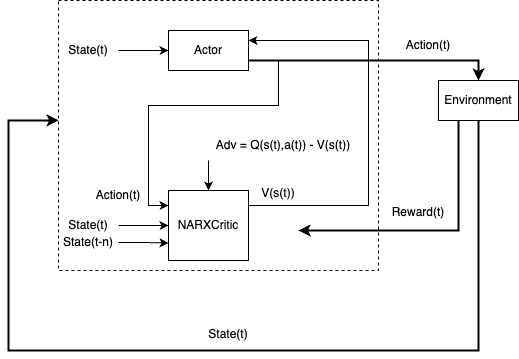
Components
- Actor: Gaussian policy \(\pi_\theta(a|s) = \mathcal{N}(\mu_\theta(s), \sigma_\theta^2)\); implemented in the
Actorclass (PyTorch) - Critic (NARX): evaluates \(V(s)\) using an extended input (current state + past signals); see
Critic(A2C) andNARX(modular NARX network) - Experience collection:
Runnergathers trajectories and clips actions to theaction_space - Training:
A2CLearner.learnupdates actor/critic with stabilization (gradient clipping, entropy bonus)
Theory (based on the implementation)
- Discounted returns:
- Advantage in the code:
and then \(A_t = \text{td\_target} - V(s_t)\).
- Losses:
NARX as critic
The NARX network (tensoraerospace/agent/narx/model.py) explicitly feeds previous outputs/states as inputs to predict the next step. In A2C the critic input is the concatenation of the current and previous states (process_memory_narx builds critic_states). This improves \(V(s)\) estimates for systems with significant dynamic memory.
Identification (simplified):
- Training NARX minimizes the MSE between predicted and target outputs over sequences (
NARX.train). - In A2C the critic minimizes the MSE between the target (returns or TD) and the current estimate \(V(s)\).
Training loop
Runner.runcollects tuples \((s_t, a_t, r_t, s_{t+1}, done_t)\), clipping actions to theaction_space.process_memory_narxprepares tensors: actions, rewards (optionally discounted), states, next states, termination flags, andcritic_states = [s_t, s_{t-1}].A2CLearner.learn:- If
discount_rewards=True, critic targettd_target = rewards(returns); otherwiser + γ V(s'). - Advantage:
advantage = td_target - V(s). - Actor: log-probabilities from
Normal(mean, std), entropy; gradient-clipped updates. - Critic: MSE; gradient-clipped updates.
- TensorBoard logging (losses, gradients/parameters, rewards).
Quick start
import gymnasium as gym
import torch
from tensoraerospace.agent.a2c.narx import Actor, Critic, A2CLearner, Runner

env = gym.make('LinearLongitudinalF16-v0', number_time_steps=2000)
actor = Actor(state_dim=env.observation_space.shape[0], n_actions=env.action_space.shape[0])
critic = Critic(state_dim=env.observation_space.shape[0])
learner = A2CLearner(actor, critic, gamma=0.99, entropy_beta=0.01)
runner = Runner(env, actor, learner.writer)

memory = runner.run(max_steps=2048)
learner.learn(memory, steps=2048, discount_rewards=True)
Tip
For systems with strong inertia set discount_rewards=False so the critic trains on the TD target with \(V(s')\).
API reference
A2CLearner(actor, critic, gamma=0.9, entropy_beta=0.01, actor_lr=0.0004, critic_lr=0.004, max_grad_norm=0.5, device=None, log_dir=None, wandb_project=None, wandb_entity=None, wandb_run_name=None, wandb_tags=None, wandb_config=None)

Learner implementing Advantage Actor-Critic (A2C) updates.
Initialize learner with optimizers and hyperparameters.
Parameters:
| Name | Type | Description | Default |
|---|---|---|---|
actor
|
Module
|
Policy network. |
required |
critic
|
Module
|
Value network. |
required |
gamma
|
float
|
Discount factor. |
0.9
|
entropy_beta
|
float
|
Entropy regularization weight. |
0.01
|
actor_lr
|
float
|
Learning rate for actor. |
0.0004
|
critic_lr
|
float
|
Learning rate for critic. |
0.004
|
max_grad_norm
|
float
|
Gradient clipping norm. |
0.5
|
log_dir
|
str | None
|
TensorBoard log directory. If None, the default
|
None
|
learn(memory, steps, discount_rewards=True)

Update actor/critic using a batch of collected transitions.
Parameters:
| Name | Type | Description | Default |
|---|---|---|---|
memory
|
list
|
Collected transitions. |
required |
steps
|
int
|
Global step index used for logging. |
required |
discount_rewards
|
bool
|
If True, uses discounted returns as TD target. |
True
|
get_param_env()

Return serializable configuration needed to reconstruct the learner.
save(path=None, save_gradients=False)

Save A2CLearner model to the specified directory.
Saves actor network, critic network, and configuration. Optionally saves optimizer states for resuming training.
Parameters:
| Name | Type | Description | Default |
|---|---|---|---|
path
|
str | Path | None
|
Base save directory. If None, saves to the current working directory. |
None
|
save_gradients
|
bool
|
If True, also persist optimizer state dicts. |
False
|
Returns:
| Name | Type | Description |
|---|---|---|
Path |
Path
|
The directory where the model was saved. |
from_pretrained(repo_name, env=None, access_token=None, version=None, load_gradients=False)
classmethod

Load pretrained model from a local directory or Hugging Face Hub.
Parameters:
| Name | Type | Description | Default |
|---|---|---|---|
repo_name
|
str
|
Path to a local folder or a Hugging Face repo id
(e.g. |
required |
env
|
Optional[Env]
|
Optional environment instance. |
None
|
access_token
|
Optional[str]
|
Hugging Face access token for private repos. |
None
|
version
|
Optional[str]
|
Revision / branch / tag on Hugging Face. |
None
|
load_gradients
|
bool
|
Restore optimizer states for continued training. |
False
|
Returns:
| Name | Type | Description |
|---|---|---|
A2CLearner |
A2CLearner
|
Initialized learner. |
publish_to_hub(repo_name, folder_path, access_token=None)

Upload a saved model folder to Hugging Face Hub.
Parameters:
| Name | Type | Description | Default |
|---|---|---|---|
repo_name
|
str
|
Repository id on Hugging Face (e.g. |
required |
folder_path
|
Union[str, Path]
|
Local folder produced by :meth: |
required |
access_token
|
Optional[str]
|
Hugging Face access token. |
None
|
Runner(env, actor, writer)

Environment interaction loop used to collect training data.
Create runner for data collection.
Parameters:
| Name | Type | Description | Default |
|---|---|---|---|
env
|
Env
|
Environment instance. |
required |
actor
|
Module
|
Policy network used to select actions. |
required |
writer
|
MetricWriter
|
TensorBoard writer for logging rewards. |
required |
reset()

Reset environment and episode state.
run(max_steps, memory=None)

Run the environment for a fixed number of steps and collect transitions.
Parameters:
| Name | Type | Description | Default |
|---|---|---|---|
max_steps
|
int
|
Number of environment steps to execute. |
required |
memory
|
list
|
Existing list to append transitions to. |
None
|
Returns:
| Name | Type | Description |
|---|---|---|
list |
list[tuple[ndarray, float, ndarray, ndarray, bool]]
|
Collected transitions. |