Recipe 15 — ET-DHP under in-flight damage
This recipe walks through example_etdhp_damage_f16.ipynb end-to-end: training the ET-DHP agent on a healthy F-16 longitudinal model, then evaluating it for 60 s with a real damage event injected at t = 20 s. The damage plumbing is the aircraft damage modeling subsystem — the env recomputes mass, area, and inertias on the fly, and the longitudinal ODE picks up the strip-theory ΔCy / ΔMy corrections, so the agent really does fly a different plant from t = 20 s onward.
Agent docs. ET-DHP · Notebook. example/reinforcement_learning/incremental_adp/example_etdhp_damage_f16.ipynb · Companion script (iADP). example/reinforcement_learning/incremental_adp/example_iadp_damage_f16.py · Related recipe. Recipe 13 — ET-DHP on the nonlinear F-16.
Why this recipe
ET-DHP is well-suited to embedded deployments thanks to its event-triggered actor/critic updates. But how does it behave when the plant itself changes mid-flight? This recipe answers two questions:
- Can ET-DHP keep flying when 30% of both wing tips are lost at t = 20 s?
- Does the Lipschitz event trigger correctly react to the changed dynamics?
The companion iADP example (linked above) tackles the same scenario with online RLS plant identification — comparing the two illustrates the trade-off between offline-fit plant NN (ET-DHP) and online RLS (iADP).
The damage event
A symmetric DamageProfile of two section_loss events fires at t = 20 s:
from tensoraerospace.aerospacemodel.f16.nonlinear.damage import (
    DamageEvent, DamageProfile,
)

damage_profile = DamageProfile(events=[
    DamageEvent(20.0, "section_loss",
                payload={"section": "left_tip", "loss_fraction": 0.30}),
    DamageEvent(20.0, "section_loss",
                payload={"section": "right_tip", "loss_fraction": 0.30}),
])
At firing the env:
- Marks
state.section_loss["left_tip"] = state.section_loss["right_tip"] = 0.30. - Recomputes effective
m, S, b, bA, J*from per-section contributions (Huygens-Steiner for the inertia tensor; mass-weighted centroid for CG). - The longitudinal ODE adds
Δcy = -Σ cl_α_s · α · f_s · area_s/S_basefrom strip theory at every step.
Symmetric loss leaves the CG centred but reduces the effective lift-curve slope and shifts inertias — the plant feels different to the controller.
Pipeline
The notebook (and equivalent script) follows ET-DHP's standard pattern with one extra piece: a damage_profile is passed to the env in the final eval episode.
import gymnasium as gym
from tensoraerospace.agent.et_dhp import ETDHPAgent, ETDHPConfig

# 1. Trim + feedforward elevator curve δₑ_trim(α)
#    (same as recipe 13)

# 2. Plant-NN pre-training on 30 s of multi-sine PE around trim
#    (healthy aircraft only — plant NN sees no damaged data)
agent.fit_plant_model(states_arr, actions_arr, next_states_arr)

# 3. Train the actor & critic for 6 episodes on the healthy F-16
for ep in range(NUM_TRAIN_EPISODES):
    log = run_episode(agent, healthy_env, learn=True)

# 4. Final evaluation — baseline (no damage)
baseline = run_episode(agent, healthy_env, learn=True)

# 5. Final evaluation — same agent, env now wraps the damage profile
def damaged_env():
    return gym.make(
        "NonlinearLongitudinalF16-v0",
        ..., damage_profile=damage_profile,
    ).unwrapped

damaged = run_episode(agent, damaged_env, learn=True)
Online actor/critic learning stays on during both eval episodes, so the trigger fires whenever tracking error crosses the Lipschitz threshold. The plant NN is frozen at its offline-pre-trained weights — that's the structural limitation we'll see below.
Training curve (6 episodes, healthy aircraft)
A representative run from the script:
ep 1/6: RMSE_late=12.5554°  triggers=266
ep 2/6: RMSE_late=0.6101°   triggers=927
ep 3/6: RMSE_late=0.2439°   triggers=530
ep 4/6: RMSE_late=0.1061°   triggers=201
ep 5/6: RMSE_late=0.1142°   triggers=160
ep 6/6: RMSE_late=0.1096°   triggers=158
The agent goes from 12.5° (random init) to ~0.11° late-window RMSE in 4–6 episodes, with trigger count converging to ~160/episode as the closed loop stabilises. Same trend as recipe 13 — adding a damage hook to the env doesn't slow down healthy training.
Final eval results
After training, two 60 s episodes:
| Baseline (no damage) | With damage (30 % bilateral tip loss @ t=20 s) | |
|---|---|---|
| Pre-damage MAE (5 – 20 s) | 0.094 ° | 0.210 ° |
| Pre-damage RMSE | 0.114 ° | 0.268 ° |
| Post-damage MAE (22 – 60 s) | 0.166 ° | 0.702 ° |
| Post-damage RMSE | 0.235 ° | 0.913 ° |
| Triggers pre / post | 56 / 261 | 219 / 547 |
| Damage events triggered | — | t=19.99 s : left_tip_30pct_loss t=19.99 s : right_tip_30pct_loss |
The headlines:
- The post-damage tracking error roughly quadruples (RMSE 0.235 ° → 0.913 °). Not catastrophic, but visibly degraded — this is the price of holding the plant NN constant across the damage event.
- The Lipschitz event trigger correctly responds: trigger count after t = 20 s doubles versus the no-damage baseline (547 vs 261). The supervisor is doing its job — it just can't get the actor/critic to a stable post-damage policy because the plant NN's
F = ∂f/∂x,G = ∂f/∂uno longer match the damaged dynamics.
Tracking traces
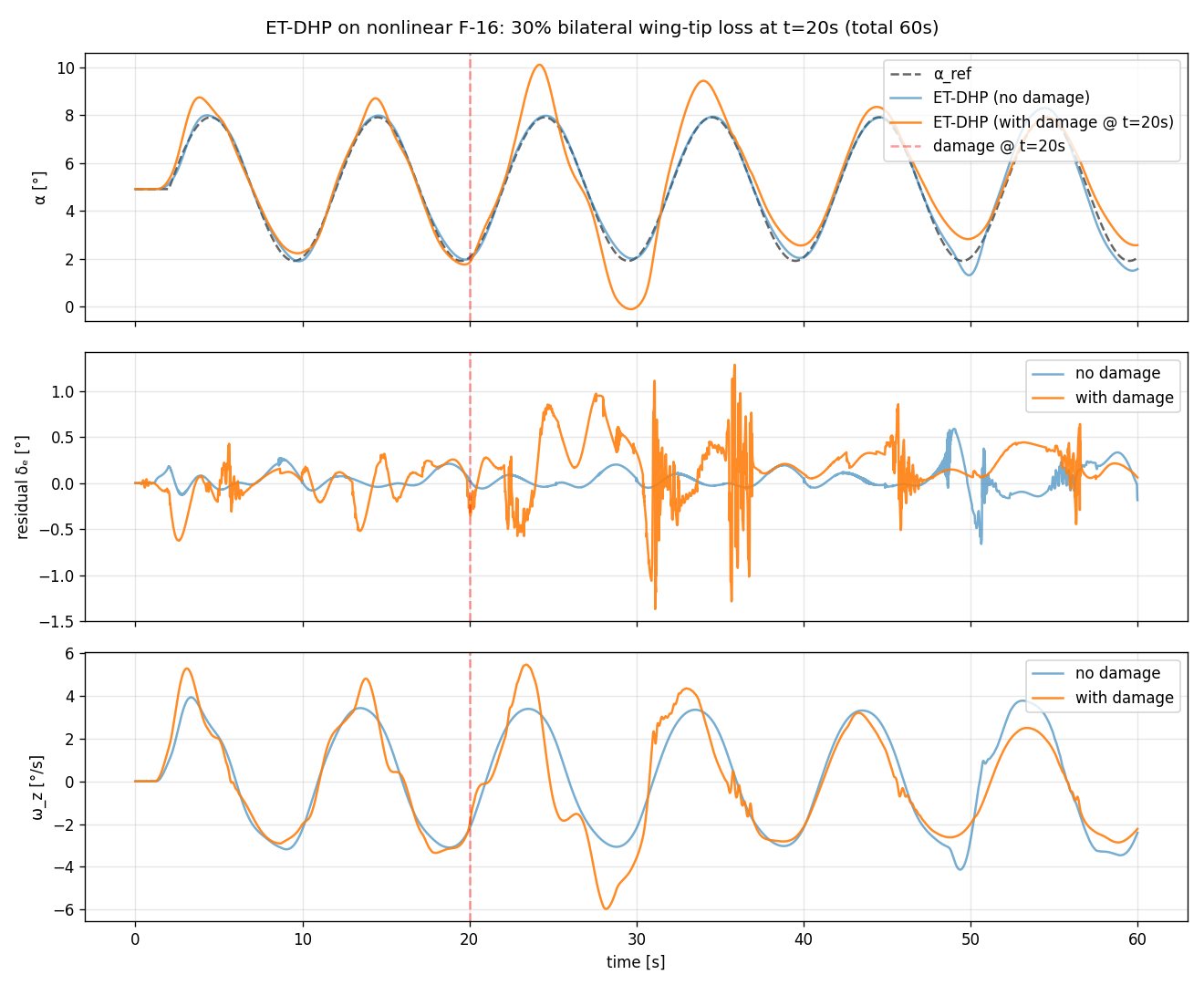
Top panel: α tracking. Both runs hit the reference cleanly until t = 20 s; after the red dashed line the damaged trace shows a visible bias and reduced amplitude (the agent is undercommanding because it's using a stale plant gain). Middle: the residual elevator goes saturation-friendly more often after damage. Bottom: pitch rate ω_z shows phase shift after damage as the actuator timing falls out of sync.
Why ET-DHP degrades — and how to recover
ET-DHP's closed-form policy is
so the action depends on G = ∂f/∂u from the plant NN. The actor and critic can adjust their weights through the event-trigger updates, but they cannot fix a stale G. Three ways to recover:
- Online plant-NN updates. Periodically call
agent.fit_plant_model(...)on a sliding window of the most recent(x, u, x_next)transitions. Practically: a 5-second window every 200 steps lets the plant NN catch the damaged dynamics within a couple of seconds. - Damage-conditioned actor. Set
damage_observable=Trueon the env and feed the section-loss vector into the agent's state. The actor can then learn a control law indexed on damage state. - Increase
u_bound. From±2°to±5°so the residual can absorb a larger plant change.
The companion iADP example (linked at the top) skips this problem entirely: its RLS identifier tracks G̃ online and the closed-form policy adapts within milliseconds. iADP's post-damage RMSE ends up indistinguishable from the no-damage baseline — at the cost of a bias-prone PE warm-start phase.
Try it
# Notebook — full narrative with plots:
jupyter lab example/reinforcement_learning/incremental_adp/example_etdhp_damage_f16.ipynb

# Or the script — same logic, faster to iterate:
poetry run python example/reinforcement_learning/incremental_adp/example_etdhp_damage_f16.py
Total runtime is ~3-5 minutes (dominated by the 6 training episodes; each is 60 s of simulation at dt = 10 ms with online actor/critic gradient steps).
See also
- Aircraft damage modeling — the damage subsystem in detail.
- Recipe 13 — ET-DHP on the nonlinear F-16 — same agent, no damage.
- Recipe 09 — Fault tolerance — broader context on adaptive RL under failures.
- iADP example with damage:
example/reinforcement_learning/incremental_adp/example_iadp_damage_f16.py— same scenario, online plant identification.