Boeing 747-100 (Nonlinear 6-DoF Model)¶
tensoraerospace.aerospacemodel.b747.nonlinear — full nonlinear 6-DoF
model of the Boeing 747-100, built from NASA CR-2144 (Heffley &
Jewell, 1972) — Aircraft Handling Qualities Data, Section IX.
| Parameter | Value |
|---|---|
| Aerodynamic source | NASA CR-2144 §IX (Heffley & Jewell 1972) |
| Published data | 10 trim points × 13 longitudinal + 15 lateral derivatives |
| Configurations | NOMINAL (cruise), POWER_APPROACH, LANDING |
| Engines | 4 × Pratt & Whitney JT9D-7 (188 400 lb T_SLS) |
| Coordinates | NED, body axis, ZYX 321 Euler |
| Control surfaces | elevator, aileron, rudder + throttle |
| Damage subsystem | per-surface effectiveness + jamming + decay |
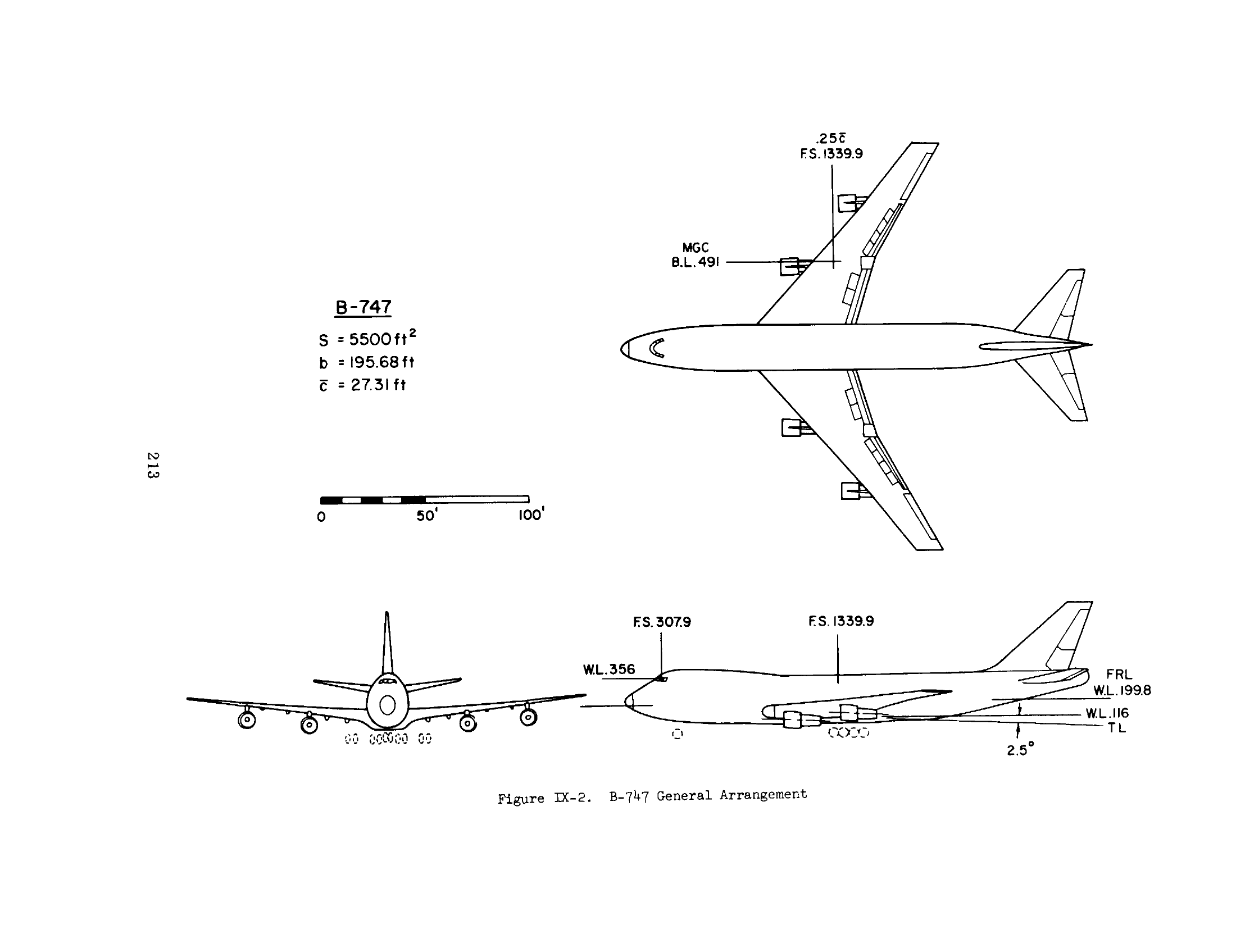
Geometry & mass (CR-2144 Table IX-3, Figure IX-2)¶
S    = 5500 ft²       (wing area)
b    = 195.68 ft       (span)
c̄    = 27.31 ft        (mean aerodynamic chord)
c.g. = 0.25 c̄         (centre of gravity)
| Configuration | W, lb | Iₓ, slug·ft² | I_y | I_z | I_xz |
|---|---|---|---|---|---|
| Nominal (TOGW − 40% fuel) | 636 600 | 18.2 × 10⁶ | 33.1 × 10⁶ | 49.7 × 10⁶ | 0.97 × 10⁶ |
| Power Approach (564 000 lb, 20° flaps) | 564 000 | 13.7 × 10⁶ | 30.5 × 10⁶ | 43.1 × 10⁶ | 0.825 × 10⁶ |
| Landing (564 000 lb, 30° flaps, gear down) | 564 000 | 13.7 × 10⁶ | 30.5 × 10⁶ | 43.1 × 10⁶ | 0.825 × 10⁶ |
Trim grid (CR-2144 Table IX-3)¶
CR-2144 publishes derivatives at 10 anchor flight conditions:
| FC | Configuration | h, ft | M | V, ft/s | α₀, deg |
|---|---|---|---|---|---|
| 1 | LANDING | 0 | 0.198 | 221 | 8.50 |
| 2 | POWER_APPROACH | 0 | 0.249 | 278 | 5.70 |
| 3 | NOMINAL | 0 | 0.450 | 502 | 3.10 |
| 4 | NOMINAL | 0 | 0.650 | 726 | 0.00 |
| 5 | NOMINAL | 20 000 | 0.500 | 518 | 6.80 |
| 6 | NOMINAL | 20 000 | 0.650 | 674 | 2.50 |
| 7 | NOMINAL | 20 000 | 0.800 | 830 | 0.00 |
| 8 | NOMINAL | 40 000 | 0.700 | 678 | 7.30 |
| 9 | NOMINAL | 40 000 | 0.800 | 774 | 4.60 |
| 10 | NOMINAL | 40 000 | 0.900 | 871 | 2.40 |
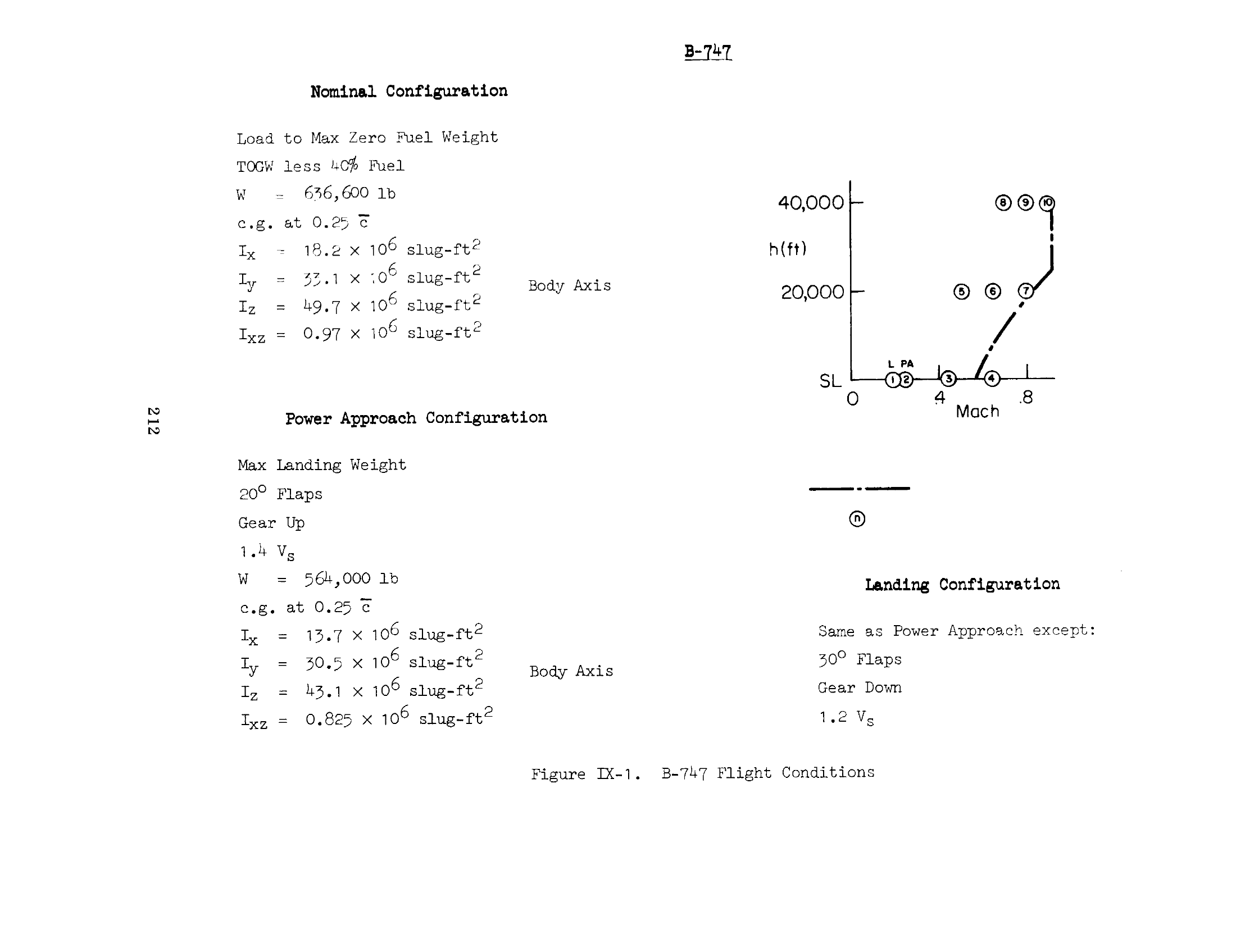
The cruise points 3..10 sit on a regular (h ∈ {0, 20K, 40K}) ×(M ∈ {0.45..0.90}) grid, allowing bilinear interpolation of all
derivatives inside the certification envelope.
State and control¶
State (12-D, body axis, NED, ZYX 321 Euler):
[u, v, w,           # body velocity, ft/s
 p, q, r,           # body angular rates, rad/s
 φ, θ, ψ,           # Euler angles, rad
 x_e, y_e, z_e]     # NED position, ft  (z_e positive down ⇒ altitude = -z_e)
Control (4-D):
Sign convention from CR-2144 Appendix A: δ_e > 0 lowers trailing
edge (nose down); δ_a > 0 right roll; δ_r > 0 right yaw;
throttle is linear, T = T_SLS · σ(h) · η(M, h) · PLA.
Equations of motion¶
Standard Newton-Euler in body axis:
Body-axis gravity components:
Forces \(X_a, Y_a, Z_a\) come from stability-axis \(L, D, Y\) via the α rotation:
Angular dynamics with \(I_{xz}\) cross-coupling:
where \(\Gamma = I_x I_z - I_{xz}^2\), \(\bar L = L_a + I_{xz}(p\,q) - (I_z - I_y)\,q\,r\), \(\bar N = N_a - I_{xz}(q\,r) - (I_y - I_x)\,p\,q\).
ZYX 321 Euler kinematics and the NED DCM are standard (Stevens-Lewis Appendix B).
Aerodynamic build¶
Non-dimensional coefficients are built by Taylor expansion around the trim point:
(analogous for \(C_D\), \(C_Y\), \(C_l\), \(C_n\)). Here \(\hat q = q\bar c/(2V)\), \(\hat p = p\,b/(2V)\), \(\hat r = r\,b/(2V)\) are the standard non-dimensional rate factors.
Dimensional forces and moments:
with ISA dynamic pressure \(q_{dyn} = \tfrac12\rho V^2\).
JT9D-7 engine¶
The 4 × JT9D-7 cluster installed thrust follows Mattingly Aircraft Engine Design §8.6.4:
with \(T_{SLS} = 188\,400\) lb (Boeing 747-100 TCDS A20WE), \(\sigma(h) = \rho(h)/\rho_{SL}\), \(n_h = 0.7\) below the tropopause / \(1.0\) above, \(\eta_{ram}(M) = 1 - 0.49\sqrt{M}\) (clamped ≥ 0.05).
| h, ft | M | δ_T | T_inst, lb |
|---|---|---|---|
| 0 | 0.0 | 1.0 | 188 400 |
| 0 | 0.2 | 1.0 | 147 115 |
| 35 000 | 0.85 | 0.80 | 36 843 |
| 40 000 | 0.90 | 0.85 | 21 281 |
Damage subsystem¶
Per-surface (elevator / aileron / rudder / throttle) effectiveness \(\mu_i \in [0,1]\) + jam deflection \(j_i\) + decay time-constant \(\tau_i\):
Five event types
(tensoraerospace.aerospacemodel.b747.nonlinear.damage):
| Event | Semantics |
|---|---|
SurfaceEffectivenessEvent(surface, mu) |
Instant loss: μ ← mu |
SurfaceJamEvent(surface, jam_value) |
Surface mechanically locks at jam_value |
SurfaceEffectivenessDecay(surface, τ, mu_floor) |
μ̇ = -(1/τ)(μ − μ_floor) |
EngineFailureEvent(engine_id, thrust_fraction) |
Single engine flameout (1..4) with asymmetric-thrust yaw moment |
FlapJamEvent(jammed_config) |
High-lift devices stuck at NOMINAL / POWER_APPROACH / LANDING |
Asymmetric-thrust yaw moment¶
When engines_mu[i] is non-uniform across the four engines, the engine
model returns both total +x thrust and a yaw moment computed from the
spanwise engine positions (±35.8 ft inner, ±71.7 ft outer):
So a dead engine on the left wing leaves more thrust on the right →
positive thrust offset toward +y → N < 0 → nose yaws left (toward
the dead engine), as observed in real V_MC engine-out incidents.
Flap-jam override¶
FlapJamEvent.jammed_config overrides the aerodynamic configuration
selection inside b747_aero regardless of params.config. The aircraft
keeps its mass / inertia from the active configuration, but lift, drag
and pitching-moment derivatives come from the jammed setting — this is
the canonical "flaps stuck at 30° during cruise" scenario.
Built-in presets:
ELEVATOR_50PCT_LOSS— 50% elevator loss at t=5 s (Lu 2019 / Wang 2019)ELEVATOR_JAMMED_NOSE_UP— Hard-over: elevator stuck at −2°AILERON_TOTAL_LOSS— Total aileron loss at t=8 sRUDDER_HYDRAULIC_LEAK— Gradual rudder decay (τ=8 s, floor=0.3)ENGINE_FLAMEOUT— Throttle locked to idle at t=15 sLEFT_OUTER_ENGINE_FAILURE— Engine #1 flameout at t=10 s (≈ 75% thrust + nose-left yaw)LEFT_TWO_ENGINES_OUT— Both left engines fail at t=10 s (≈ 50% thrust, max asymmetry)FLAPS_JAMMED_LANDING— Flaps stuck at 30° at t=5 s (high CL/CD, low V_max)FLAPS_JAMMED_RETRACTED— Flaps fail to deploy past clean at t=5 s
Trim finder¶
tensoraerospace.aerospacemodel.b747.nonlinear.trim(h, V) solves
(u̇, ẇ, q̇) = 0 via Newton-Raphson (scipy.optimize.fsolve),
returning trimmed (α, δ_e, δ_T) at the requested (altitude,
airspeed, configuration). For the landing configuration (FC1,
V=221 ft/s) the trimmer returns α=8.17°, matching the published
8.50° within 0.35° (figure-digitisation noise).
Gymnasium env¶
Registered as "NonlinearB747-v0". Three initialisation modes:
import gymnasium as gym
import tensoraerospace  # registers the env

# 1. By one of the 10 published trim points
env = gym.make("NonlinearB747-v0", flight_condition_id=4, number_time_steps=2000)

# 2. Trim-finder at arbitrary (h, V)
env = gym.make("NonlinearB747-v0", trim_at=(20000.0, 674.0), number_time_steps=2000)

# 3. Arbitrary initial state
env = gym.make("NonlinearB747-v0",
    initial_state=np.array([726, 0, 0, 0, 0, 0, 0, 0, 0, 0, 0, 0]),
    number_time_steps=2000)
Action-space: either "virtual" (physical units) or "normalized"
(for RL: [-1, 1]^4).
Related modules¶
- Boeing 747-100 (linear) — legacy single-trim-point state-space model (longitudinal channel only).
- B-747 usage examples — practical recipes (trim, cruise, gymnastics, elevator failure).
- Aircraft Damage Modeling — general damage-subsystem concept (F-16 version).
References¶
- NASA CR-2144 — Heffley R.K., Jewell W.F. Aircraft Handling Qualities Data, Systems Technology Inc., December 1972, §IX.
- Boeing 747-100 Type Certificate Data Sheet A20WE (FAA).
- Mattingly J.D. Aircraft Engine Design, AIAA Education Series, 2nd ed., 2002 — §8.6.4 (installed-thrust lapse model).
- Stevens B.L., Lewis F.L., Johnson E.N. Aircraft Control and Simulation, Wiley, 3rd ed., 2015 — §3.7 (trim algorithm), Appendix B (ZYX 321 kinematics).