A3C (Asynchronous Advantage Actor‑Critic)
A3C combines the strengths of policy-based and value-based methods: multiple asynchronous workers explore the environment in parallel and update a shared (global) network using the advantage function. This PyTorch implementation uses multiprocessing with a shared global network and SharedAdam optimizer.
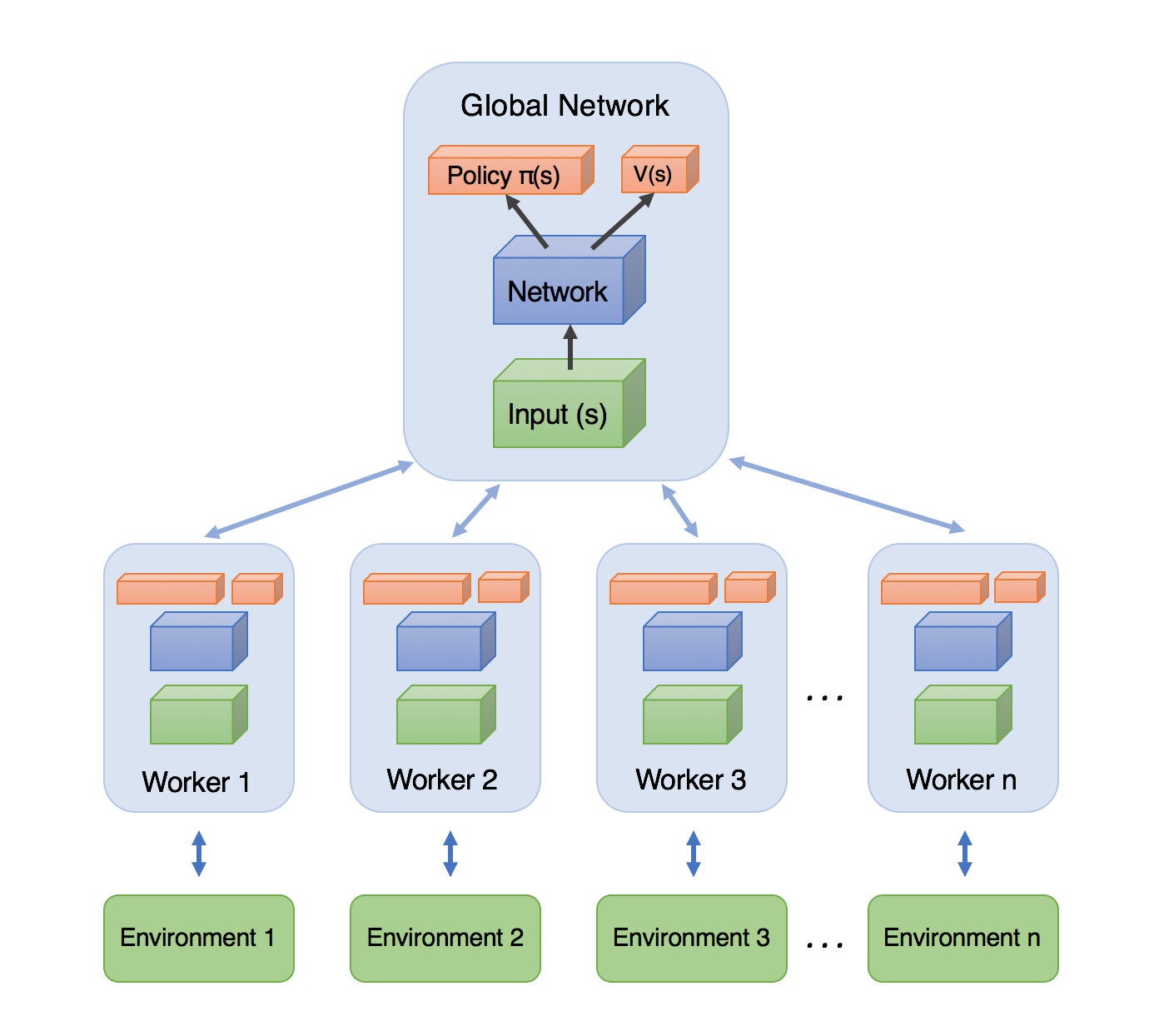
Components
- Global Network: Shared parameters for both Actor (policy) and Critic (value) in a single
Netmodule - Workers: Independent processes, each with its own environment and local network copy
- SharedAdam: Optimizer with shared state across processes for consistent parameter updates
- Advantage: TD-error used to weight policy gradients and update value function
Theory (based on the implementation)
Network Architecture
The Net module combines both Actor and Critic:
Actor branch: - Input → Linear(s_dim, 256) → ReLU6 - → mu: Linear(256, a_dim) → Tanh → scale by 2 (action range: [-2, 2]) - → sigma: Linear(256, a_dim) → Softplus + 0.001 (for numerical stability)
Critic branch: - Input → Linear(s_dim, 256) → ReLU6 - → value: Linear(256, 1)
Policy (Actor) — Gaussian Distribution
The actor outputs mean \(\mu(s)\) and standard deviation \(\sigma(s)\). Actions are sampled from:
For multidimensional actions, an Independent distribution wraps the base Normal distribution.
Log-probability:
Value Function (Critic)
The critic estimates state value \(V_\phi(s)\). The temporal difference error is:
Value loss (mean squared error):
N-Step Returns with Bootstrapping
The implementation uses proper n-step returns with bootstrapping:
If the episode terminates, \(V_\phi(s_{t+n}) = 0\).
Loss Function
Policy loss (with entropy regularization):
where \(H[\pi]\) is the entropy of the policy.
Total loss:
The advantage (TD-error) is detached when computing policy loss to prevent backpropagation through the value function.
Asynchrony and Synchronization
The implementation uses torch.multiprocessing for parallel training:
- Gradient computation: Each worker computes gradients on its local network
- Push gradients: Local gradients are transferred to global network parameters (
gp._grad = lp.grad) - Gradient clipping: Global gradients are clipped (max_norm=40.0) for stability
- Optimizer step: SharedAdam updates global network parameters
- Pull parameters: Local network loads updated global parameters (
load_state_dict)
This push-and-pull happens every update_global_iter steps or when an episode ends.
Hyperparameters
lr: Learning rate for SharedAdam (default: 1e-4)gamma: Discount factor (default: 0.99)n_workers: Number of parallel workers (default: CPU count)max_episodes: Total episodes to run (default: 10)max_ep_step: Maximum steps per episode (default: 200)update_global_iter: Frequency of global updates (default: 10)- Entropy coefficient: 0.005 (hardcoded in loss function)
- Hidden layer size: 256 (hardcoded in Net architecture)
Training Algorithm (Pseudocode)
# Global setup
global_net = Net(s_dim, a_dim).share_memory()
optimizer = SharedAdam(global_net.parameters(), lr)

# Each worker runs in parallel:
def worker_process(worker_id):
    local_net = Net(s_dim, a_dim)
    local_net.load_state_dict(global_net.state_dict())  # Initial sync
    env = env_function(worker_id)

    while global_episodes < max_episodes:
        s = env.reset()
        buffer_s, buffer_a, buffer_r = [], [], []
        episode_reward = 0

        for t in range(max_ep_step):
            # Select action
            a = local_net.choose_action(s)
            s', r, done = env.step(clip(a, action_space))

            # Store transition
            buffer_s.append(s)
            buffer_a.append(a)
            buffer_r.append(r)
            episode_reward += r

            # Update condition
            if t % update_global_iter == 0 or done:
                # Compute n-step returns with bootstrapping
                if done:
                    v_s_ = 0
                else:
                    v_s_ = local_net.forward(s')[2]  # value estimate

                # Reverse accumulation
                returns = []
                for r in reversed(buffer_r):
                    v_s_ = r + gamma * v_s_
                    returns.insert(0, v_s_)

                # Compute loss
                loss = local_net.loss_func(buffer_s, buffer_a, returns)

                # Push gradients to global, pull updated parameters
                optimizer.zero_grad()
                loss.backward()
                transfer_gradients(local_net, global_net)
                clip_grad_norm(global_net.parameters(), max_norm=40.0)
                optimizer.step()
                local_net.load_state_dict(global_net.state_dict())

                # Clear buffers
                buffer_s, buffer_a, buffer_r = [], [], []

                if done:
                    record_episode(episode_reward)
                    break

            s = s'
Quick Start
Here's a complete example training A3C on the B747 environment to track a sinusoidal pitch angle:
import numpy as np
import torch
from tensoraerospace.envs.b747 import ImprovedB747Env
from tensoraerospace.signals.standard import sinusoid_vertical_shift
from tensoraerospace.utils import convert_tp_to_sec_tp, generate_time_period
from tensoraerospace.agent.a3c import Agent, setup_global_params

# Set random seed
SEED = 42
np.random.seed(SEED)
torch.manual_seed(SEED)

# Create time base and reference signal
dt = 0.1
_tp = generate_time_period(tn=20, dt=dt)
tps = convert_tp_to_sec_tp(_tp, dt=dt)
number_time_steps = len(_tp)

reference_signals = np.reshape(
    sinusoid_vertical_shift(
        tp=np.asarray(tps),
        frequency=0.05,
        amplitude=np.deg2rad(1.0),
        vertical_shift=0.0,
    ),
    [1, -1],
)

# Initial state: [u, w, q, theta]
init_state = np.array([0.0, 0.0, 0.0, 0.0], dtype=np.float32)

# Configure hyperparameters
setup_global_params(
    max_episodes=3000,
    max_ep_step=number_time_steps,
    gamma=0.99,
    update_global_iter=10,
    lr=1e-4,
)

# Environment factory
def make_env(worker_id: int):
    return ImprovedB747Env(
        initial_state=init_state,
        reference_signal=reference_signals,
        number_time_steps=number_time_steps,
        dt=dt,
        initial_elevator_deg=0.0,
    )

# Create and train agent
agent = Agent(
    env_function=make_env,
    gamma=0.99,
    n_workers=4,
    lr=1e-4,
    max_episodes=3000,
    max_ep_step=number_time_steps,
    update_global_iter=10,
    render=False,
    run_in_main=True,  # Set False for multiprocessing
    log_dir="runs/a3c_b747",
)

# Train
agent.train()

# Evaluate
eval_env = make_env(0)
obs, _ = eval_env.reset()
agent.gnet.eval()
episode_reward = 0.0

with torch.no_grad():
    terminated = truncated = False
    while not (terminated or truncated):
        obs_tensor = torch.from_numpy(np.array(obs).reshape(1, -1).astype(np.float32))
        mu, _, _ = agent.gnet.forward(obs_tensor)
        action = mu.cpu().numpy().reshape(-1)
        obs, reward, terminated, truncated, _ = eval_env.step(action)
        episode_reward += reward

print(f"Evaluation reward: {episode_reward:.4f}")
eval_env.close()
agent.close()
Monitoring with TensorBoard
Metrics include: - Loss/w*/total: Total loss per worker - Loss/w*/value: Value loss (TD error) - Loss/w*/policy: Policy loss - Loss/w*/entropy: Policy entropy - Performance/w*/episode_reward: Episode rewards - Performance/w*/moving_avg_reward: Moving average
Best Practices
- Use
run_in_main=Truefor notebooks/debugging - Set
run_in_main=Falseandn_workers=8for production training - Actions are automatically clipped to
env.action_space.low/high - Sigma has minimum value 0.001 for numerical stability
- Monitor TensorBoard for entropy collapse or value loss divergence
Advanced Example: Training on B747 Environment
This complete example demonstrates training an A3C agent on the ImprovedB747Env to track a sinusoidal pitch angle reference.
Setup and Environment Creation
import numpy as np
import torch
import matplotlib.pyplot as plt
from queue import Empty

from tensoraerospace.envs.b747 import ImprovedB747Env
from tensoraerospace.signals.standard import sinusoid_vertical_shift
from tensoraerospace.utils import convert_tp_to_sec_tp, generate_time_period
from tensoraerospace.agent.a3c import Agent, setup_global_params

# Set random seed for reproducibility
SEED = 42
np.random.seed(SEED)
torch.manual_seed(SEED)

# Create time base
dt = 0.1  # seconds
_tp = generate_time_period(tn=20, dt=dt)
tps = convert_tp_to_sec_tp(_tp, dt=dt)
number_time_steps = len(_tp)

print(f"Episode length: {number_time_steps} steps ({number_time_steps * dt:.1f} seconds)")

# Generate sinusoidal reference signal for pitch angle (theta)
reference_signals = np.reshape(
    sinusoid_vertical_shift(
        tp=np.asarray(tps),
        frequency=0.05,             # Hz
        amplitude=np.deg2rad(1.0),  # 1 degree amplitude
        vertical_shift=0.0,
    ),
    [1, -1],
)

# Define initial state: [u, w, q, theta]
init_state = np.array([0.0, 0.0, 0.0, 0.0], dtype=np.float32)

# Create environment
env = ImprovedB747Env(
    initial_state=init_state,
    reference_signal=reference_signals,
    number_time_steps=number_time_steps,
    dt=dt,
    initial_elevator_deg=0.0,
)

print(f"Observation space: {env.observation_space}")
print(f"Action space: {env.action_space}")
Configure and Create Agent
# Configure hyperparameters
setup_global_params(
    max_episodes=3000,
    max_ep_step=number_time_steps,
    gamma=0.99,
    update_global_iter=10,
    lr=1e-4,
)

# Environment factory function
def make_env(worker_id: int):
    """Create environment for each worker."""
    return ImprovedB747Env(
        initial_state=init_state,
        reference_signal=reference_signals,
        number_time_steps=number_time_steps,
        dt=dt,
        initial_elevator_deg=0.0,
    )

# Create A3C agent
agent = Agent(
    env_function=make_env,
    gamma=0.99,
    n_workers=4,              # Use 4 parallel workers
    lr=1e-4,
    max_episodes=3000,
    max_ep_step=number_time_steps,
    update_global_iter=10,
    render=False,
    run_in_main=True,         # Set to False for true multiprocessing
    log_dir="runs/a3c_b747",
)

print("A3C Agent created successfully!")
Train the Agent
import time

print("Starting A3C training...\n")

episode_rewards = []
start_time = time.time()

# Start training (synchronous if run_in_main=True)
agent.train()

# Collect rewards from queue
while True:
    try:
        r = agent.res_queue.get_nowait()
    except Empty:
        break
    if r is None:
        break
    episode_rewards.append(float(r))

training_time = time.time() - start_time
print(f"\nTraining completed in {training_time:.2f} seconds")
print(f"Total episodes: {len(episode_rewards)}")
print(f"Final reward (moving avg): {episode_rewards[-1]:.4f}")
Plot Training Progress
plt.figure(figsize=(12, 5))
plt.plot(episode_rewards, label='Moving avg reward', alpha=0.7)

# Add smoothed trend
window = 50
if len(episode_rewards) >= window:
    smoothed = np.convolve(episode_rewards, np.ones(window)/window, mode='valid')
    plt.plot(range(window-1, len(episode_rewards)), smoothed,
             'r-', linewidth=2, label=f'Smoothed (MA{window})')

plt.grid(True, alpha=0.3)
plt.xlabel('Episode')
plt.ylabel('Reward (moving average)')
plt.title('A3C Training Progress on B747 Environment')
plt.legend()
plt.tight_layout()
plt.show()
Evaluate Trained Policy
# Deterministic evaluation using policy mean
eval_env = make_env(0)
obs, info = eval_env.reset()

agent.gnet.eval()
episode_reward = 0.0
terminated = False
truncated = False

with torch.no_grad():
    while not (terminated or truncated):
        obs_tensor = torch.from_numpy(np.array(obs).reshape(1, -1).astype(np.float32))
        mu, sigma, value = agent.gnet.forward(obs_tensor)

        # Use mean for deterministic policy
        action = mu.cpu().numpy().reshape(-1)

        obs, reward, terminated, truncated, info = eval_env.step(action)
        episode_reward += float(reward)

print(f"Deterministic evaluation reward: {episode_reward:.4f}")

# Plot pitch angle tracking
eval_env.unwrapped.model.plot_transient_process(
    'theta',
    tps,
    reference_signals[0],
    to_deg=True,
    figsize=(15, 4)
)

eval_env.close()
agent.close()
Monitor with TensorBoard
Available metrics: - Loss/w*/total: Total loss per worker - Loss/w*/value: Value function loss (TD error squared) - Loss/w*/policy: Policy loss (negative expected advantage) - Loss/w*/entropy: Policy entropy (exploration measure) - Performance/w*/episode_reward: Raw episode rewards - Performance/w*/moving_avg_reward: Exponentially weighted moving average
Expected Results
After 3000 episodes of training: - Agent learns to track sinusoidal pitch reference with ~1° amplitude - Final moving average reward: approximately -1.6 to -2.0 - Pitch tracking error: < 0.5° RMS
Tips for Better Performance
- Increase training duration: 10000+ episodes for better convergence
- Tune hyperparameters:
- Lower
lr(5e-5) for more stable learning - Increase
update_global_iter(20-30) for smoother gradients - Use multiple workers: Set
run_in_main=Falseandn_workers=8for faster training - Adjust reference signal: Try different frequencies and amplitudes
- Monitor TensorBoard: Watch for entropy collapse or value loss divergence
Unified training interface
A3C follows the shared unified train() signature from BaseRLModel:
agent.train(
    num_episodes=500,   # optional: overrides self.max_episodes
    max_steps=200,      # optional: overrides self.max_ep_step
)
Calling agent.train() with no arguments still works and preserves
the values passed to the Agent constructor (max_episodes,
max_ep_step). The method returns a dict with global_ep,
global_step and global_ep_r.
API Reference
Agent
Agent(env_function, gamma=DEFAULT_GAMMA, n_workers=None, lr=DEFAULT_LR, max_episodes=DEFAULT_MAX_EP, max_ep_step=DEFAULT_MAX_EP_STEP, update_global_iter=DEFAULT_UPDATE_GLOBAL_ITER, render=False, run_in_main=False, log_dir='runs/a3c', wandb_project=None, wandb_entity=None, wandb_run_name=None, wandb_tags=None, wandb_config=None)

Simple A3C Agent wrapper around multiprocessing Workers.
Parameters:
| Name | Type | Description | Default |
|---|---|---|---|
env_function
|
Callable[[int], Env]
|
callable that returns a new env for a given worker id. |
required |
gamma
|
float
|
discount factor. |
DEFAULT_GAMMA
|
n_workers
|
Optional[int]
|
number of worker processes. |
None
|
lr
|
float
|
learning rate for SharedAdam. |
DEFAULT_LR
|
max_episodes
|
int
|
total episodes to run per global counter. |
DEFAULT_MAX_EP
|
max_ep_step
|
int
|
max steps per episode. |
DEFAULT_MAX_EP_STEP
|
update_global_iter
|
int
|
frequency to push/pull. |
DEFAULT_UPDATE_GLOBAL_ITER
|
render
|
bool
|
render from worker w0 (optional). |
False
|
Note: For unit tests or debugging, set run_in_main=True to avoid spawning processes. The single worker will run in the main process.
Configure A3C agent wrapper.
Parameters:
| Name | Type | Description | Default |
|---|---|---|---|
env_function
|
Callable[[int], Env]
|
Factory returning an environment per worker id. |
required |
gamma
|
float
|
Discount factor. |
DEFAULT_GAMMA
|
n_workers
|
Optional[int]
|
Number of worker processes; defaults to CPU count. |
None
|
lr
|
float
|
Learning rate for optimizer. |
DEFAULT_LR
|
max_episodes
|
int
|
Total episodes to run. |
DEFAULT_MAX_EP
|
max_ep_step
|
int
|
Max steps per episode. |
DEFAULT_MAX_EP_STEP
|
update_global_iter
|
int
|
Sync frequency for global net updates. |
DEFAULT_UPDATE_GLOBAL_ITER
|
render
|
bool
|
Whether to render from worker 0. |
False
|
run_in_main
|
bool
|
If True, run worker inline for debugging/tests. |
False
|
log_dir
|
str
|
TensorBoard log directory. |
'runs/a3c'
|
train(num_episodes=None, *, max_steps=None, save_best=False, save_path=None, verbose=True, **kwargs)

Launch training across worker processes (unified interface).
Parameters:
| Name | Type | Description | Default |
|---|---|---|---|
num_episodes
|
Optional[int]
|
Override for |
None
|
max_steps
|
Optional[int]
|
Override for |
None
|
save_best
|
bool
|
Reserved for API consistency. |
False
|
save_path
|
Optional[str]
|
Reserved for API consistency. |
None
|
verbose
|
bool
|
Reserved for symmetry. |
True
|
**kwargs
|
Any
|
Currently unused. |
{}
|
Returns:
| Name | Type | Description |
|---|---|---|
dict |
dict
|
Summary dictionary ( |
dict
|
|
close()

Close TensorBoard writer and cleanup resources.
get_param_env()

Return serializable configuration of the agent.
save(path=None, save_gradients=False)

Save A3C agent to the specified directory.
Saves the global actor-critic network and configuration. Optionally saves the shared optimizer state for resuming training.
Parameters:
| Name | Type | Description | Default |
|---|---|---|---|
path
|
str | Path | None
|
Base save directory. If None, saves to the current working directory. |
None
|
save_gradients
|
bool
|
If True, also save optimizer state dict. |
False
|
Returns:
| Name | Type | Description |
|---|---|---|
Path |
Path
|
The directory where the model was saved. |
load(path, env_function=None, load_gradients=False)
classmethod

Load an A3C agent from a checkpoint directory.
Parameters:
| Name | Type | Description | Default |
|---|---|---|---|
path
|
Union[str, Path]
|
Directory containing saved model files. |
required |
env_function
|
Optional[Callable[[int], Env]]
|
Factory returning an environment per worker id. Required because A3C needs environments for its workers. |
None
|
load_gradients
|
bool
|
If True, restore optimizer state. |
False
|
Returns:
| Name | Type | Description |
|---|---|---|
Agent |
'Agent'
|
Reconstructed agent. |
from_pretrained(repo_name, env_function=None, access_token=None, version=None, load_gradients=False)
classmethod

Load pretrained model from a local directory or Hugging Face Hub.
Parameters:
| Name | Type | Description | Default |
|---|---|---|---|
repo_name
|
str
|
Path to a local folder or a Hugging Face repo id
(e.g. |
required |
env_function
|
Optional[Callable[[int], Env]]
|
Factory returning an environment per worker id (required). |
None
|
access_token
|
Optional[str]
|
Hugging Face access token for private repos. |
None
|
version
|
Optional[str]
|
Revision / branch / tag on Hugging Face. |
None
|
load_gradients
|
bool
|
Restore optimizer state for continued training. |
False
|
Returns:
| Name | Type | Description |
|---|---|---|
Agent |
'Agent'
|
Initialized agent. |
publish_to_hub(repo_name, folder_path, access_token=None)

Upload a saved model folder to Hugging Face Hub.
Parameters:
| Name | Type | Description | Default |
|---|---|---|---|
repo_name
|
str
|
Repository id on Hugging Face (e.g. |
required |
folder_path
|
Union[str, Path]
|
Local folder produced by :meth: |
required |
access_token
|
Optional[str]
|
Hugging Face access token. |
None
|
Worker
Worker(gnet, opt, global_ep, global_ep_r, res_queue, name, num_actions, num_observations, MAX_EP, MAX_EP_STEP, GAMMA, update_global_iter, env_function=None, env=None, render=False, writer=None, global_step=None, global_env_step=None)

Bases: Process
Worker process class for asynchronous agent training.
Parameters:
| Name | Type | Description | Default |
|---|---|---|---|
env
|
Env
|
Environment for agent training. |
None
|
gnet
|
Net
|
Global model for shared training. |
required |
opt
|
SharedAdam
|
Optimizer for global network. |
required |
global_ep
|
Value
|
Global episode counter. |
required |
global_ep_r
|
Value
|
Global total reward counter across all processes. |
required |
res_queue
|
Queue
|
Queue for storing results. |
required |
name
|
int
|
Process number. |
required |
num_actions
|
int
|
Number of possible actions in the environment. |
required |
num_observations
|
int
|
Number of observations (state variables) in the environment. |
required |
MAX_EP
|
int
|
Maximum number of episodes. |
required |
MAX_EP_STEP
|
int
|
Maximum number of steps per episode. |
required |
GAMMA
|
float
|
Discount factor for future rewards. |
required |
update_global_iter
|
int
|
Frequency of global model updates. |
required |
render
|
bool
|
Whether to render the environment. Defaults to False. |
False
|
writer
|
Optional[SummaryWriter]
|
TensorBoard writer. Defaults to None. |
None
|
global_step
|
Optional[Value]
|
Global step counter. Defaults to None. |
None
|
Attributes:
| Name | Type | Description |
|---|---|---|
name |
str
|
Unique process name. |
g_ep |
Value
|
Global episode counter. |
g_ep_r |
Value
|
Global total reward counter. |
res_queue |
Queue
|
Results queue. |
gnet |
Net
|
Global neural network. |
opt |
SharedAdam
|
Optimizer for updating global network. |
lnet |
Net
|
Local neural network. |
env |
Env
|
OpenAI Gym environment. |
gamma |
float
|
Discount factor. |
max_ep |
int
|
Maximum number of episodes. |
max_ep_step |
int
|
Maximum number of steps per episode. |
update_global_iter |
int
|
Frequency of global network updates. |
render |
bool
|
Whether to render the environment. |
writer |
Optional[SummaryWriter]
|
TensorBoard writer. |
global_step |
Optional[Value]
|
Global step counter. |
Initialize worker process.
Parameters:
| Name | Type | Description | Default |
|---|---|---|---|
env_function
|
Optional[Callable[[int], Env]]
|
Factory callable taking worker id and returning
a fresh env. The env is created inside |
None
|
env
|
Optional[Env]
|
Legacy/direct env instance. Provided for backward compatibility (and for single-process tests); DO NOT use this path with real multi-process training because a single env would be shared across forked workers. |
None
|
gnet
|
Net
|
Global shared network. |
required |
opt
|
SharedAdam
|
Shared optimizer. |
required |
global_ep
|
Any
|
Shared episode counter. |
required |
global_ep_r
|
Any
|
Shared reward accumulator. |
required |
res_queue
|
Queue
|
Queue for results. |
required |
name
|
int
|
Worker id. |
required |
num_actions
|
int
|
Action dimension. |
required |
num_observations
|
int
|
Observation dimension. |
required |
MAX_EP
|
int
|
Max episodes to run. |
required |
MAX_EP_STEP
|
int
|
Max steps per episode. |
required |
GAMMA
|
float
|
Discount factor. |
required |
update_global_iter
|
int
|
Steps between syncs with global net. |
required |
render
|
bool
|
Whether to render (only worker 0 typically). |
False
|
writer
|
Optional[MetricWriter]
|
TensorBoard writer for metrics. |
None
|
global_step
|
Any | None
|
Shared global update counter (push_and_pull count). |
None
|
global_env_step
|
Any | None
|
Shared global env-step counter (incremented
once per |
None
|
run()

Execute worker process containing agent training.
Network
Net(s_dim, a_dim)

Bases: Module
Neural network for policy and value function approximation in RL.
Parameters:
| Name | Type | Description | Default |
|---|---|---|---|
s_dim
|
int
|
State space dimension. |
required |
a_dim
|
int
|
Action space dimension. |
required |
Attributes:
| Name | Type | Description |
|---|---|---|
s_dim |
int
|
State space dimension. |
a_dim |
int
|
Action space dimension. |
a1 |
Linear
|
First policy layer. |
mu |
Linear
|
Mean layer of policy distribution. |
sigma |
Linear
|
Standard deviation layer of policy distribution. |
c1 |
Linear
|
First value function layer. |
v |
Linear
|
Value function output layer. |
distribution |
Distribution
|
Distribution for modeling agent actions. |
Create network layers.
Parameters:
| Name | Type | Description | Default |
|---|---|---|---|
s_dim
|
int
|
State dimension. |
required |
a_dim
|
int
|
Action dimension. |
required |
forward(x)

Perform one forward pass.
Parameters:
| Name | Type | Description | Default |
|---|---|---|---|
x
|
Tensor
|
Input data, environment state. |
required |
Returns:
| Type | Description |
|---|---|
Tensor
|
Tuple[torch.Tensor, torch.Tensor, torch.Tensor]: Predicted mu, sigma, |
Tensor
|
and value for the given state. |
choose_action(s)

Select agent action based on current state.
Parameters:
| Name | Type | Description | Default |
|---|---|---|---|
s
|
Tensor
|
Current environment state. |
required |
Returns:
| Type | Description |
|---|---|
ndarray
|
np.ndarray: Selected action. |
loss_func(s, a, v_t)

Compute loss function for network training.
Parameters:
| Name | Type | Description | Default |
|---|---|---|---|
s
|
Tensor
|
States. |
required |
a
|
Tensor
|
Actions. |
required |
v_t
|
Tensor
|
Target state value function values. |
required |
Returns:
| Type | Description |
|---|---|
Tensor
|
torch.Tensor: Loss function value. |
Optimizer
SharedAdam(params, lr=0.001, betas=(0.9, 0.99), eps=1e-08, weight_decay=0)

Bases: Adam
Adam optimizer with shared state for multi-process training.
This optimizer stores its internal state tensors (step counter, exp_avg, exp_avg_sq) in shared memory so multiple worker processes can update a single set of parameters consistently.
Parameters:
| Name | Type | Description | Default |
|---|---|---|---|
params
|
Iterable[Parameter]
|
Parameters to optimize. |
required |
lr
|
float
|
Learning rate. Defaults to |
0.001
|
betas
|
Tuple[float, float]
|
Coefficients used for computing running averages of gradient and
its square. Defaults to |
(0.9, 0.99)
|
eps
|
float
|
Term added to the denominator for numerical stability. Defaults to
|
1e-08
|
weight_decay
|
float
|
Weight decay (L2 penalty). Defaults to |
0
|
Initialize shared Adam optimizer.
Parameters:
| Name | Type | Description | Default |
|---|---|---|---|
params
|
Iterable[Parameter]
|
Iterable of parameters to optimize. |
required |
lr
|
float
|
Learning rate. |
0.001
|
betas
|
Tuple[float, float]
|
Beta coefficients for Adam moments. |
(0.9, 0.99)
|
eps
|
float
|
Numerical stability term. |
1e-08
|
weight_decay
|
float
|
L2 weight decay. |
0
|
Utilities
setup_global_params(*, max_episodes=DEFAULT_MAX_EP, max_ep_step=DEFAULT_MAX_EP_STEP, gamma=DEFAULT_GAMMA, update_global_iter=DEFAULT_UPDATE_GLOBAL_ITER, lr=DEFAULT_LR)

Update defaults used by Agent.
This matches the previous TF API name to ease migration.
Implementation Details
Key Features
- Unified Network: Single
Netmodule with shared layers, reducing memory overhead - ReLU6 Activation: More stable gradients compared to standard ReLU
- Gradient Clipping: Max norm of 40.0 prevents exploding gradients
- Entropy Regularization: Coefficient of 0.005 encourages exploration
- SharedAdam: Optimizer state shared across processes for consistent updates
- Proper Bootstrapping: N-step returns include terminal state value when episode continues
Advantages over Synchronous Methods
- Parallel Experience Collection: Multiple workers explore simultaneously
- Decorrelated Samples: Different workers in different states reduce correlation
- No Replay Buffer: Online learning reduces memory requirements
- Natural Exploration: Asynchrony provides diversity without ε-greedy
Debugging Tips
- Use
run_in_main=Trueto run single worker without multiprocessing - Check TensorBoard for loss divergence or entropy collapse
- Reduce
lrif training is unstable - Increase
update_global_iterfor more stable gradients - Ensure environment is properly seeded for reproducibility
References
- Asynchronous Methods for Deep Reinforcement Learning (Mnih et al., 2016)
- PyTorch Multiprocessing Best Practices
Tested Environments
- Unity ML-Agents environments
- Gymnasium continuous control tasks
- TensorAeroSpace LinearLongitudinal* environments
- Custom aerospace control environments