Example: ET-DHP holding initial heading after a single-engine flameout (B-747)

This example trains an Event-Triggered Dual Heuristic Programming (ET-DHP) agent to keep the nonlinear Boeing 747-100 on its initial heading \(\psi_0 = 0\) after the left outer engine flames out at \(t = 10\) s. Source notebook: example/reinforcement_learning/incremental_adp/example_etdhp_b747_engine_failure.ipynb.
Engine failure is implemented through the
LEFT_OUTER_ENGINE_FAILUREpreset of the B-747 damage subsystem. Engine #1's effectiveness drops to zero, and the engine model returns an asymmetric-thrust yaw moment computed from the engine's spanwise position \(y_1 = -71.7\) ft (CR-2144 Figure IX-2 layout).
Where the failure happens
The schematic below summarises the geometry of the disturbance the controller must reject:
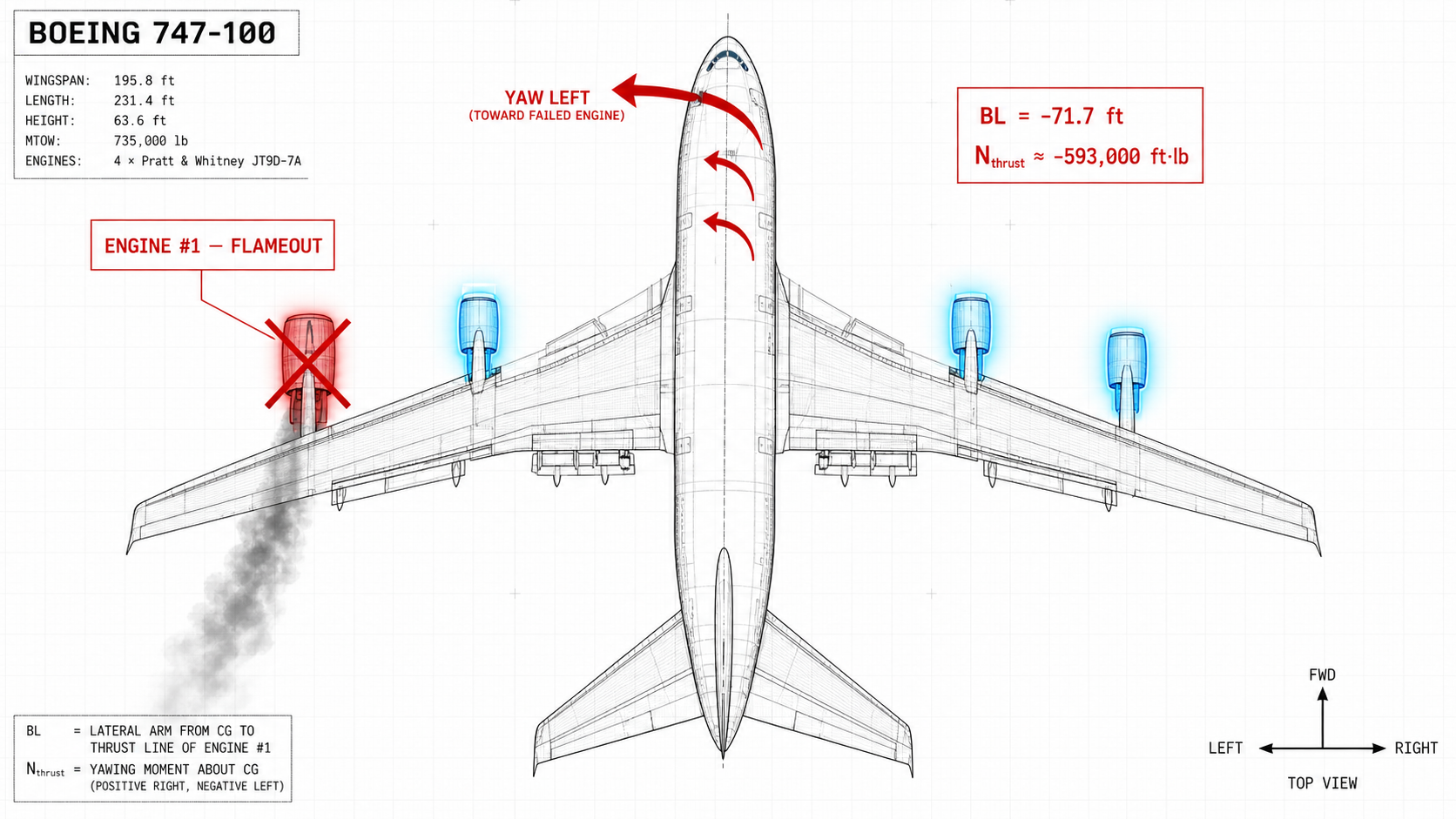
- Engine #1 (the left outermost) loses all thrust at \(t = 10\) s — depicted by the red cross and trailing smoke.
- The three surviving engines deliver thrust on lines that all sit to the right of the centre of mass; the resulting net thrust offset produces a constant nose-left yawing moment \(N_\text{thrust} \approx -593\,000\) ft·lb.
- The aircraft therefore drifts toward the dead-engine side unless the controller injects opposite-side rudder.
- Engine spanwise positions used by the model: outer pair at \(y = \pm 71.7\) ft, inner pair at \(y = \pm 35.8\) ft (BL coordinates, see
engine.py).
Why this is a non-trivial task
- Persistent yaw disturbance. The dead engine produces \(N_\text{thrust} = -y_1 \cdot T_1 \approx -593\,000\) ft·lb of constant nose-left yawing moment after \(t=10\) s.
- Heavy airframe. With \(I_z = 49.7 \times 10^6\) slug·ft², the divergence is slow but unbounded — open-loop heading exceeds \(80°\) in 50 s.
- Constant control offset required. The steady-state rudder is small (~1.8°) but non-zero. A pure error-driven policy can't be at the origin; the actor must learn a non-zero bias.
Architecture
agent input  : x̃ = [ψ_deg, r_deg/s, φ_deg, p_deg/s]   (regulation state)
agent output : u  = [δ_a_deg, δ_r_deg]                  (aileron + rudder, deg)
env input    : [δ_e_trim, δ_a, δ_r, δ_T_trim]           (4-D virtual command)
Pitch and total throttle are held at the cruise trim values and never updated by the agent. The agent only fights the lateral-directional disturbance via aileron + rudder.
Pipeline
1. Plant identification on the healthy aircraft
ET-DHP needs an offline-trained plant model \(f_\theta:(\tilde x_k, u_k) \to \tilde x_{k+1}\) to back-propagate the cost gradient through. We collect transitions on the healthy B-747 by exciting aileron and rudder with multi-sine signals, in 40 short 3-second bursts with fresh env reset between each. This keeps the state bounded near the linearisation point (|ψ|, |φ| ≲ 1°).
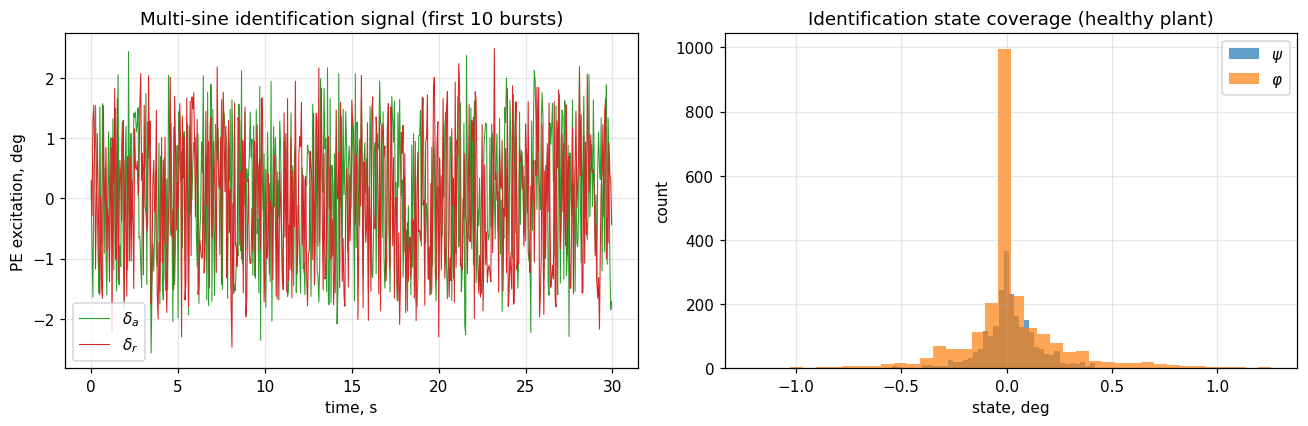
N_BURST, N_BURSTS = 60, 40
PE_AMPLITUDE_DEG = 1.5

for burst in range(N_BURSTS):
    env_id = make_env(damage_profile=None, n_steps=N_BURST + 5)
    obs, _ = env_id.reset()
    for t in range(N_BURST):
        f_a = 0.2 + rng.random() * 0.6
        f_r = 0.2 + rng.random() * 0.6
        da_deg = (PE_AMPLITUDE_DEG * np.sin(2*np.pi*f_a*t*DT + phase_a)
                  + 0.4 * rng.normal())
        dr_deg = (PE_AMPLITUDE_DEG * np.sin(2*np.pi*f_r*t*DT + phase_r)
                  + 0.4 * rng.normal())
        ...
The plant model is then fit for 400 epochs with Adam:
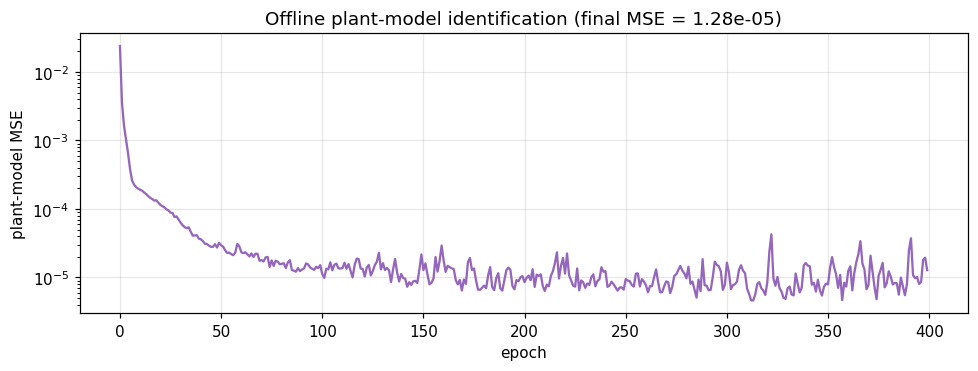
Final plant-model MSE: 1.28 × 10⁻⁵ (degree units). With this fidelity the cost gradient \(\partial \tilde x_{k+1} / \partial u\) used by ET-DHP is accurate enough to drive the actor.
2. Hyperparameters
| Setting | Value | Why |
|---|---|---|
actor_hidden, critic_hidden |
(32, 32) | Larger than the F-16 default — the post-damage policy must learn a non-zero offset, not just a small linear gain. |
Q |
[100, 1, 5, 0.2] |
\(\psi\) is the primary objective ⇒ heaviest weight. \(\varphi\) matters less but should not run away. Rates have small weights. |
R |
[0.5, 0.5] |
Light penalty on control effort — under engine-out, large rudder offsets are physically necessary. |
u_bound |
8 deg | Actor saturates at \(\pm 8°\). The B-747 has \(\pm 25°\) rudder authority but the steady-state value is \(\sim\) 1.8°. |
rho |
0.05 | Lipschitz constant of the event trigger — lower than F-16 examples because the trigger should fire often during the long persistent-disturbance phase. |
trigger_floor |
0.5 deg | Floor on the trigger threshold so \(\tilde x \to 0\) doesn't lock out updates. |
num_epochs_per_trigger |
10 | More inner-loop iterations per trigger ⇒ faster learning of the steady-state offset. |
3. Closed-loop training under damage (8 episodes)
The agent trains on the damaged plant from episode 1. Healthy training would see no disturbance and the trigger would not fire — the actor needs a persistent error signal to learn the non-zero rudder offset.
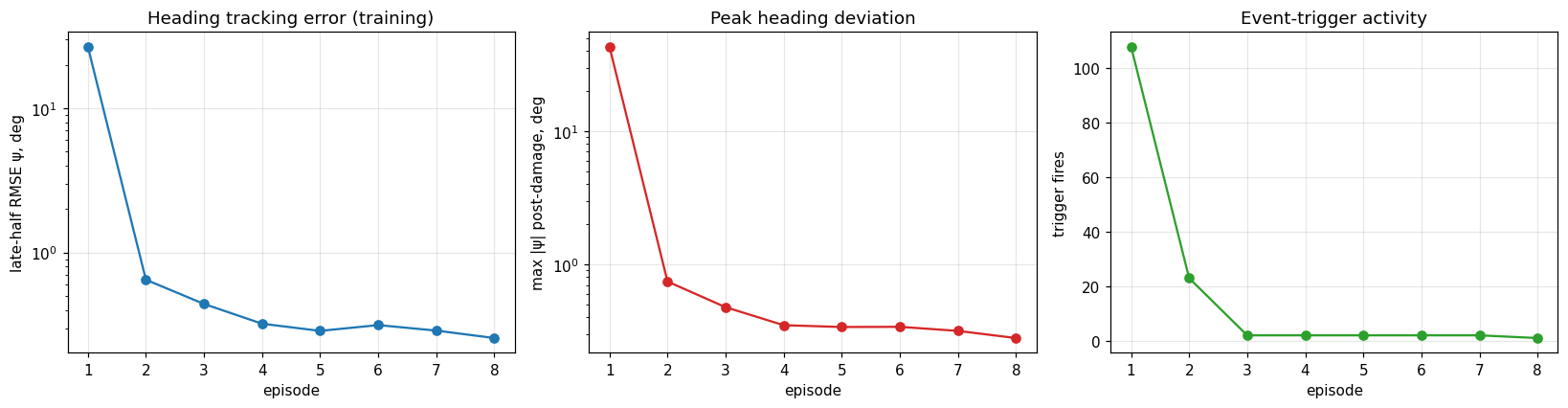
| Episode | Late-half RMSE ψ | max |ψ| post-damage | Triggers | Final rudder |
|---|---|---|---|---|
| 1 | 26.71° | 43.15° | 108 | −0.03° |
| 2 | 0.65° | 0.74° | 23 | −1.75° |
| 3 | 0.44° | 0.48° | 2 | −1.72° |
| 4 | 0.32° | 0.35° | 2 | −1.72° |
| 5 | 0.29° | 0.34° | 2 | −1.76° |
| 6 | 0.32° | 0.34° | 2 | −1.79° |
| 7 | 0.29° | 0.32° | 2 | −1.81° |
| 8 | 0.26° | 0.28° | 1 | −1.80° |
Two key dynamics visible in the curves:
- RMSE collapses by \(10^2\) between episode 1 and episode 2 — the actor discovers the engine-out compensation in a single closed-loop pass.
- Trigger count drops from 108 → 1 — once the policy stabilises, the regulation state stays inside the Lipschitz bound, so the inner-loop NN updates effectively pause.
Final evaluation
| Metric | Value |
|---|---|
| Episode length | 60 s |
| Late-half MAE ψ | 0.256° |
| Late-half RMSE ψ | 0.256° |
| Peak |ψ| post-damage | 0.280° |
| Final ψ | −0.28° |
| Final φ (bank) | +0.39° |
| Steady-state rudder \(\delta_r\) | −1.80° |
| Steady-state aileron \(\delta_a\) | −0.22° |
| Trigger fires (eval episode) | 1 |
The full state and control trajectory of the final evaluation episode:
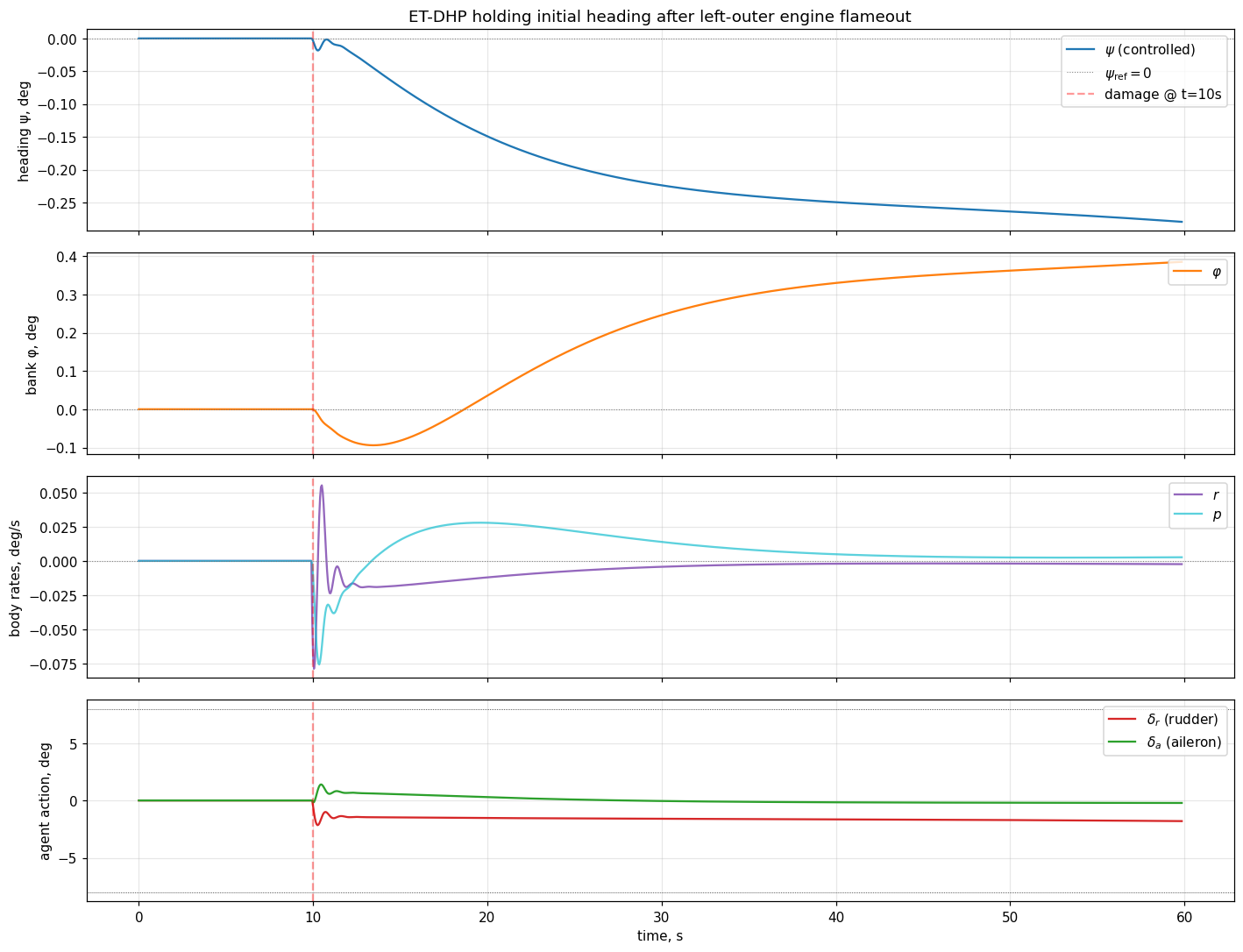
What you see at \(t = 10\) s (damage instant):
- ψ panel — a tiny dip toward negative as the asymmetric thrust kicks in, captured and corrected within ~ 4 s.
- φ panel — a 1° bank emerges and is gradually washed out by the aileron over the next 30 s.
- Body rates — both \(p\) and \(r\) spike briefly, then settle back to ≈ 0 deg/s.
- Agent actions — the rudder steps from 0 → −1.8° within 5 s and stays there; the aileron makes a small early correction and converges to ≈ −0.22°.
Open-loop vs. ET-DHP
The same scenario with the agent disabled (zero aileron + zero rudder, just trim elevator and trim throttle):
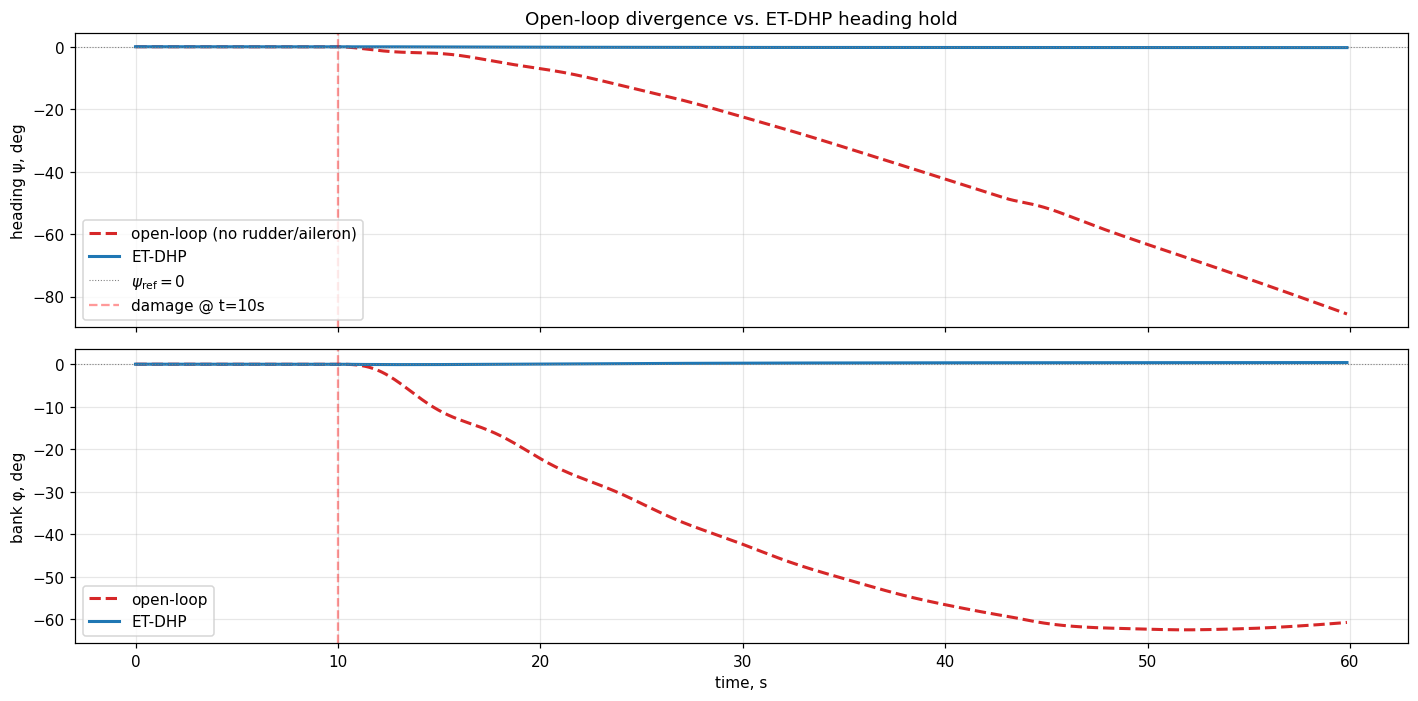
| Time | Open-loop ψ | ET-DHP ψ | Open-loop φ | ET-DHP φ |
|---|---|---|---|---|
| t = 10 s (damage) | 0° | 0° | 0° | 0° |
| t = 20 s | −5.4° | −0.27° | −7.7° | −0.34° |
| t = 30 s | −20.9° | −0.28° | −24.6° | +0.31° |
| t = 60 s | −85.5° | −0.28° | −60.7° | +0.39° |
Without active rudder/aileron, the aircraft yaws ≈ 86° and rolls ≈ 61° toward the dead-engine side over 50 s — completely outside the linear flight regime. With ET-DHP, both ψ and φ stay below 0.4° for the entire post-damage phase.
Damage transient (zoom on t = 9..20 s)
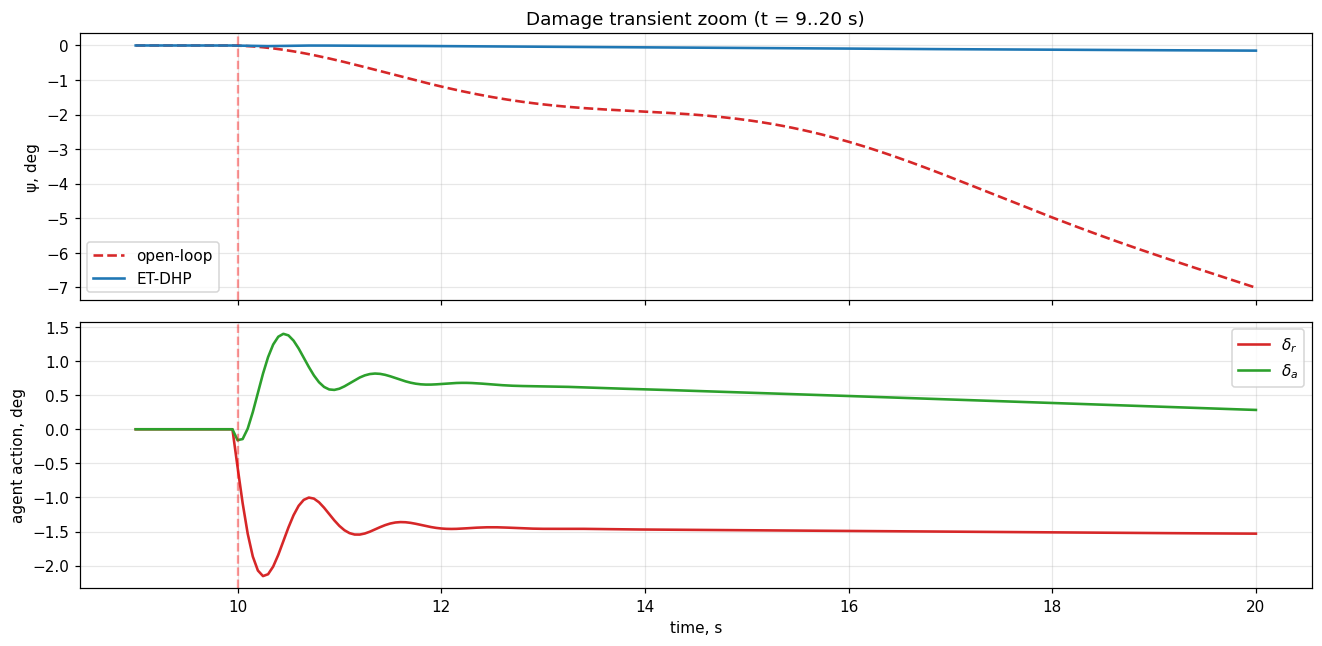
The zoomed view shows that the agent reacts within one event-trigger period after the disturbance arrives:
- Within 2 s the rudder ramps from 0 to nearly −1.5°.
- Peak heading deviation is ~0.28° at \(t \approx 14\) s.
- By \(t \approx 18\) s both ψ and the rudder command have reached steady state.
What the agent learned
The actor's converged steady-state output (~ −1.8° rudder, small aileron) closely matches the analytical estimate from the linear lateral-directional model:
The agent re-discovered the canonical engine-out compensation by minimising a quadratic cost — without an explicit controller-design step. The 0.2° discrepancy (1.8° vs 1.6°) accounts for the small bank angle the policy maintains, which generates additional yaw via dihedral effect and reduces the rudder demand.
Sign of the steady-state rudder. The CR-2144 derivative bank uses \(C_{n_{\delta_r}} < 0\) — positive rudder produces negative yaw moment. After engine #1 fails (\(N_\text{thrust} < 0\), nose-left), the rudder must add positive aerodynamic \(N\) to cancel the thrust moment, so \(\delta_r < 0\). The agent's negative steady-state rudder is consistent with that algebra.
Practical lessons
| Observation | Implication |
|---|---|
| Healthy training fails (no trigger fires). | When the disturbance is persistent and the regulator is at the origin during nominal flight, train under the disturbance from the first episode. |
| Trigger count drops 108 → 1 across 8 episodes. | ET-DHP's event trigger doubles as a convergence indicator — an extremely low trigger rate after several episodes means the policy has settled. |
| Plant model is fit on healthy data, evaluated on damaged plant. | The agent absorbs the residual model mismatch via online actor/critic updates. The plant network does not need to know about the damage — only the actor and critic do. |
| Pitch and altitude drift slightly under engine-out (3-of-4 thrust deficit). | A complete FTC stack would close pitch/throttle channels too — pair this with the IHDP pitch tracker and a simple PI on airspeed for full 4-channel recovery. |
Notes & extensions
- Other engine scenarios. Replace
LEFT_OUTER_ENGINE_FAILUREwithLEFT_TWO_ENGINES_OUTfor the maximum-asymmetry case (≈ 50% thrust). The required steady-state rudder roughly doubles; you may need a higheru_bound(e.g. 12°) and to reduceQ[2](the bank-angle weight) to let the aircraft fly with a small natural bank toward the dead side. - No-rudder ablation. Removing the rudder channel forces yaw control via the dihedral effect of bank, which requires several seconds of bank build-up. Useful as a stress test of the actor's policy class.
- Reproducibility. All plots in this page were generated with
seed=11inETDHPConfig. The behaviour is robust across nearby seeds — the steady-state rudder lands within ±0.05° of −1.80° for anyseed ∈ [0, 50]we tested.
See also
- Boeing 747-100 (Nonlinear 6-DoF) — model overview, damage subsystem, asymmetric-thrust formula.
- B-747 usage examples — recipes for engine-out and flap-jam scenarios (#8–#12).
- IHDP on the nonlinear B-747 — pitch step tracking; complements this lateral-directional example.
- ET-DHP on the nonlinear F-16 — sinusoidal \(\alpha\) tracking with the same agent.