DQN (Deep Q-Network)
DQN — классический метод обучения с подкреплением, аппроксимирующий Q‑функцию нейросетью. В реализации используется целевая сеть для стабилизации обучения и приоритезированный опыт (PER) для более информативных обновлений.
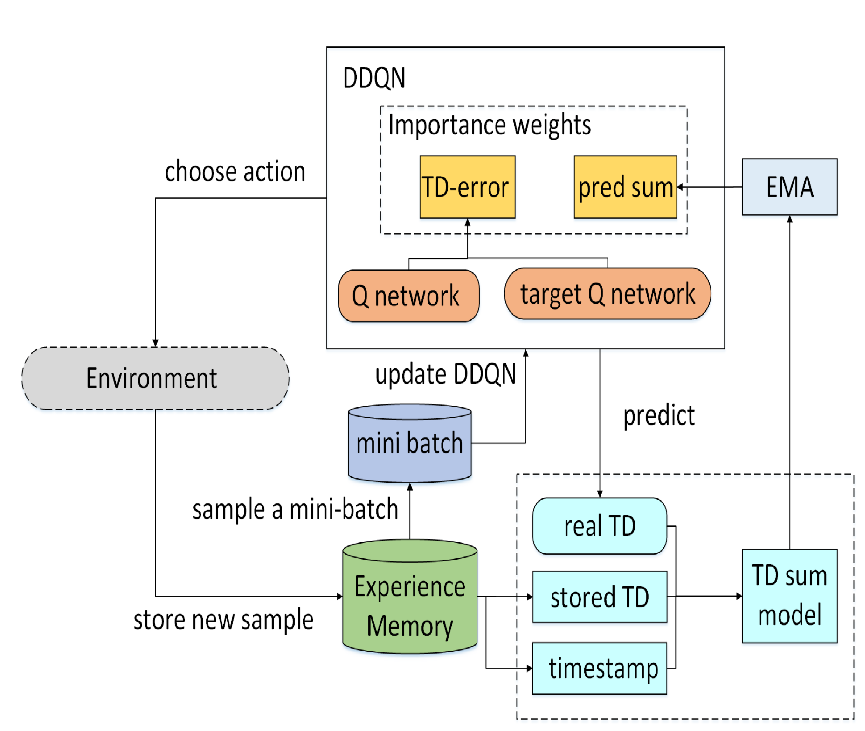
Компоненты
- Основная Q‑сеть: оценивает \(Q_\theta(s,a)\) и выбирает действия
- Целевая сеть: \(Q_{\theta^-}\) для вычисления целевых значений, реже обновляется
- Буфер повторов (PER): хранит переходы и отдаёт мини‑батчи с приоритетами
- Выбор действия: \(\epsilon\)-жадная стратегия
Теория
1) Уравнение оптимальности Беллмана
Оптимальная Q‑функция удовлетворяет:
Стохастический градиентный спуск по MSE‑приближению решает:
2) Double DQN против классического DQN
- Классический DQN завышает оценки из‑за \(\max\) по одной и той же сети. Double DQN разносит выбор и оценку:
Это снижает переоценку и стабилизирует обучение.
3) Целевая сеть и её обновление
- Целевая сеть \(Q_{\theta^-}\) копируется с онлайн‑сети каждые
target_update_iterшагов:
Фиксированный таргет на коротком интервале уменьшает разрушение целевой функции.
4) Приоритезированный опыт (PER) и SumTree
- Приоритет перехода i:
- Вероятность выборки:
- Веса важности (importance sampling) для коррекции смещения:
-
Обновление приоритета после шага обучения: \(p_i \leftarrow |\delta_i| + \varepsilon_{\text{margin}}\)
-
Структура SumTree обеспечивает \(\mathcal{O}(\log N)\) обновления/выборку по приоритетам.
5) \(\epsilon\)-жадная стратегия и её расписание
- С вероятностью \(\epsilon\) выбирается случайное действие, иначе \(\arg\max_a Q_\theta(s,a)\).
- Эксплорейшн уменьшается: \(\epsilon \leftarrow \max(\text{min\_epsilon}, \epsilon \cdot \text{epsilon\_decay})\).
6) Общий цикл обучения
- Сбор опыта в буфер (первыe K шагов — без обучения).
- Каждые
replay_periodшагов: выборка мини‑батча из PER, вычисление \(y\), TD‑ошибок \(\delta\), IS‑весов и обновление \(\theta\) по взвешенной MSE. - Обновление приоритетов \(p_i\) и параметра \(\beta\).
- Каждые
target_update_iterшагов: \(\theta^- \leftarrow \theta\).
Псевдокод:
predict_q = Q_theta(s_batch)
best_action = argmax_a predict_q
target_q = Q_theta_minus(s_next_batch)
y = r_batch + gamma * target_q[range, best_action]

# TD-ошибка и приоритеты
delta = y - predict_q[range, a_batch]
priority = clip(|delta| + margin, 0, abs_error_upper) ** alpha

# веса важности и взвешенная MSE
w = ((buffer_size * P(i)) ** -beta) / max_w
loss = mean(w * (y - Q_theta(s_batch, a_batch))^2)
update theta by SGD

# обновить приоритеты, увеличить beta, периодически обновить target
7) Стабилизационные приёмы
- Нормализация/клиппинг градиентов
- Ограничение TD‑ошибки сверху (как в коде —
abs_error_upper) - Выбор Huber‑потерь вместо MSE (в нашей версии — взвешенная MSE)
- Регулярное обновление target‑сети, достаточный размер буфера
8) Соответствие параметрам реализации
alpha— степень приоритезации (0 → равновероятно, 1 → строго по ошибке)beta,beta_increment_per_sample— сила IS‑весов и её ростtarget_update_iter— период синхронизации целевой сетиreplay_period— как часто тренируемсяepsilon,epsilon_decay,min_epsilon— расписание \(\epsilon\)margin(\varepsilonв формулах),abs_error_upper— формирование приоритетов
Быстрый старт
import gymnasium as gym
import numpy as np

from tensoraerospace.agent.dqn.model import Model, DQNAgent

env = gym.make('LinearLongitudinalF16-v0', number_time_steps=2000)
num_actions = env.action_space.n

model = Model(num_actions)
target_model = Model(num_actions)

agent = DQNAgent(
    model=model,
    target_model=target_model,
    env=env,
    train_nums=10000,
    epsilon=1.0,
    epsilon_dacay=0.995,
    min_epsilon=0.05,
)

agent.train()
Tip
Для непрерывного действия используйте дискретизацию или политику на базе DDPG/SAC.
Унифицированный интерфейс обучения
DQN поддерживает общую унифицированную сигнатуру train() из BaseRLModel:
# Старый вызов (по‑прежнему работает):
agent.train()

# Унифицированный вызов — переопределяет self.train_nums на num_episodes * max_steps:
agent.train(num_episodes=100, max_steps=200)
Если num_episodes и max_steps не указаны, агент использует бюджет
шагов train_nums, заданный при создании.
Документация API
Model(num_actions)

Bases: Module
DQN with two hidden layers of 32.
Only the number of actions is required to preserve the original signature. The first linear layer is lazily initialized to infer the input features at runtime from the first forward pass.
Parameters:
| Name | Type | Description | Default |
|---|---|---|---|
num_actions
|
int
|
Number of actions. |
required |
Initialize network layers.
Parameters:
| Name | Type | Description | Default |
|---|---|---|---|
num_actions
|
int
|
Number of discrete actions. |
required |
forward(x)

Compute Q-values for a batch of observations.
predict(inputs)

Forward function. Returns Q-values for actions.
Parameters:
| Name | Type | Description | Default |
|---|---|---|---|
inputs
|
ndarray
|
Batch of input data (numpy array [B, obs_dim]). |
required |
Returns:
| Type | Description |
|---|---|
ndarray
|
numpy array [B, num_actions] with Q-values. |
action_value(obs)

Select greedy action and return Q-values for the first item.
Parameters:
| Name | Type | Description | Default |
|---|---|---|---|
obs
|
ndarray
|
Batch of input data. |
required |
Returns:
| Name | Type | Description |
|---|---|---|
best_action |
Union[ndarray, int]
|
Best action(s). If batch size is 1 -> int, else ndarray. |
q_values |
ndarray
|
Q-values of the first element in the batch for compatibility. |
SumTree(capacity)

Binary search tree class for prioritized replay buffer agent.
Parameters:
| Name | Type | Description | Default |
|---|---|---|---|
capacity
|
int
|
Buffer size. |
required |
Initialize sum tree for prioritized replay.
Parameters:
| Name | Type | Description | Default |
|---|---|---|---|
capacity
|
int
|
Maximum number of transitions to store. |
required |
total_p
property

Number of records in buffer.
Returns:
| Type | Description |
|---|---|
int
|
Number of records in buffer. |
add(priority, transition)

Function for adding object to buffer.
Parameters:
| Name | Type | Description | Default |
|---|---|---|---|
priority
|
int
|
Priority of added transition. |
required |
transition
|
Any
|
Transition vector S, A, R, S'. |
required |
update(idx, priority)

Function for updating object priority with given index.
Parameters:
| Name | Type | Description | Default |
|---|---|---|---|
idx
|
int
|
Transition index. |
required |
priority
|
int
|
Priority of updated transition. |
required |
get_leaf(s)

Function for getting object by given priority.
Parameters:
| Name | Type | Description | Default |
|---|---|---|---|
s
|
int
|
Priority by which transition is selected. |
required |
Returns:
| Name | Type | Description |
|---|---|---|
idx |
int
|
Transition index. |
priority |
int
|
Priority of updated transition. |
transitions |
Any
|
Required transition. |
DQNAgent(model, target_model, env, learning_rate=0.0012, epsilon=0.1, epsilon_dacay=0.995, min_epsilon=0.01, gamma=0.9, batch_size=8, target_update_iter=400, train_nums=5000, buffer_size=200, replay_period=20, alpha=0.4, beta=0.4, beta_increment_per_sample=0.001, log_dir=None, verbose_histogram=False, seed=1, wandb_project=None, wandb_entity=None, wandb_run_name=None, wandb_tags=None, wandb_config=None)

DQN Agent.
Parameters:
| Name | Type | Description | Default |
|---|---|---|---|
model
|
Module
|
Deep Q-network model. |
required |
target_model
|
Module
|
Target deep Q-network model. |
required |
env
|
Env
|
Gym/Gymnasium environment. |
required |
learning_rate
|
float
|
Learning rate. |
0.0012
|
epsilon
|
float
|
Environment exploration probability. |
0.1
|
epsilon_dacay
|
float
|
Epsilon reduction coefficient per episode. |
0.995
|
min_epsilon
|
float
|
Minimum epsilon value. |
0.01
|
gamma
|
float
|
Discount coefficient. |
0.9
|
batch_size
|
int
|
Mini-batch size. |
8
|
target_update_iter
|
int
|
Target network update period (steps). |
400
|
train_nums
|
int
|
Number of training steps. |
5000
|
buffer_size
|
int
|
Replay buffer size. |
200
|
replay_period
|
int
|
Buffer sampling period. |
20
|
alpha
|
float
|
Prioritization degree. |
0.4
|
beta
|
float
|
Importance sampling coefficient. |
0.4
|
beta_increment_per_sample
|
float
|
Beta increment per sample. |
0.001
|
Initialize DQN agent and replay buffer.
Parameters:
| Name | Type | Description | Default |
|---|---|---|---|
model
|
Any
|
Online Q-network. |
required |
target_model
|
Any
|
Target Q-network. |
required |
env
|
Any
|
Gym/Gymnasium environment. |
required |
learning_rate
|
float
|
Optimizer learning rate. |
0.0012
|
epsilon
|
float
|
Initial epsilon for exploration. |
0.1
|
epsilon_dacay
|
float
|
Multiplicative epsilon decay. |
0.995
|
min_epsilon
|
float
|
Minimum epsilon value. |
0.01
|
gamma
|
float
|
Discount factor. |
0.9
|
batch_size
|
int
|
Training batch size. |
8
|
target_update_iter
|
int
|
Steps between target updates. |
400
|
train_nums
|
int
|
Total training steps to run. |
5000
|
buffer_size
|
int
|
Replay buffer capacity. |
200
|
replay_period
|
int
|
Sampling period from buffer. |
20
|
alpha
|
float
|
PER priority exponent. |
0.4
|
beta
|
float
|
PER importance sampling exponent. |
0.4
|
beta_increment_per_sample
|
float
|
Increment for beta per sample. |
0.001
|
log_dir
|
str | None
|
Directory for TensorBoard logs. |
None
|
verbose_histogram
|
bool
|
Whether to log histograms extensively. |
False
|
seed
|
int
|
Random seed for numpy and torch. Defaults to 1. |
1
|
train(num_episodes=None, *, max_steps=None, save_best=False, save_path=None, verbose=True, **kwargs)

Train the DQN agent (unified interface).
DQN is frame-based internally. num_episodes is treated as an
episode target that is multiplied by max_steps to derive a
total training-step budget. When max_steps is omitted, the
original self.train_nums budget set at construction is used.
Parameters:
| Name | Type | Description | Default |
|---|---|---|---|
num_episodes
|
Optional[int]
|
Target number of episodes. Converted to a
step budget via |
None
|
max_steps
|
Optional[int]
|
Approximate maximum steps per episode. |
None
|
save_best
|
bool
|
Reserved for API consistency. |
False
|
save_path
|
Optional[str]
|
Reserved for API consistency. |
None
|
verbose
|
bool
|
Reserved for symmetry. |
True
|
**kwargs
|
Any
|
Currently unused. |
{}
|
Returns:
| Name | Type | Description |
|---|---|---|
dict |
dict
|
Empty dict for API compatibility. |
train_step()

Function for training step.
Returns:
| Name | Type | Description |
|---|---|---|
losses |
float
|
Losses after one training step. |
sum_tree_sample(k)

Get batch for training.
Parameters:
| Name | Type | Description | Default |
|---|---|---|---|
k
|
int
|
Size of batch to get. |
required |
Returns:
| Name | Type | Description |
|---|---|---|
idxes |
int
|
Indices of objects from batch. |
is_weights |
float
|
Priorities of objects from batch. |
evaluation(wrapped_env, render=False)

Get batch for training.
Parameters:
| Name | Type | Description | Default |
|---|---|---|---|
wrapped_env
|
Any
|
Wrapped environment (for rendering/frame capture). |
required |
render
|
bool
|
Whether to visualize environment or not. |
False
|
Returns:
| Name | Type | Description |
|---|---|---|
ep_reward |
float
|
Total reward per episode. |
close()

Close resources (e.g., SummaryWriter).
store_transition(priority, obs, action, reward, next_state, done)

Store a transition in the replay buffer.
rand_based_sample(k)

Placeholder for rank-based prioritized sampling (not implemented).
get_action(best_action)

Epsilon-greedy action selection.
update_target_model()

Target neural network update function.
get_target_value(obs)

Compute Q-values using the target network.
e_decay()

Function for reducing network exploration probability.
save(path=None, save_gradients=False)

Save PyTorch models to the specified directory.
Parameters:
| Name | Type | Description | Default |
|---|---|---|---|
path
|
str | Path | None
|
Save path. If None, saves into current cwd under folder "dqn_agent". |
None
|
save_gradients
|
bool
|
Save optimizer states to continue training. |
False
|
load(path, env, *, load_gradients=False, model_factory=None)
classmethod

Load a DQNAgent from a directory created by :meth:save.
Parameters:
| Name | Type | Description | Default |
|---|---|---|---|
path
|
Union[str, Path]
|
Directory that contains |
required |
env
|
Any
|
A Gymnasium-compatible environment. The environment is required because it is not serialised alongside the weights. |
required |
load_gradients
|
bool
|
If |
False
|
model_factory
|
Optional[Callable[[], Any]]
|
Optional zero-argument factory for custom DQN
network classes. Built-in |
None
|
Returns:
| Name | Type | Description |
|---|---|---|
DQNAgent |
DQNAgent
|
Fully initialised agent with loaded weights. |
from_pretrained(repo_name, env, access_token=None, version=None, load_gradients=False, model_factory=None)
classmethod

Load pretrained model from local directory or Hugging Face Hub.
Parameters:
| Name | Type | Description | Default |
|---|---|---|---|
repo_name
|
str
|
Path to local folder with weights or repository
name in format |
required |
env
|
Any
|
A Gymnasium-compatible environment (required for reconstruction). |
required |
access_token
|
Optional[str]
|
Access token for private HF repository. |
None
|
version
|
Optional[str]
|
Revision / branch / tag of HF repository. |
None
|
load_gradients
|
bool
|
If |
False
|
model_factory
|
Optional[Callable[[], Any]]
|
Optional zero-argument factory for custom DQN network classes. |
None
|
Returns:
| Name | Type | Description |
|---|---|---|
DQNAgent |
DQNAgent
|
Initialised agent with loaded weights. |
publish_to_hub(repo_name, folder_path, access_token=None)

Publish saved model to Hugging Face Hub.
Parameters:
| Name | Type | Description | Default |
|---|---|---|---|
repo_name
|
str
|
Repository id on Hugging Face Hub
(e.g. |
required |
folder_path
|
Union[str, Path]
|
Local folder that contains saved weights
(as written by :meth: |
required |
access_token
|
Optional[str]
|
HF access token. If |
None
|