A2C с NARX‑Critic
A2C (Advantage Actor‑Critic) использует актёра для выбора действий и критика для оценки состояний. В нашей реализации критик — NARX (Nonlinear AutoRegressive with eXogenous inputs), что позволяет лучше моделировать динамику и историю за счёт явного учёта прошедших состояний.
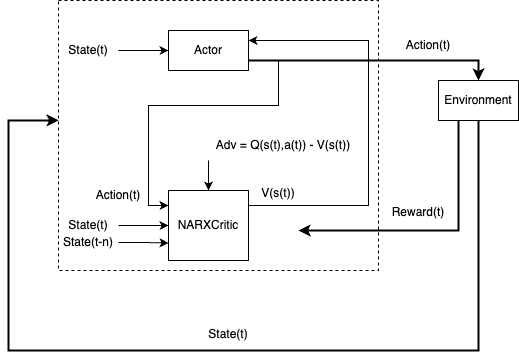
Компоненты
- Актор: гауссовская политика \(\pi_\theta(a|s) = \mathcal{N}(\mu_\theta(s), \sigma_\theta^2)\); параметры —
Actor(PyTorch) - Критик (NARX): оценка \(V(s)\) на основе расширенного входа (текущее состояние + предыдущие сигналы); классы
Critic(A2C) иNARX(модульная NARX‑сеть) - Сбор опыта:
Runnerсобирает траектории, клиппирует действия подaction_space - Обучение:
A2CLearner.learn— обновления актёра/критика со стабилизацией (клиппинг градиента, энтропия)
Теория (на базе реализации)
- Дисконтированные возвраты:
- Advantage в коде:
и далее \(A_t = \text{td\_target} - V(s_t)\).
- Потери:
NARX как критик
NARX‑сеть (tensoraerospace/agent/narx/model.py) явно использует прошлый выход/состояние в качестве входа для предсказания следующего. В A2C вход критика формируется как конкатенация текущего состояния и предыдущего состояния (см. process_memory_narx — формирование critic_states). Это повышает качество оценок \(V(s)\) для систем с выраженной динамической памятью.
Идентификация (упрощённо):
- Обучение NARX сводится к минимизации MSE между предсказанным и целевым выходом по последовательности (см.
NARX.train). - В A2C критик обучается по MSE между таргетом (возвраты или TD) и текущей оценкой \(V(s)\).
Обучение (контур)
Runner.runсобирает пары \((s_t, a_t, r_t, s_{t+1}, done_t)\), клиппирует действия подaction_space.process_memory_narxформирует тензоры: действия, вознаграждения (опц. дисконтируются), состояния, следующие состояния, флаги завершения иcritic_states = [s_t, s_{t-1}].A2CLearner.learn:- Если
discount_rewards=True, таргет критикаtd_target = rewards(возвраты); иначеr + γ V(s'). - Advantage:
advantage = td_target - V(s). - Actor: лог‑вероятности из
Normal(mean,std), энтропия; обновление с клиппингом градиента. - Critic: MSE; обновление с клиппингом градиента.
- Логирование в TensorBoard (losses, градиенты/параметры, награды).
Быстрый старт
import gymnasium as gym
import torch
from tensoraerospace.agent.a2c.narx import Actor, Critic, A2CLearner, Runner

env = gym.make('LinearLongitudinalF16-v0', number_time_steps=2000)
actor = Actor(state_dim=env.observation_space.shape[0], n_actions=env.action_space.shape[0])
critic = Critic(state_dim=env.observation_space.shape[0])
learner = A2CLearner(actor, critic, gamma=0.99, entropy_beta=0.01)
runner = Runner(env, actor, learner.writer)

memory = runner.run(max_steps=2048)
learner.learn(memory, steps=2048, discount_rewards=True)
Tip
Для систем с сильной инерцией используйте discount_rewards=False, чтобы критик обучался по TD‑таргету с \(V(s')\).
Документация API
A2CLearner(actor, critic, gamma=0.9, entropy_beta=0.01, actor_lr=0.0004, critic_lr=0.004, max_grad_norm=0.5, device=None, log_dir=None, wandb_project=None, wandb_entity=None, wandb_run_name=None, wandb_tags=None, wandb_config=None)

Learner implementing Advantage Actor-Critic (A2C) updates.
Initialize learner with optimizers and hyperparameters.
Parameters:
| Name | Type | Description | Default |
|---|---|---|---|
actor
|
Module
|
Policy network. |
required |
critic
|
Module
|
Value network. |
required |
gamma
|
float
|
Discount factor. |
0.9
|
entropy_beta
|
float
|
Entropy regularization weight. |
0.01
|
actor_lr
|
float
|
Learning rate for actor. |
0.0004
|
critic_lr
|
float
|
Learning rate for critic. |
0.004
|
max_grad_norm
|
float
|
Gradient clipping norm. |
0.5
|
log_dir
|
str | None
|
TensorBoard log directory. If None, the default
|
None
|
learn(memory, steps, discount_rewards=True)

Update actor/critic using a batch of collected transitions.
Parameters:
| Name | Type | Description | Default |
|---|---|---|---|
memory
|
list
|
Collected transitions. |
required |
steps
|
int
|
Global step index used for logging. |
required |
discount_rewards
|
bool
|
If True, uses discounted returns as TD target. |
True
|
get_param_env()

Return serializable configuration needed to reconstruct the learner.
save(path=None, save_gradients=False)

Save A2CLearner model to the specified directory.
Saves actor network, critic network, and configuration. Optionally saves optimizer states for resuming training.
Parameters:
| Name | Type | Description | Default |
|---|---|---|---|
path
|
str | Path | None
|
Base save directory. If None, saves to the current working directory. |
None
|
save_gradients
|
bool
|
If True, also persist optimizer state dicts. |
False
|
Returns:
| Name | Type | Description |
|---|---|---|
Path |
Path
|
The directory where the model was saved. |
from_pretrained(repo_name, env=None, access_token=None, version=None, load_gradients=False)
classmethod

Load pretrained model from a local directory or Hugging Face Hub.
Parameters:
| Name | Type | Description | Default |
|---|---|---|---|
repo_name
|
str
|
Path to a local folder or a Hugging Face repo id
(e.g. |
required |
env
|
Optional[Env]
|
Optional environment instance. |
None
|
access_token
|
Optional[str]
|
Hugging Face access token for private repos. |
None
|
version
|
Optional[str]
|
Revision / branch / tag on Hugging Face. |
None
|
load_gradients
|
bool
|
Restore optimizer states for continued training. |
False
|
Returns:
| Name | Type | Description |
|---|---|---|
A2CLearner |
A2CLearner
|
Initialized learner. |
publish_to_hub(repo_name, folder_path, access_token=None)

Upload a saved model folder to Hugging Face Hub.
Parameters:
| Name | Type | Description | Default |
|---|---|---|---|
repo_name
|
str
|
Repository id on Hugging Face (e.g. |
required |
folder_path
|
Union[str, Path]
|
Local folder produced by :meth: |
required |
access_token
|
Optional[str]
|
Hugging Face access token. |
None
|
Runner(env, actor, writer)

Environment interaction loop used to collect training data.
Create runner for data collection.
Parameters:
| Name | Type | Description | Default |
|---|---|---|---|
env
|
Env
|
Environment instance. |
required |
actor
|
Module
|
Policy network used to select actions. |
required |
writer
|
MetricWriter
|
TensorBoard writer for logging rewards. |
required |
reset()

Reset environment and episode state.
run(max_steps, memory=None)

Run the environment for a fixed number of steps and collect transitions.
Parameters:
| Name | Type | Description | Default |
|---|---|---|---|
max_steps
|
int
|
Number of environment steps to execute. |
required |
memory
|
list
|
Existing list to append transitions to. |
None
|
Returns:
| Name | Type | Description |
|---|---|---|
list |
list[tuple[ndarray, float, ndarray, ndarray, bool]]
|
Collected transitions. |