Proximal Policy Optimization (PPO)
PPO — надёжный policy‑gradient метод, сочетающий простоту реализации и стабильность обучения. В нашей реализации актор и критик обучаются на батчах собранных роллаутов, используется клиппированный суррогат, энтропия политики и оценка преимуществ с обобщённой ошибкой (GAE‑подобная).
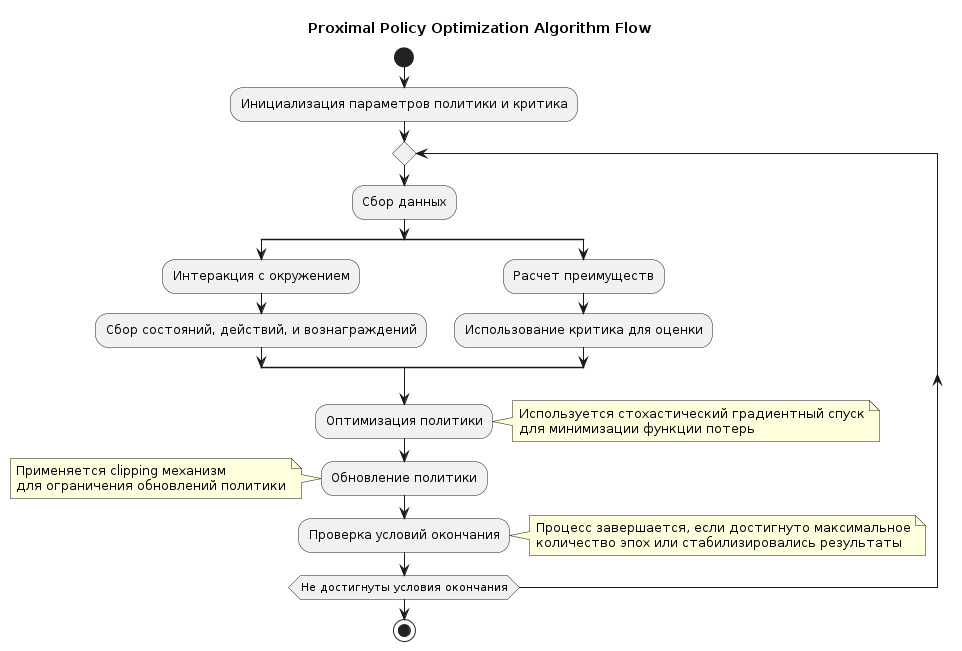
Компоненты
- Актор (гауссовская политика): параметры \(\mu, \sigma\) → распределение \(\mathcal{N}(\mu, \sigma^2)\)
- Критик: скалярная оценка \(V(s)\)
- Сбор опыта: роллаут длины
rollout_lenс записью \(s,a,\log\pi(a|s), r, d, V(s)\) - Обучение: мини‑батчи по несколько эпох
num_epochsс клиппингом вероятностных отношений
Теория
- Отношение вероятностей:
- Клиппированный суррогат (Actor):
- Потеря критика (Value):
- Энтропийная регуляризация (стохастичность политики):
-
Полная цель: \(\mathcal{L} = \mathcal{L}_\text{actor} + \mathcal{L}_\text{critic} + \mathcal{L}_\text{entropy}\)
-
Преимущество (GAE‑подобное): в
preprocess1возвращается \(\text{return} = V + \sum\gamma\lambda\,\delta\), а \(A = \text{return} - V\)
Детали реализации
- Политика:
Actor.forward(..., continous_actions=True)выводитmu = tanh(Wx)иlog_std = tanh(Wx)с последующим линеарным растяжением в диапазон[log_std_min, log_std_max]; \(\sigma = e^{\log \sigma}\). Действие семплируется изNormal(mu, sigma). - Отношения вероятностей: берутся через разность лог‑плотностей
new_probs - old_probs, затем экспонента (torch.exp) — это численно устойчивее, чем делить плотности напрямую. - Энтропия: в коде в
actor_lossподаётся отрицательная энтропия-new_distr.entropy().mean(), а затем добавляется как+ entropy_coef * entropy. Эффект равнозначен вычитанию энтропии с коэффициентом (стимулируется стохастичность политики). - GAE и бустрап: в
preprocess1добавляетсяnext_valueвvalues, затем по реверсу считается \(\delta\) и аккумулируется \(g\) с \(\lambda=0.8\); в итогеreturns = V + g,advantages = returns - V. - Мини‑батчи: итератор
ppo_iterслучайно выбирает индексы размераmini_batch_sizeмногократно в течениеepoch. - Доп. голова r: актор возвращает ещё и предсказание наград (линия
self.r), для вспомогательной задачиauxillary_task(MSE по наградам); по умолчанию в loss не добавляется.
Псевдокод обучения
for episode in range(max_episodes):
  rollout = collect(rollout_len)
  next_value = V(s_T)
  returns, advantages = GAE(rollout.rewards, rollout.values, dones, gamma, lambda)
  for epoch in range(num_epochs):
    for batch in mini_batches(rollout, returns, advantages):
      ratios = exp(new_logp - old_logp)
      a_loss = -mean(min(ratios*A, clip(ratios)*A)) + entropy_coef * (-entropy)
      c_loss = mse(returns - V(s))
      update(actor, critic)
  log TensorBoard metrics
Гиперпараметры и соответствие коду
clip_pram = ε— порог клиппинга вероятностных отношенийnum_epochs,batch_size— количество проходов и размер мини‑батча для обновленийrollout_len— длина роллаута перед обновлениямиentropy_coef— вес энтропийного члена (учитывая знак в реализации)actor_lr,critic_lr— скорости обучения оптимизаторов Adamgamma,lambda(=0.8)— скидка и параметр GAE внутриpreprocess1
Быстрый старт
import gymnasium as gym
from tensoraerospace.agent.ppo.model import PPO

# Создаём среду (пример — F16)
env = gym.make('LinearLongitudinalF16-v0', number_time_steps=2000)

# Инициализация PPO
agent = PPO(
    env=env,
    gamma=0.99,
    max_episodes=50,
    rollout_len=2048,
    clip_pram=0.2,
    num_epochs=64,
    batch_size=64,
    entropy_coef=0.005,
    actor_lr=1e-3,
    critic_lr=5e-3,
)

# Обучение
agent.train()

# Сохранение
agent.save('./runs')
Tip
Для непрерывных действий используем гауссовскую политику; полезно ограничивать log_std (как в коде) и нормировать признаки.
Практические советы
- Увеличивайте
rollout_lenдля более стабильной оценки преимуществ - Балансируйте
clip_pram(обычно 0.1–0.3) иentropy_coefдля исследовательности - Несколько эпох (
num_epochs) и мелкиеbatch_sizeулучшают сходимость, но следите за переобучением
Вспомогательные задачи (Auxiliary Tasks)
Реализация PPO включает опциональный механизм вспомогательных задач (auxiliary tasks) для предсказания награды. Этот дополнительный выход помогает агенту формировать более качественные представления состояний, предсказывая ожидаемые награды параллельно с основной оптимизацией политики.
Как это работает
- Сеть
Actorвключает дополнительный выходной слойself.r, который предсказывает награду - Вспомогательная ошибка вычисляется как MSE между предсказанной и фактической наградой
- Эта ошибка может быть добавлена к основной ошибке PPO через метод
auxillary_taskв классеAgent
Использование
# Вспомогательная задача вычисляется отдельно от основного обучения
aux_loss = agent.auxillary_task(states, rewards)
Вспомогательная задача стимулирует сеть кодировать признаки, релевантные для награды, в скрытых представлениях, что потенциально улучшает эффективность использования выборки и обобщающую способность.
Унифицированный интерфейс обучения
PPO следует общему унифицированному API train() из BaseRLModel:
stats = agent.train(
    num_episodes=200,   # необязательно: переопределяет self.max_episodes
    max_steps=1024,     # необязательно: переопределяет self.rollout_len
)
Вызов agent.train() без аргументов также поддерживается — в этом случае
используются гиперпараметры, заданные при создании. Обратите внимание,
что метод PPO learn(states, actions, adv, old_probs, returns, rewards, old_values)
является внутренним помощником, выполняющим один шаг градиентного
обновления по батчу, и не затрагивается унифицированным интерфейсом.
Документация API
PPO(env, gamma=0.99, max_episodes=30, rollout_len=2048, clip_pram=0.2, num_epochs=64, batch_size=64, entropy_coef=0.005, actor_lr=0.001, critic_lr=0.005, gae_lambda=0.95, max_grad_norm=0.5, target_kl=None, normalize_obs=True, normalize_reward=False, actor_hidden_dim=256, critic_hidden_dim=256, actor_log_std_min=-20.0, actor_log_std_max=0.0, eval_freq=10, seed=336699, device=None, log_dir=None, save_best_model=True, best_model_dir=None, save_best_async=True, wandb_project=None, wandb_entity=None, wandb_run_name=None, wandb_tags=None, wandb_config=None)

Bases: BaseRLModel
Proximal Policy Optimization (PPO) reinforcement learning agent.
PPO is a policy gradient method that uses a clipped objective function to ensure stable and monotonic policy improvements. This implementation includes: - Actor-Critic architecture with separate networks - Generalized Advantage Estimation (GAE) - Observation and reward normalization - Value function clipping - Gradient clipping for stability - KL divergence early stopping - TensorBoard logging
The agent is designed for continuous control tasks in aerospace applications.
Attributes:
| Name | Type | Description |
|---|---|---|
actor |
Policy network that outputs action distributions. |
|
critic |
Value network that estimates state values. |
|
gamma |
Discount factor for future rewards. |
|
clip_pram |
PPO clipping parameter epsilon. |
|
gae_lambda |
GAE lambda for advantage estimation. |
|
max_grad_norm |
Maximum gradient norm for clipping. |
|
target_kl |
Target KL divergence for early stopping. |
|
normalize_obs |
Whether to normalize observations. |
|
normalize_reward |
Whether to normalize rewards. |
|
obs_rms |
Running statistics for observation normalization. |
|
ret_rms |
Running statistics for return normalization. |
|
writer |
TensorBoard summary writer. |
Initialize agent with given environment and discount coefficient.
Parameters:
| Name | Type | Description | Default |
|---|---|---|---|
env
|
Any
|
Environment object with which agent will interact. |
required |
gamma
|
float
|
Discount coefficient. Defaults to 0.99. |
0.99
|
max_episodes
|
int
|
Maximum number of training episodes. |
30
|
rollout_len
|
int
|
Number of steps per rollout. |
2048
|
clip_pram
|
float
|
PPO clipping parameter epsilon. |
0.2
|
num_epochs
|
int
|
Number of optimization epochs per rollout. |
64
|
batch_size
|
int
|
Mini-batch size for SGD. |
64
|
entropy_coef
|
float
|
Entropy bonus coefficient. |
0.005
|
actor_lr
|
float
|
Learning rate for actor network. |
0.001
|
critic_lr
|
float
|
Learning rate for critic network. |
0.005
|
gae_lambda
|
float
|
GAE lambda parameter for advantage estimation. |
0.95
|
max_grad_norm
|
float
|
Maximum gradient norm for clipping. |
0.5
|
target_kl
|
Optional[float]
|
Target KL divergence for early stopping. |
None
|
normalize_obs
|
bool
|
Whether to normalize observations. |
True
|
normalize_reward
|
bool
|
Whether to normalize rewards. |
False
|
actor_hidden_dim
|
int
|
Hidden layer size for actor network. |
256
|
critic_hidden_dim
|
int
|
Hidden layer size for critic network. |
256
|
eval_freq
|
int
|
Frequency (in episodes) for evaluation. |
10
|
seed
|
int
|
Random seed. |
336699
|
device
|
Union[str, device, None]
|
Torch device to run the training on. If None, the agent will auto-select CUDA (if available), else MPS (if available), else CPU. |
None
|
save_best_model
|
bool
|
Whether to save the best checkpoint during training. |
True
|
best_model_dir
|
Union[str, Path, None]
|
Directory for the best checkpoint (config.json + weights). If None, defaults to "{cwd}/best_model_PPO/". |
None
|
save_best_async
|
bool
|
If True, save best checkpoint in a background thread (recommended to avoid slowing training). |
True
|
act(state, deterministic=False)

Select action for given state.
Parameters:
| Name | Type | Description | Default |
|---|---|---|---|
state
|
ndarray | Tensor
|
Current environment state. |
required |
deterministic
|
bool
|
If True, use mean action (no sampling). |
False
|
Returns:
| Name | Type | Description |
|---|---|---|
tuple |
Tuple[Tensor, ndarray, Tensor]
|
Tuple containing action, mean action and log probability. |
actor_loss(probs, entropy, actions, adv, old_probs)

Calculate actor losses.
Parameters:
| Name | Type | Description | Default |
|---|---|---|---|
probs
|
Tensor
|
Action probabilities of new policy. |
required |
entropy
|
Tensor
|
Action entropy. |
required |
actions
|
Tensor
|
Actions taken. |
required |
adv
|
Tensor
|
Advantages. |
required |
old_probs
|
Tensor
|
Action probabilities of old policy. |
required |
Returns:
| Name | Type | Description |
|---|---|---|
Tensor |
Tensor
|
Actor loss function value. |
eval()

Switch actor and critic networks to evaluation mode.
Returns:
| Type | Description |
|---|---|
PPO
|
self for method chaining. |
close()

Flush and stop background saver (safe to call multiple times).
learn(states, actions, adv, old_probs, discnt_rewards, rewards, old_values)

Agent training procedure.
Parameters:
| Name | Type | Description | Default |
|---|---|---|---|
states
|
Tensor
|
States experienced by agent. |
required |
actions
|
Tensor
|
Actions taken by agent. |
required |
adv
|
Tensor
|
Advantages. |
required |
old_probs
|
Tensor
|
Log probabilities of previous actions. |
required |
discnt_rewards
|
Tensor
|
Discounted rewards. |
required |
rewards
|
Tensor
|
Actual received rewards. |
required |
old_values
|
Tensor
|
Previous value function estimates. |
required |
Returns:
| Name | Type | Description |
|---|---|---|
dict |
Dict[str, float]
|
Dictionary with training metrics. |
test_reward()

Test model by executing one episode with deterministic actions.
Returns:
| Name | Type | Description |
|---|---|---|
float |
float
|
Total reward per episode. |
preprocess1(states, actions, rewards, dones, values, probs, gamma)

Preprocess transitions for buffer.
Parameters:
| Name | Type | Description | Default |
|---|---|---|---|
states
|
list[Tensor]
|
List of states. |
required |
actions
|
list[Tensor]
|
List of actions. |
required |
rewards
|
list[Tensor]
|
List of rewards. |
required |
dones
|
list[Tensor]
|
List of boolean values indicating episode termination. |
required |
values
|
list[Tensor]
|
State values. |
required |
probs
|
list[Tensor]
|
Log probabilities of actions. |
required |
gamma
|
float
|
Discount coefficient. |
required |
Returns:
| Name | Type | Description |
|---|---|---|
tuple |
Tuple[Tensor, Tensor, list[Tensor], Tensor, Tensor, Tensor]
|
Tuple containing processed states, actions, rewards, advantages and probabilities. |
train(num_episodes=None, *, max_steps=None, save_best=False, save_path=None, verbose=True, **kwargs)

Train the PPO agent through interaction with the environment.
This method implements the complete PPO training loop
- Collect rollout data by interacting with environment
- Compute advantages using GAE
- Update policy and value function using mini-batch SGD
- Log metrics to TensorBoard
- Periodically evaluate policy performance
Parameters:
| Name | Type | Description | Default |
|---|---|---|---|
num_episodes
|
Optional[int]
|
Number of training episodes. When |
None
|
max_steps
|
Optional[int]
|
Optional override for |
None
|
save_best
|
bool
|
Reserved for unified interface; PPO already handles best-model saving via its internal background saver, so this flag is currently a no-op. |
False
|
save_path
|
Optional[str]
|
Reserved for unified interface (see
|
None
|
verbose
|
bool
|
Reserved for symmetry with other agents. |
True
|
**kwargs
|
Any
|
Additional algorithm-specific keyword arguments (currently ignored by PPO). |
{}
|
Returns:
| Name | Type | Description |
|---|---|---|
dict |
dict
|
Training metrics dictionary with episode rewards |
dict
|
collected so far, the final running average and any |
|
dict
|
early-stopping flag PPO may have triggered. |
Training can be stopped early using KL divergence thresholds
(target_kl) or by setting self.target = True.
Note
All metrics are logged to TensorBoard including actor/critic losses, rewards, entropy, KL divergence, clip fraction, and explained variance.
get_param_env()

Get environment and agent parameters for serialization.
This method extracts all necessary information to reconstruct the agent and its environment, including hyperparameters, network architectures, and environment specifications.
Returns:
| Type | Description |
|---|---|
Dict[str, Dict[str, Any]]
|
Dictionary with two main keys: - 'env': Dictionary containing environment name and parameters. - 'policy': Dictionary containing agent name and hyperparameters. |
Note
For TensorAeroSpace environments, full environment parameters are serialized. For other environments, only the class name is stored.
save(path=None)

Save the PPO model to disk.
This method saves all components needed to restore the agent
- Configuration file (config.json) with hyperparameters
- Actor network weights (actor.pth)
- Critic network weights (critic.pth)
- Actor optimizer state (actor_opt.pth) for resuming training
- Critic optimizer state (critic_opt.pth) for resuming training
- Training state (train_state.json): best_reward, timestamps, etc.
- Observation normalization statistics (obs_rms.npz, if enabled)
- Return normalization statistics (ret_rms.npz, if enabled)
The model is saved in a timestamped directory with format: {path}/{Month}{Day}_{Hour}-{Minute}-{Second}_PPO/
Parameters:
| Name | Type | Description | Default |
|---|---|---|---|
path
|
Union[str, Path, None]
|
Directory where the model will be saved. If None, uses current working directory. Defaults to None. |
None
|
Returns:
| Type | Description |
|---|---|
Path
|
Path to the created timestamped directory. |
__load(path)
classmethod

Load a PPO model from disk (internal method).
This private method handles the complete restoration of a saved PPO agent, including network weights, configuration, and normalization statistics.
Parameters:
| Name | Type | Description | Default |
|---|---|---|---|
path
|
Union[str, Path]
|
Directory containing the saved model files (config.json, actor.pth, critic.pth, and optional normalization files). |
required |
Returns:
| Type | Description |
|---|---|
PPO
|
Restored PPO agent instance with loaded weights and configuration. |
Raises:
| Type | Description |
|---|---|
TheEnvironmentDoesNotMatch
|
If the agent type in the saved config does not match the current class. |
FileNotFoundError
|
If required model files are not found. |
Note
This is a private method. Use from_pretrained() for loading models.
from_pretrained(repo_name, access_token=None, version=None)
classmethod

Load a pretrained PPO model from local path or Hugging Face Hub.
This method provides a unified interface for loading models from either
- Local filesystem paths
- Hugging Face Hub repositories
The method automatically detects whether repo_name is a local path or a remote repository and handles downloading/loading appropriately.
Parameters:
| Name | Type | Description | Default |
|---|---|---|---|
repo_name
|
str
|
Either a local directory path containing saved model files, or a Hugging Face Hub repository name (e.g., 'username/model-name'). |
required |
access_token
|
Optional[str]
|
Hugging Face API token for accessing private repositories. Only required for private models. Defaults to None. |
None
|
version
|
Optional[str]
|
Specific version/tag of the model to load from Hub. Defaults to None (loads latest version). |
None
|
Returns:
| Type | Description |
|---|---|
PPO
|
Loaded PPO agent instance ready for inference or further training. |
Examples:
Load from local path:
Load from Hugging Face Hub:
Load specific version with auth:
Actor(input_dim, out_dim, hidden_dim=256, *, log_std_min=-20.0, log_std_max=0.0)

Bases: Module
Policy network for PPO algorithm with continuous action spaces.
The actor implements a Gaussian policy that outputs mean and standard deviation for continuous action distributions.
Architecture
- Two hidden layers with ReLU activation
- Separate output heads for mean (mu) and log std (delta)
- Tanh activation on outputs to bound actions
Attributes:
| Name | Type | Description |
|---|---|---|
d1 |
First hidden layer. |
|
d2 |
Second hidden layer. |
|
mu |
Mean output layer for action distribution. |
|
delta |
Log standard deviation output layer. |
|
log_std_min |
Minimum allowed log std value. |
|
log_std_max |
Maximum allowed log std value. |
Initialize actor network.
Parameters:
| Name | Type | Description | Default |
|---|---|---|---|
input_dim
|
int
|
Dimension of input observations. |
required |
out_dim
|
int
|
Dimension of action space. |
required |
hidden_dim
|
int
|
Number of units in hidden layers. Defaults to 256. |
256
|
forward(input_data)

Perform forward pass to compute action distribution and sample action.
Parameters:
| Name | Type | Description | Default |
|---|---|---|---|
input_data
|
Tensor
|
Input observation tensor of shape (batch_size, input_dim). |
required |
Returns:
| Type | Description |
|---|---|
Tuple[Tensor, Normal]
|
Tuple containing: - Sampled action tensor of shape (batch_size, action_dim). - Normal distribution object representing the action distribution. |
Critic(input_dim, hidden_dim=256)

Bases: Module
Value function network for PPO algorithm.
The critic estimates the expected return (value) from a given state, which is used to compute advantages for policy updates.
Architecture
- Two hidden layers with ReLU activation
- Final linear layer outputs scalar value estimate
Attributes:
| Name | Type | Description |
|---|---|---|
d1 |
First hidden layer. |
|
d2 |
Second hidden layer. |
|
v |
Value output layer. |
Initialize critic network.
Parameters:
| Name | Type | Description | Default |
|---|---|---|---|
input_dim
|
int
|
Dimension of input observations. |
required |
hidden_dim
|
int
|
Number of units in hidden layers. Defaults to 256. |
256
|
forward(input_data)

Perform forward pass to compute state value.
Parameters:
| Name | Type | Description | Default |
|---|---|---|---|
input_data
|
Tensor
|
Input observation tensor of shape (batch_size, input_dim). |
required |
Returns:
| Type | Description |
|---|---|
Tensor
|
Value estimates of shape (batch_size, 1). |
ppo_iter(epoch, mini_batch_size, states, actions, log_probs, returns, advantages, rewards, values)

Create mini-batch iterator for PPO training with shuffled indices.
This function generates mini-batches by randomly shuffling the data indices for each epoch, which helps prevent overfitting and improves generalization.
Parameters:
| Name | Type | Description | Default |
|---|---|---|---|
epoch
|
int
|
Number of epochs to iterate over the data. |
required |
mini_batch_size
|
int
|
Size of each mini-batch. |
required |
states
|
Tensor
|
State tensor of shape (batch_size, state_dim). |
required |
actions
|
Tensor
|
Action tensor of shape (batch_size, action_dim). |
required |
log_probs
|
Tensor
|
Log probability tensor of shape (batch_size, 1). |
required |
returns
|
Tensor
|
Return tensor of shape (batch_size, 1). |
required |
advantages
|
Tensor
|
Advantage tensor of shape (batch_size, 1). |
required |
rewards
|
Tensor
|
Reward tensor of shape (batch_size, 1). |
required |
values
|
Tensor
|
Old value estimates of shape (batch_size, 1). |
required |
Yields:
| Type | Description |
|---|---|
Tensor
|
Tuple containing mini-batches of (states, actions, log_probs, returns, |
Tensor
|
advantages, rewards, values) for each iteration. |
Источники
Где тестировалось
- Unity‑среда