Incremental Heuristic Dynamic Programming (IHDP)
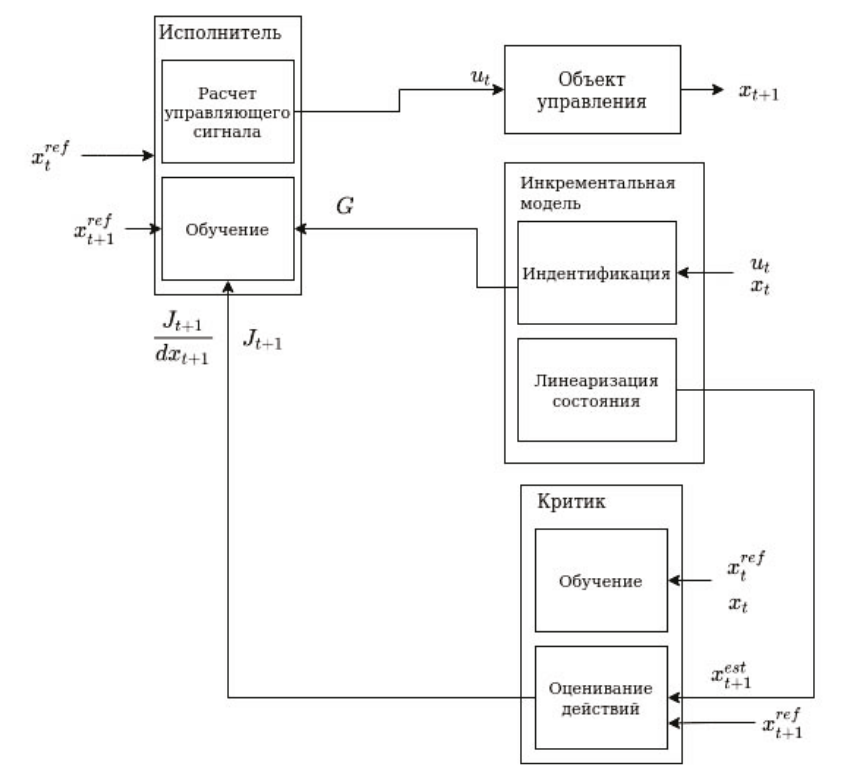
IHDP — инкрементальный вариант Heuristic Dynamic Programming из семейства Adaptive Critic Designs (ACD) для управления нелинейными объектами при неполном знании модели. В авиационных задачах используется для синтеза продольного управления. См. также модель F‑16: LinearLongitudinalF16.
Ключевые идеи
- Инкрементальная модель линеаризует динамику локально по данным онлайн
- Actor формирует управляющее воздействие по ошибке слежения
- Critic оценивает стоимостную функцию и даёт градиенты Actor
Состав IHDP
| Компонент | Роль | Реализация |
|---|---|---|
| Incremental model | Онлайн-идентификация и линеаризация динамики | tensoraerospace.agent.ihdp.Incremental_model.IncrementalModel |
| Actor | Генерация управляющего сигнала (NN) | tensoraerospace.agent.ihdp.Actor |
| Critic | Оценка J(x) и градиента dJ/dx (NN) | tensoraerospace.agent.ihdp.Critic |
| IHDPAgent | Оркестрация модулей, шаг predict и обучение | tensoraerospace.agent.ihdp.model.IHDPAgent |
Быстрый старт
Пример инициализации агента и одного шага предсказания:
import numpy as np
from tensoraerospace.agent.ihdp.model import IHDPAgent

actor_settings = {
    "start_training": 100,
    "layers": (64, 32, 1),
    "activations": ("tanh", "tanh", "tanh"),
    "learning_rate": 0.01,
    "learning_rate_exponent_limit": 8,
    "type_PE": "3211",
    "amplitude_3211": 1,
    "pulse_length_3211": 15,
    "maximum_input": 25,
    "maximum_q_rate": 20,
    "WB_limits": 30,
    "NN_initial": None,
    "cascade_actor": False,
    "learning_rate_cascaded": 0.01,
}

critic_settings = {
    "Q_weights": np.eye(2),
    "start_training": 100,
    "gamma": 0.99,
    "learning_rate": 0.01,
    "learning_rate_exponent_limit": 8,
    "layers": (64, 32, 1),
    "activations": ("tanh", "tanh", "tanh"),
    "indices_tracking_states": [0, 1],
    "WB_limits": 30,
    "NN_initial": None,
}

incremental_settings = {
    "number_time_steps": 1000,
    "dt": 0.02,
    "input_magnitude_limits": 25,
    "input_rate_limits": 20,
}

tracking_states = ["alpha", "wz"]
selected_states = ["alpha", "wz"]
selected_input = ["elevator"]
number_time_steps = 1000
indices_tracking_states = [0, 1]

agent = IHDPAgent(
    actor_settings,
    critic_settings,
    incremental_settings,
    tracking_states,
    selected_states,
    selected_input,
    number_time_steps,
    indices_tracking_states,
)

# Один шаг предсказания
xt = np.zeros((len(selected_states), 1))
reference = np.zeros((len(selected_states), number_time_steps))
ut = agent.predict(xt, reference, time_step=0)
Tip
Убедитесь, что indices_tracking_states согласованы с порядком вектора состояний среды.
Гиперпараметры
Actor
| Параметр | Описание |
|---|---|
| layers, activations | Архитектура NN и активации |
| learning_rate, learning_rate_exponent_limit | Скорость обучения и предел масштабирования |
| type_PE, amplitude_3211, pulse_length_3211 | Персистентное возбуждение |
| maximum_input, maximum_q_rate, WB_limits | Ограничения и насыщения |
| cascade_actor, learning_rate_cascaded | Каскадный режим |
Critic
| Параметр | Описание |
|---|---|
| Q_weights | Матрица весов функции стоимости |
| gamma | Дисконт |
| learning_rate, learning_rate_exponent_limit | Обучение |
| layers, activations | Архитектура |
| indices_tracking_states | Индексы отслеживаемых состояний |
| WB_limits, NN_initial | Ограничения/инициализация |
Incremental model
| Параметр | Описание |
|---|---|
| number_time_steps, dt | Горизонт и шаг интегрирования |
| input_magnitude_limits | Ограничение по величине управления |
| input_rate_limits | Ограничение по скорости изменения |
Поддерживаемые окружения
LinearLongitudinalF16-v0
Примеры
- Подробный пример для F‑16: IHDP ↔ LinearLongitudinalF16
Документация API
IHDPAgent(actor_settings, critic_settings, incremental_settings, tracking_states, selected_states, selected_input, number_time_steps, indices_tracking_states)

Bases: object
IHDP Control Agent.
Parameters:
| Name | Type | Description | Default |
|---|---|---|---|
actor_settings
|
dict
|
Actor settings. |
required |
critic_settings
|
dict
|
Critic settings. |
required |
incremental_settings
|
dict
|
Incremental model settings. |
required |
tracking_states
|
list[str]
|
Tracked states. |
required |
selected_states
|
list[str]
|
Selected states. |
required |
selected_input
|
list[str]
|
Selected input signals. |
required |
number_time_steps
|
int
|
Number of time steps. |
required |
indices_tracking_states
|
list[int]
|
Index of tracked states. |
required |
Compose IHDP agent components.
Parameters:
| Name | Type | Description | Default |
|---|---|---|---|
actor_settings
|
dict
|
Configuration for Actor. |
required |
critic_settings
|
dict
|
Configuration for Critic. |
required |
incremental_settings
|
dict
|
Configuration for IncrementalModel. |
required |
tracking_states
|
list[str]
|
Tracked state names. |
required |
selected_states
|
list[str]
|
State variable names. |
required |
selected_input
|
list[str]
|
Control input names. |
required |
number_time_steps
|
int
|
Episode length. |
required |
indices_tracking_states
|
list[int]
|
Indices of tracked states. |
required |
predict(xt, reference_signals, time_step)

Make prediction and get next control signals.
Parameters:
| Name | Type | Description | Default |
|---|---|---|---|
xt
|
_type_
|
Current state of the control object at step t. |
required |
reference_signals
|
_type_
|
Reference control signal. |
required |
time_step
|
_type_
|
Current time step. |
required |
Returns:
| Name | Type | Description |
|---|---|---|
ut |
_type_
|
Control signal at step t+1. |
get_param_env()

Build a JSON-serialisable config for :meth:save.
Mirrors the structure used by other TensorAeroSpace agents:
policy.name identifies the agent class, policy.params
captures everything the constructor needs.
save(path=None)

Write the agent to a directory.
Files produced
config.json— constructor kwargs (settings dicts + tracking/state metadata).actor.pth/critic.pth—state_dictof the actor and critic innertorch.nnnetworks.
Parameters:
| Name | Type | Description | Default |
|---|---|---|---|
path
|
Union[str, Path, None]
|
Base directory ( |
None
|
Returns:
| Type | Description |
|---|---|
str
|
Absolute path to the created run directory. |
from_pretrained(repo_name, access_token=None, version=None)
classmethod

Load an agent from a local directory or Hugging Face Hub.
Parameters:
| Name | Type | Description | Default |
|---|---|---|---|
repo_name
|
str
|
Local folder path, or |
required |
access_token
|
Optional[str]
|
Hub access token for private repos. |
None
|
version
|
Optional[str]
|
Hub revision / branch / tag. |
None
|
Returns:
| Name | Type | Description |
|---|---|---|
IHDPAgent |
IHDPAgent
|
Reconstructed agent. |
publish_to_hub(repo_name, folder_path, access_token=None)

Upload a :meth:save directory to the Hugging Face Hub.
Parameters:
| Name | Type | Description | Default |
|---|---|---|---|
repo_name
|
str
|
Target repository id, e.g. |
required |
folder_path
|
Union[str, Path]
|
Local folder produced by :meth: |
required |
access_token
|
Optional[str]
|
Hub access token. |
None
|
Actor

Actor network for IHDP.
This module defines the Actor component used by the IHDP agent.
Actor(selected_inputs, selected_states, tracking_states, indices_tracking_states, number_time_steps, start_training, layers=(6, 1), activations=('sigmoid', 'sigmoid'), learning_rate=0.9, learning_rate_cascaded=0.9, learning_rate_exponent_limit=10, type_PE='3211', amplitude_3211=1, pulse_length_3211=15, WB_limits=30, maximum_input=25, maximum_q_rate=20, cascaded_actor=False, NN_initial=None, cascade_tracking_state=None, model_path=None, use_integral_correction=False, integral_gain=0.0, integral_clamp_deg=5.0, integral_warmup_steps=500)

Actor Model in IHDP.
Provides Actor class with Actor function approximator (NN). Actor creates neural network model using PyTorch and can train network online. User can choose number of layers, number of neurons, batch size, number of epochs and activation functions.
Parameters:
| Name | Type | Description | Default |
|---|---|---|---|
selected_inputs
|
list[str]
|
Selected control signals. |
required |
selected_states
|
list[str]
|
Selected state signals. |
required |
tracking_states
|
list[str]
|
Tracked states. |
required |
indices_tracking_states
|
list[int]
|
Indices of tracked states. |
required |
number_time_steps
|
int
|
Number of time steps. |
required |
start_training
|
int
|
Step from which training begins. |
required |
layers
|
tuple
|
Model layers. Defaults to (6, 1). |
(6, 1)
|
activations
|
tuple
|
Activation layers ('sigmoid', 'sigmoid'). |
('sigmoid', 'sigmoid')
|
learning_rate
|
float
|
Learning rate. Defaults to 0.9. |
0.9
|
learning_rate_cascaded
|
float
|
Learning rate in cascade mode. Defaults to 0.9. |
0.9
|
learning_rate_exponent_limit
|
int
|
Learning rate exponent limit. Defaults to 10. |
10
|
type_PE
|
str
|
PE type. Defaults to '3211'. |
'3211'
|
amplitude_3211
|
int
|
3211 amplitude. Defaults to 1. |
1
|
pulse_length_3211
|
int
|
3211 pulse length. Defaults to 15. |
15
|
WB_limits
|
int
|
Weight limits. Defaults to 30. |
30
|
maximum_input
|
int
|
Maximum value. Defaults to 25. |
25
|
maximum_q_rate
|
int
|
Maximum rate. Defaults to 20. |
20
|
cascaded_actor
|
bool
|
Enable cascade network mode. Defaults to False. |
False
|
NN_initial
|
optional
|
Weight initialization. Defaults to None. |
None
|
cascade_tracking_state
|
list
|
Tracking in cascade mode. Defaults to ['alpha', 'wz']. |
None
|
model_path
|
str
|
Model path for loading weights. Defaults to None. |
None
|
Initialize IHDP Actor network and hyperparameters.
Parameters:
| Name | Type | Description | Default |
|---|---|---|---|
selected_inputs
|
list[str]
|
Control input names. |
required |
selected_states
|
list[str]
|
State variable names. |
required |
tracking_states
|
list[str]
|
Tracked states for reward. |
required |
indices_tracking_states
|
list[int]
|
Indices of tracked states in state vector. |
required |
number_time_steps
|
int
|
Total time steps in episode. |
required |
start_training
|
int
|
Step index to start training. |
required |
layers
|
tuple[int, ...]
|
Hidden layer sizes. |
(6, 1)
|
activations
|
tuple[str, ...]
|
Activations per layer. |
('sigmoid', 'sigmoid')
|
learning_rate
|
float
|
Base learning rate. |
0.9
|
learning_rate_cascaded
|
float
|
Learning rate for cascaded mode. |
0.9
|
learning_rate_exponent_limit
|
int
|
Exponent limit for LR decay. |
10
|
type_PE
|
str
|
Persistent excitation pattern. |
'3211'
|
amplitude_3211
|
float
|
Amplitude for 3211 signal. |
1
|
pulse_length_3211
|
int
|
Pulse length for 3211 signal. |
15
|
WB_limits
|
float
|
Weight/bias clipping limit. |
30
|
maximum_input
|
float
|
Max control magnitude. |
25
|
maximum_q_rate
|
float
|
Max pitch rate. |
20
|
cascaded_actor
|
bool
|
Whether to use cascaded network. |
False
|
NN_initial
|
int | None
|
Optional weight initializer seed. |
None
|
cascade_tracking_state
|
list[str] | None
|
Tracking states for cascade mode. |
None
|
model_path
|
str | None
|
Path to load/save model weights. |
None
|
use_integral_correction
|
bool
|
Enable an integral compensation term
added to the actor's control output. IHDP minimizes a
quadratic LQ-functional and therefore has no integral
action — the closed loop has a small but persistent
steady-state offset on setpoint-tracking. Enabling this
flag adds |
False
|
integral_gain
|
float
|
|
0.0
|
integral_clamp_deg
|
float
|
Anti-windup limit on the integrator
state, in degrees. Caps the magnitude of accumulated
error so a long initial transient cannot saturate the
actuator after settling. Default |
5.0
|
integral_warmup_steps
|
int
|
Number of steps after which the
integrator starts accumulating. Set this to be at least
as long as the persistent-excitation pulse, so the
integrator does not "see" the PE injection as a real
tracking error. Default |
500
|
build_actor_model()

Function creating Actor network. This is a fully connected network. Can define number of layers, number of neurons per layer, and activation functions.
In cascade mode the actor decomposes into two SISO sub-networks
- outer
model: alpha_error (scalar) -> q_ref - inner
model_q: q_error (scalar) -> u
Both sub-networks therefore have input_dim=1 regardless of the
number of tracking states declared on the agent. The cascade
indices_tracking_states rewrite (which advertises [alpha_idx,wz_idx] so that :meth:run_actor_online can address both rows of
the augmented observation) is applied AFTER both sub-models have
been built — otherwise create_NN would size model_q for a
2-element input and matrix multiplication would fail at runtime.
save_model()

Save model.
save_dut_dWb()

Save gradient.
load_dut_dWb()

Load gradient.
load_model()

Load model weights.
create_NN(store_weights, seed)

Create NN with user input.
Parameters:
| Name | Type | Description | Default |
|---|---|---|---|
store_weights
|
dict
|
Dictionary containing weights and biases. |
required |
seed
|
int
|
Seed for saving random variables. |
required |
Returns:
| Name | Type | Description |
|---|---|---|
model |
Sequential
|
Created NN model. |
store_weights |
dict
|
Dictionary containing updated weights and biases. |
run_actor_online(xt, xt_ref)

Generate system input with given and real states.
Parameters:
| Name | Type | Description | Default |
|---|---|---|---|
xt
|
ndarray
|
Current state of time step. |
required |
xt_ref
|
ndarray
|
Reference state of current time step. |
required |
Returns:
| Name | Type | Description |
|---|---|---|
ut |
ndarray
|
Input to system and incremental model. |
train_actor_online(Jt1, dJt1_dxt1, G)

Get chain rule elements, calculate gradient and apply it to corresponding weights and biases.
Parameters:
| Name | Type | Description | Default |
|---|---|---|---|
Jt1
|
_type_
|
dEa/dJ |
required |
dJt1_dxt1
|
_type_
|
dJ/dx |
required |
G
|
ndarray
|
dx/du, obtained from incremental model. |
required |
train_actor_online_adaptive_alpha(Jt1, dJt1_dxt1, G, incremental_model, critic, xt_ref1)

Train Actor using adaptive alpha depending on sign and magnitude of network errors.
Parameters:
| Name | Type | Description | Default |
|---|---|---|---|
Jt1
|
ndarray
|
Critic evaluation with incremental model next time step prediction. |
required |
dJt1_dxt1
|
ndarray
|
Critical network gradient with respect to incremental model next time prediction. |
required |
G
|
ndarray
|
Input data distribution matrix. |
required |
incremental_model
|
Any
|
Incremental model. |
required |
critic
|
Any
|
Critic. |
required |
xt_ref1
|
ndarray
|
Reference state at next time step. |
required |
train_actor_online_adam(Jt1, dJt1_dxt1, G, incremental_model, critic, xt_ref1)

Train the actor online using Adam updates.
train_actor_online_alpha_decay(Jt1, dJt1_dxt1, G, incremental_model, critic, xt_ref1)

Train the actor with a learning rate that decays over time.
compute_Adam_update(count, gradient, model, learning_rate)

Compute an Adam-style weight update and apply it.
check_WB_limits(count, model)

Clamp weights/biases that exceed the configured WB_limits.
compute_persistent_excitation(*args)

Compute the persistent excitation term for the current time step.
update_actor_attributes()

Update time-dependent actor attributes after each time step.
evaluate_actor(*args)

Evaluate the actor using provided or stored state/reference.
restart_time_step()

Reset the internal time-step counter to zero.
restart_actor()

Reset actor state and optimizer-related attributes.
Critic

Critic network for IHDP.
This module defines the Critic component used by the IHDP agent.
Critic(Q_weights, selected_states, tracking_states, indices_tracking_states, number_time_steps, start_training, gamma=0.8, learning_rate=2, learning_rate_exponent_limit=10, layers=(10, 6, 1), activations=('sigmoid', 'sigmoid', 'linear'), WB_limits=30, NN_initial=None, model_path=None)

Provides Critic class with function approximator (NN) for Critic class.
Critic creates neural network model using PyTorch and can train network online. User can choose number of layers, number of neurons, batch size, number of epochs and activation functions.
Parameters:
| Name | Type | Description | Default |
|---|---|---|---|
Q_weights
|
list[float]
|
Q-function weights. |
required |
selected_states
|
list[str]
|
Selected states. |
required |
tracking_states
|
list[str]
|
Tracked states. |
required |
indices_tracking_states
|
list[int]
|
Index of tracked states. |
required |
number_time_steps
|
int
|
Number of time steps. |
required |
start_training
|
int
|
Training start step. |
required |
gamma
|
float
|
Gamma discount factor. Defaults to 0.8. |
0.8
|
learning_rate
|
int
|
Learning rate. Defaults to 2. |
2
|
learning_rate_exponent_limit
|
int
|
Learning rate exponent limit. Defaults to 10. |
10
|
layers
|
tuple
|
Number of layers and neurons in layers. Defaults to (10, 6, 1). |
(10, 6, 1)
|
activations
|
tuple
|
Activation functions in layers. Defaults to ("sigmoid", "sigmoid", "linear"). |
('sigmoid', 'sigmoid', 'linear')
|
WB_limits
|
int
|
Weight value constraints. Defaults to 30. |
30
|
NN_initial
|
optional
|
Initial weight values. Defaults to None. |
None
|
model_path
|
optional
|
Model path. Defaults to None. |
None
|
Initialize IHDP Critic network and buffers.
Parameters:
| Name | Type | Description | Default |
|---|---|---|---|
Q_weights
|
list[float]
|
Diagonal weights for Q matrix. |
required |
selected_states
|
list[str]
|
State variable names. |
required |
tracking_states
|
list[str]
|
Tracked states for cost. |
required |
indices_tracking_states
|
list[int]
|
Indices of tracked states. |
required |
number_time_steps
|
int
|
Total steps in episode. |
required |
start_training
|
int
|
Step index to start training. |
required |
gamma
|
float
|
Discount factor. |
0.8
|
learning_rate
|
float
|
Optimizer learning rate. |
2
|
learning_rate_exponent_limit
|
int
|
Exponent limit for LR decay. |
10
|
layers
|
tuple[int, ...]
|
Hidden layer sizes. |
(10, 6, 1)
|
activations
|
tuple[str, ...]
|
Activation functions per layer. |
('sigmoid', 'sigmoid', 'linear')
|
WB_limits
|
float
|
Weight/bias clipping limit. |
30
|
NN_initial
|
int | None
|
Optional weight initializer seed. |
None
|
model_path
|
str | None
|
Optional path to load/save model. |
None
|
save_model()

Save model.
load_model()

Load weights.
save_Jt_ct()

Save critic state evaluation.
load_Jt_ct()

Load critic state evaluation.
build_critic_model()

Function creating neural network. Currently this is a densely connected neural network. User can define number of layers, number of neurons, and activation function.
run_train_critic_online_adaptive_alpha(xt, xt_ref)

Function that evaluates critic neural network once and returns J(xt) value. At the same time it trains function approximator with adaptive learning rate scheme.
Parameters:
| Name | Type | Description | Default |
|---|---|---|---|
xt
|
ndarray
|
Current state of time step. |
required |
xt_ref
|
ndarray
|
Reference state of current time step for computing one-step cost function. |
required |
Returns:
| Name | Type | Description |
|---|---|---|
Jt |
ndarray
|
Critic evaluation at current time step. |
run_train_critic_online_adam(xt, xt_ref)

Function that evaluates critic neural network once and returns J(xt) value. At the same time, it trains function approximator using Adam optimizer.
Parameters:
| Name | Type | Description | Default |
|---|---|---|---|
xt
|
ndarray
|
Current state of time step. |
required |
xt_ref
|
ndarray
|
Reference state of current time step for computing one-step cost function. |
required |
Returns:
| Name | Type | Description |
|---|---|---|
Jt |
ndarray
|
Critic evaluation at current time step. |
adam_iteration(dJt_dW, dE_dJ, iteration=None)

Adam updates all weights and biases considering loss function derivative with respect to NN output and derivative of neural network output with respect to weights and biases.
Parameters:
| Name | Type | Description | Default |
|---|---|---|---|
dJt_dW
|
_type_
|
Derivative of NN output with respect to weights and biases. |
required |
dE_dJ
|
_type_
|
Derivative of loss function with respect to NN output. |
required |
run_train_critic_online_alpha_decay(xt, xt_ref)

Evaluate the critic once and update it with a decaying learning rate.
Parameters:
| Name | Type | Description | Default |
|---|---|---|---|
xt
|
ndarray
|
Current state. |
required |
xt_ref
|
ndarray
|
Reference state used to compute one-step cost. |
required |
Returns:
| Type | Description |
|---|---|
ndarray
|
np.ndarray: Critic value estimate at the current time step. |
train_critic_replay_adam(replay_size, iteration)

Train the critic using samples from the replay buffer (Adam).
compute_forward_pass(xt, xt_ref, replay=False)

Compute critic output and gradients with respect to weights/biases.
compute_loss_derivative(*args)

Compute derivative of the critic loss with respect to critic output.
check_WB_limits(count)

Clamp weights/biases to the configured absolute limit (WB_limits).
evaluate_critic(xt, xt_ref)

Evaluate critic and compute gradient with respect to the input.
c_computation()

Compute one-step cost for the current time step.
targets_computation_online(*args)

Compute the TD target used for critic training.
update_critic_attributes()

Update time-dependent critic attributes after each step.
restart_time_step()

Reset the time step counter to zero.
restart_critic()

Reset critic internal state and buffers.
IncrementalModel(selected_states, selected_input, number_time_steps, discretisation_time=0.5, input_magnitude_limits=25, input_rate_limits=60)

Provides IncrementalModel class for system identification.
IncrementalModel computes A and x matrices needed for system identification, computes F and G matrices needed for incremental model, and evaluates identified model to provide state estimates at next time step.
Parameters:
| Name | Type | Description | Default |
|---|---|---|---|
selected_states
|
list[str]
|
Selected states. |
required |
selected_input
|
list[str]
|
Selected control signals. |
required |
number_time_steps
|
int
|
Number of time steps. |
required |
discretisation_time
|
float
|
Discretization time. Defaults to 0.5. |
0.5
|
input_magnitude_limits
|
int
|
Input control signal limits. Defaults to 25. |
25
|
input_rate_limits
|
int
|
Control signal rate constraints. Defaults to 60. |
60
|
Initialize incremental model buffers and limits.
Parameters:
| Name | Type | Description | Default |
|---|---|---|---|
selected_states
|
list[str]
|
Names of states. |
required |
selected_input
|
list[str]
|
Names of control inputs. |
required |
number_time_steps
|
int
|
Horizon length. |
required |
discretisation_time
|
float
|
Sampling period. |
0.5
|
input_magnitude_limits
|
float
|
Max control magnitude. |
25
|
input_rate_limits
|
float
|
Max control rate change. |
60
|
save_matrix()

Save identification matrices to disk (NumPy .npy files).
load_matrix()

Load identification matrices from disk (NumPy .npy files).
build_A_LS_matrix()

Build the least-squares A matrix used for online identification.
build_x_LS_vector()

Build the least-squares x vector used for online identification.
identify_incremental_model_LS(xt, ut_0)

Estimate F and G matrices for the incremental model (least squares).
evaluate_incremental_model(*args)

Estimate states for the next time step.
Returns:
| Name | Type | Description |
|---|---|---|
xt1_est |
_type_
|
Estimated state for the next time step. |
update_incremental_model_attributes()

Update attributes that change with each time step.
restart_time_step()

Reset time step to zero.
restart_incremental_model()

Restart the incremental model.